Home › The Dragons of Old Time-Dinosaurs › The Dragons of Old Time-Dinosaurs: Anchisaurus
The Dragons of Old Time-Dinosaurs: Anchisaurus
With the more complete materials now in his possession, Professor Marsh was enabled to make the restoration of the skeleton of the genus Anchisaurus, seen in Fig. 49. We may attribute a length of about six feet to the creature when alive. The skeleton, from which this restoration was chiefly made, was discovered entire, and apparently in the position in which the animal died. Unfortunately, some of the vertebræ belonging to the neck and tail were lost before the importance of the specimen was realised, but the skull and nearly all the rest of the skeleton was saved. In order to complete the outline, Professor Marsh made use of the corresponding parts, fortunately preserved, in another specimen of an allied species, viz. Anchisaurus solus, found in the same locality. Although it would doubtless be preferable to make restorations from a single specimen only, because the result would be free from all doubt (except perhaps in some of the positions assigned to limbs, etc.), yet this is seldom possible. Those who make extinct forms of life their study are frequently obliged to adopt the method of scholars in reconstructing the text of some classical author, who, when breaks, or lacuna, occur in one manuscript, consult another one which they consider trustworthy, and from it fill in the gaps.
The restoration of this Dinosaur shown in Plate XVII. is based on the figure of the skeleton shown above. The Anchisaurus colurus was one of the most slender and delicate of all the Dinosaurs yet discovered, being only surpassed in this respect by the little bird-like form, from the Solenhofen slate, known as Compsognathus, the skeleton of which is reproduced for comparison on p. 138. This was the creature of which Professor Huxley remarked that no one could look at it without concluding that it must have hopped about on its hind feet, like a bird. The position chosen for the Anchisaurus, as represented in our Plate, is one which, doubtless, the creature was in the habit of assuming during life. But, at the same time, there can be but little doubt that it was also in the habit of progressing on all-fours. In fact, some persons may think that it looks a little "top-heavy," so to speak, in this semi-erect position assigned to it. But, as other carnivorous Dinosaurs of a later period must have walked erect on their hind legs, we may be allowed to follow Professor Marsh in this matter, and to adopt his conclusion.
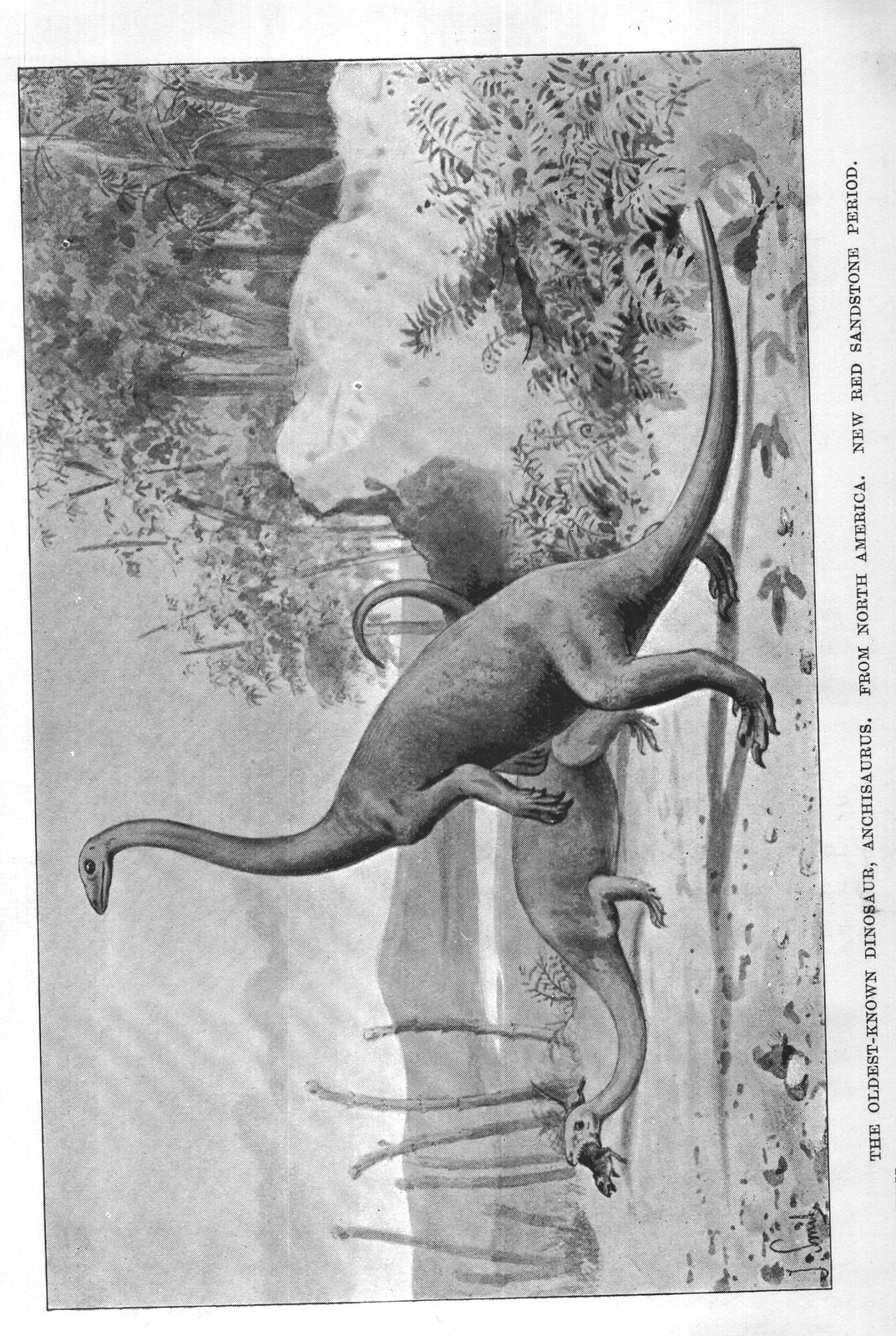
THE OLDEST-KNOWN DINOSAUR, ANCHISAURUS. FROM NORTH AMERICA. NEW RED SANDSTONE PERIOD. PLATE XVII.
DRAGONS OF OLD TIME But the most interesting opinion connected with this discovery is that the Anchisaurus was probably the creature that made some of the tracks found in the strata in which its remains were buried up (see chap. II., p. 44). For half a century or more these tracks have been a fruitful source of contention, and now at last we seem to be literally "on the track " of one of the many antediluvian creatures that made them. This is very satisfactory, and shows that time solves most things. Professor Marsh points out that, on a firm but moist beach, only three-toed impressions would have been left by the hind feet, and the tail could have been kept free from the ground. On a soft muddy shore, the claw of the first toe of the hind foot would have left its mark, and perhaps the tail also might have touched the ground. As we have already remarked, such additional impressions have been found on the Connecticut Sandstones (see Plate I.).