Home › The Dragons of Old Time-Dinosaurs › The Dragons of Old Time-Dinosaurs: Triassic
The Dragons of Old Time-Dinosaurs: Triassic
One other carnivorous Dinosaur, named Ammosaurus by Professor Marsh, and allied to the one above described, is also partly known in the same strata, but we cannot at present give any account of it. One or two other forms from Triassic strata are only imperfectly known; such as the Thecodontosaurus, from the Triassic conglomerate of Clifton, Bristol, and Zanclodon, from Germany and South Africa.
Taking one consideration with another, there can be but little doubt that Dinosaurs flourished vigorously during the period of the New Red Sandstone. We have two kinds of evidence to confirm such a conclusion; one is the large number and variety of footprints which they have left behind-although, of course, we cannot suppose that they were all made by Dinosaurs; for, as we have seen, some were probably due to tortoises, while others were probably made by Labyrinthodonts and perhaps even Anomodonts. Another piece of evidence is the known fact that Dinosaurs were abundant in the succeeding Jurassic period. Judging from the size of some of the footprints, it would appear that not a few of the Triassic forms attained large dimensions. And, if the strata had been more favourable, we should have had more of them preserved. Belodon, described in the author's Creatures of Other Days as a crocodile, has been proved by recent discoveries in America to be a Dinosaur of Triassic age.
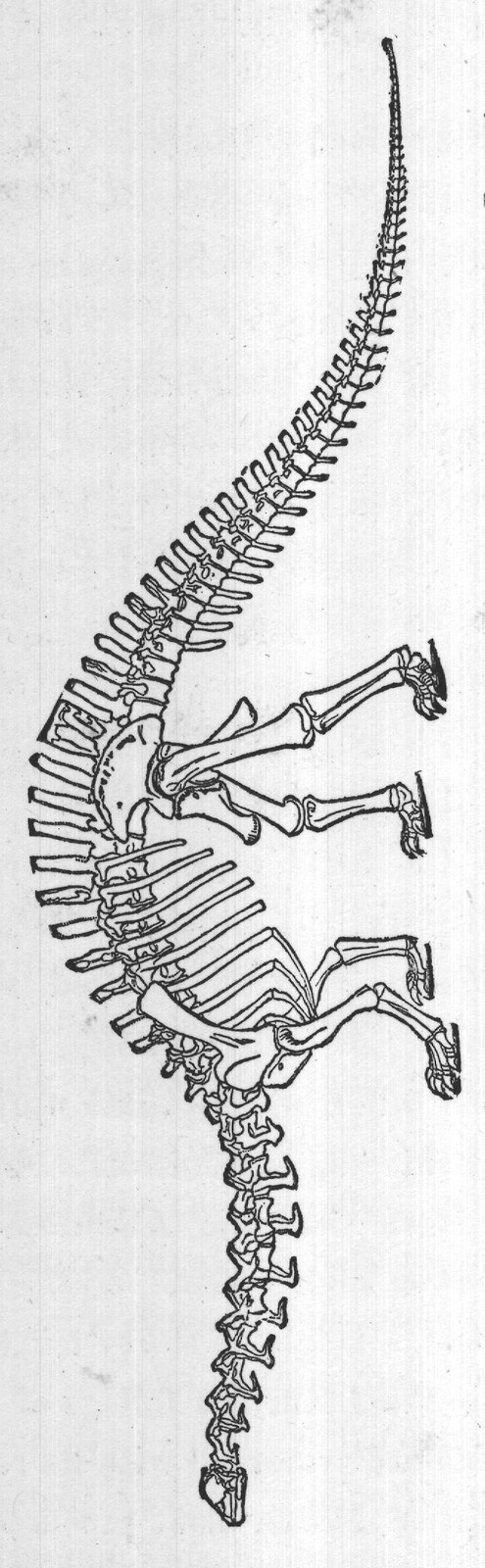
We pass on to consider the very interesting and huge forms included by the late Professor Marsh (of Yale College), in his suborder Sauropoda, or lizard-footed Dinosaurs. Various parts of the skeletons, such as vertebræ, leg-bones, etc., of these cumbrous beasts have long been known in this country; but Professor Marsh was the first person to discover a complete skeleton.
We shall, therefore, now turn our attention to the bony framework of the huge Brontosaurus (Fig. 50), a vegetable-feeding lizard. But it will be necessary to completely lay aside all our previous notions taken from lizards of the present day, with their short legs and snake-like scaly bodies, before we can come to any fair conclusion with regard to this monstrous beast.
It was nearly sixty feet long, and probably when alive weighed more than thirty-eight tons! that it was a stupid, slow-moving reptile, may be inferred from its very small brain and slender spinal cord. By taking casts of the brain-cavities in the skulls of extinct animals, anatomists can obtain a very good idea of the nature and capacity of their brains; and in this way important evidence is obtained, and such as helps to throw light upon their habits and general intelligence. No bony plates or spines have been discovered with the remains of this monster; so that we are driven to conclude that it was wholly without armour: and, DRAGONS OF OLD TIME moreover, there seem to be no signs of offensive weapons of any kind except the lash of the tail.
Professor Marsh concludes that it was more or less amphibious FIG. 50. Skeleton of a Sauropodous Dinosaur (Brontosaurus excelsus), from the Upper Jurassic of Wyoming, U.S.A. (After O. C. Marsh.) in its habits, and that it fed upon aquatic plants and other succulent vegetation. Its remains, he says, are generally found in localities where the animal had evidently become mired, just as cattle at the present day sometimes become hopelessly fixed in a swampy place on the margin of a lake or river (see p. 19). Each track made by the creature in walking occupied one square yard in extent!
The Sauropoda, or lizard-footed Dinosaurs, show in many ways a decided approach to a simple or generalised crocodile; so much so, that Professor Cope is inclined to include crocodiles and sauropodous Dinosaurs in the same order. Vertebræ, limb-bones, skulls, and teeth have all been discovered through the zeal and energy of Professor Marsh and his comrades, in the far west of America, as well as by the researches of English geologists, assisted by the labours of many ardent collectors of fossils, in this country. Some of these may now be briefly considered.