Home › The Dragons of Old Time-Dinosaurs › The Dragons of Old Time-Dinosaurs: Brontosaurus
The Dragons of Old Time-Dinosaurs: Brontosaurus
DRAGONS OF OLD TIME way as those of Brontosaurus. The fore limbs were large, as in the latter animal; and the extremities of the limbs were provided with claws. It had two sternal bones like Diplodocus (see Plate XXI.). Taking all present evidence, it appears that the Atlantosaurus bore a general resemblance to its smaller contemporary. We can therefore form a fairly good idea of its aspect and proportions.
The same Jurassic strata from the Rocky Mountains have 1. 2.
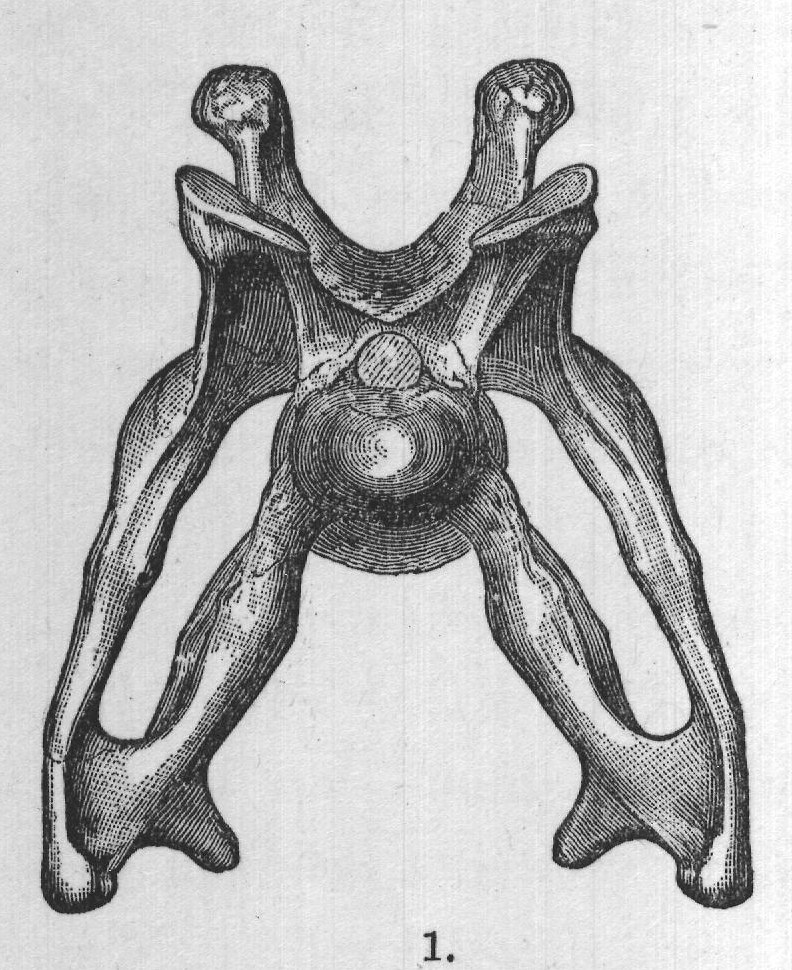
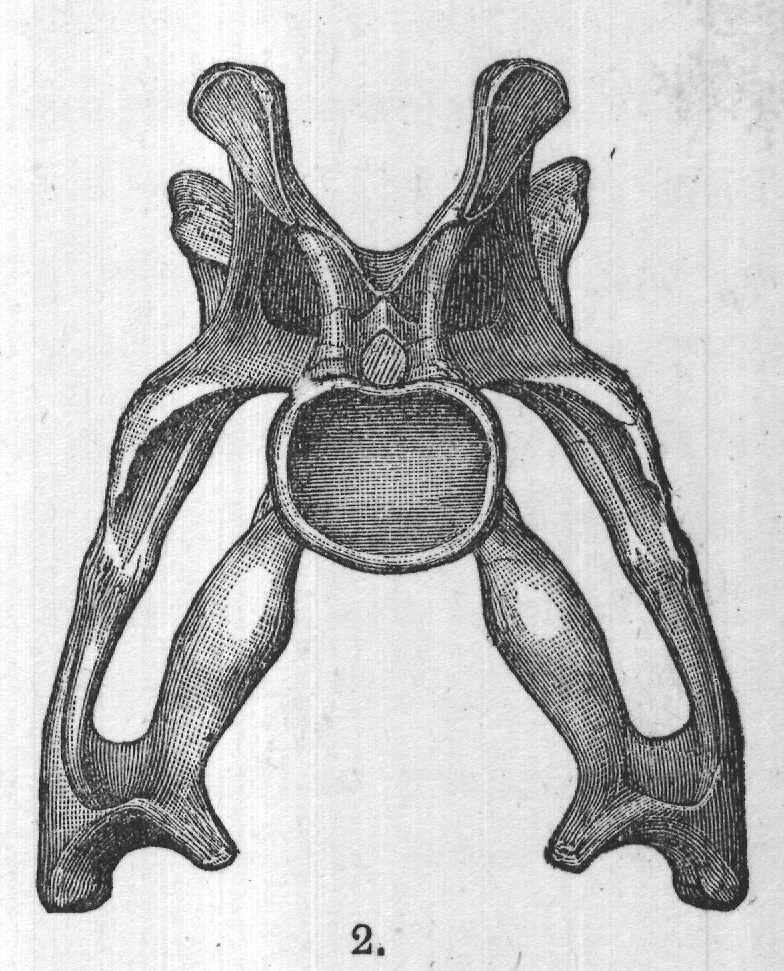
FIG. 51. Neck vertebræ of Brontosaurus. 1. Front view. 2. Back view. yielded remains of another big Dinosaur, belonging to the same family. This genus, which has been named the Apatosaurus, is represented by a nearly complete skeleton, in the Yale College Museum; and it is fortunately in an excellent state of preservation. Another species, of smaller size, though not so complete, adorns the same collection. This was about thirty feet long, and is known as Apatosaurus grandis.
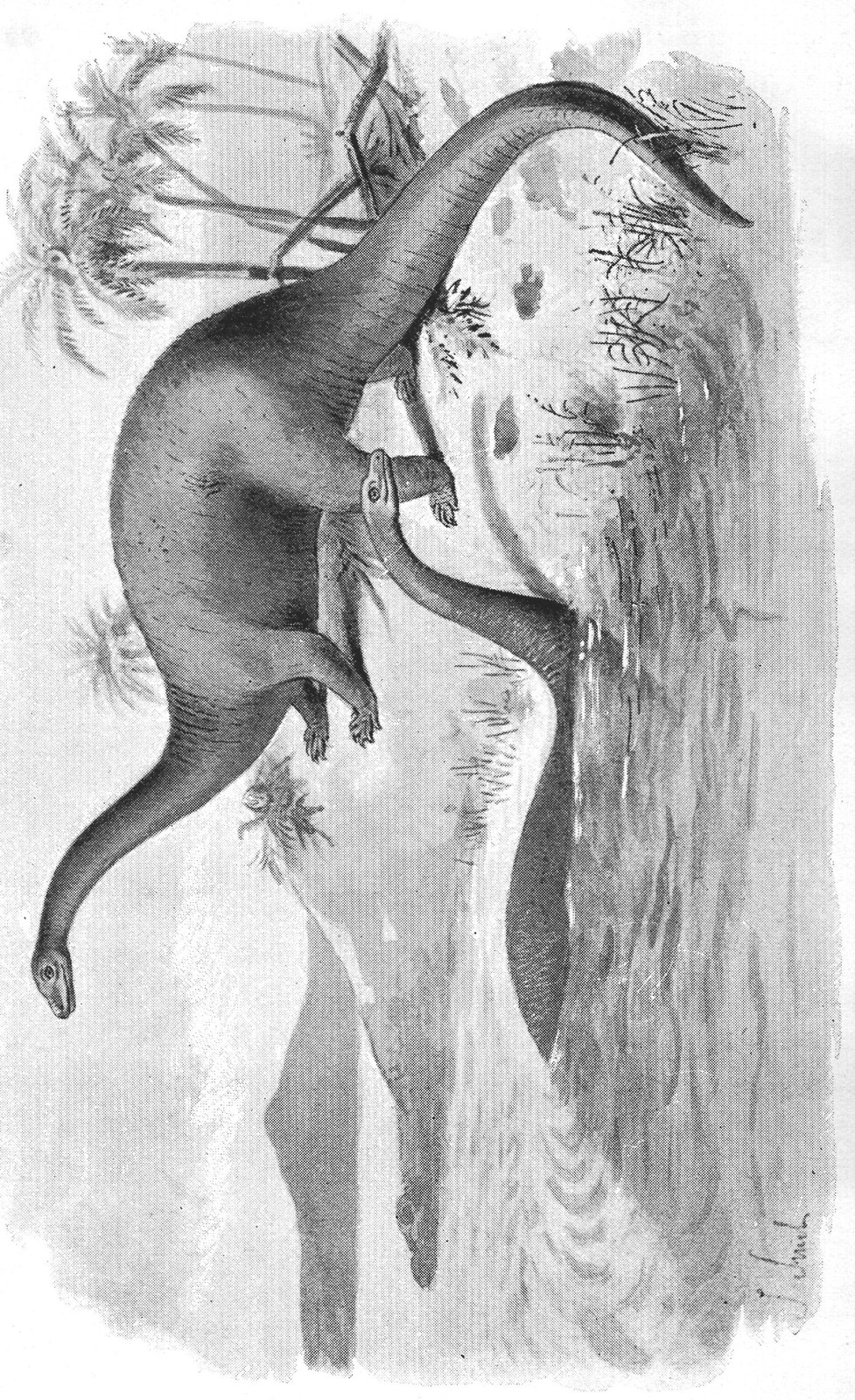
The remarkably small head is one of the most striking features of these Dinosaurs, and presents a curious contrast to the large and formidable skulls possessed by some other forms to be described further on. But it is clear that no animal with such a long neck as this creature had could have borne the weight of a heavy skull. Short thick necks and heavy skulls always go together. Indeed, the weight of the long neck itself would have been serious had it not been for the fact that the vertebræ in this part of the skeleton, and as far as the region of the tail, have large cavities in the sides of the centra. This cavernous structure of the vertebræ gradually decreases towards the tail. The cavities communicated with a series of internal cavities which give a kind of honeycombed structure to the whole vertebræ. This arrangement affords a combination of strength and lightness in the massive supports required for the huge ribs, limbs, and muscles, such as could not have been provided by any other plan. (See Fig. 51.) The body of the Brontosaur was comparatively short, with a fairly large paunch (see restoration, Plate XIX.). The legs and feet were strong and massive, and the limb-bones solid. As if partly in order to balance the neck, we find a long and powerful tail, in which the vertebræ are nearly all solid. In most Dinosaurs the fore limbs are small compared to the hind limbse.g. Megalosaurus, Iguanodon, and Scelidosaurus, but here we find them unusually large. In this case, then, it is hardly possible that the creature walked upon its hind legs, as many of the Dinosaurs did. There can be little doubt but that many other fierce and formidable Dinosaurs were living at the same time and in the same region with Brontosaurus, whose remains are found in the Jurassic rocks of Colorado (Atlantosaurus beds). How this apparently helpless and awkward animal escaped in the struggle for existence it is not easy to conjecture; but since there is reason to believe it was more or less at home in the PLATE XIX.
A GIGANTIC DINOSAUR, BRONTOSAURUS EXCELSUS.
Length nearly 60 feet.
DRAGONS OF OLD TIME water, and could use its powerful tail in swimming, we may perhaps find a way out of the difficulty by supposing that, when alarmed by dangerous flesh-eating foes, it took to the water, and found discretion to be the better part of valour. Although apparently stupid, the Brontosaur probably possessed a good deal of cunning, and we can fancy it stretching its long neck above reeds, ferns, and cycads to get a view of the approaching enemy.