Home › Extinct Whales and Wombats › Extinct Whales and Wombats: Diprotodon
Extinct Whales and Wombats: Diprotodon
The late Professor Newton, of Cambridge, also received a letter from Dr. Stirling, which was published in The Proceedings of the Zoological Society for May 2, 1893. From this letter we learn that Diprotodon has five well-developed toes; the bones of the PLATE LIV.
Fore limb.
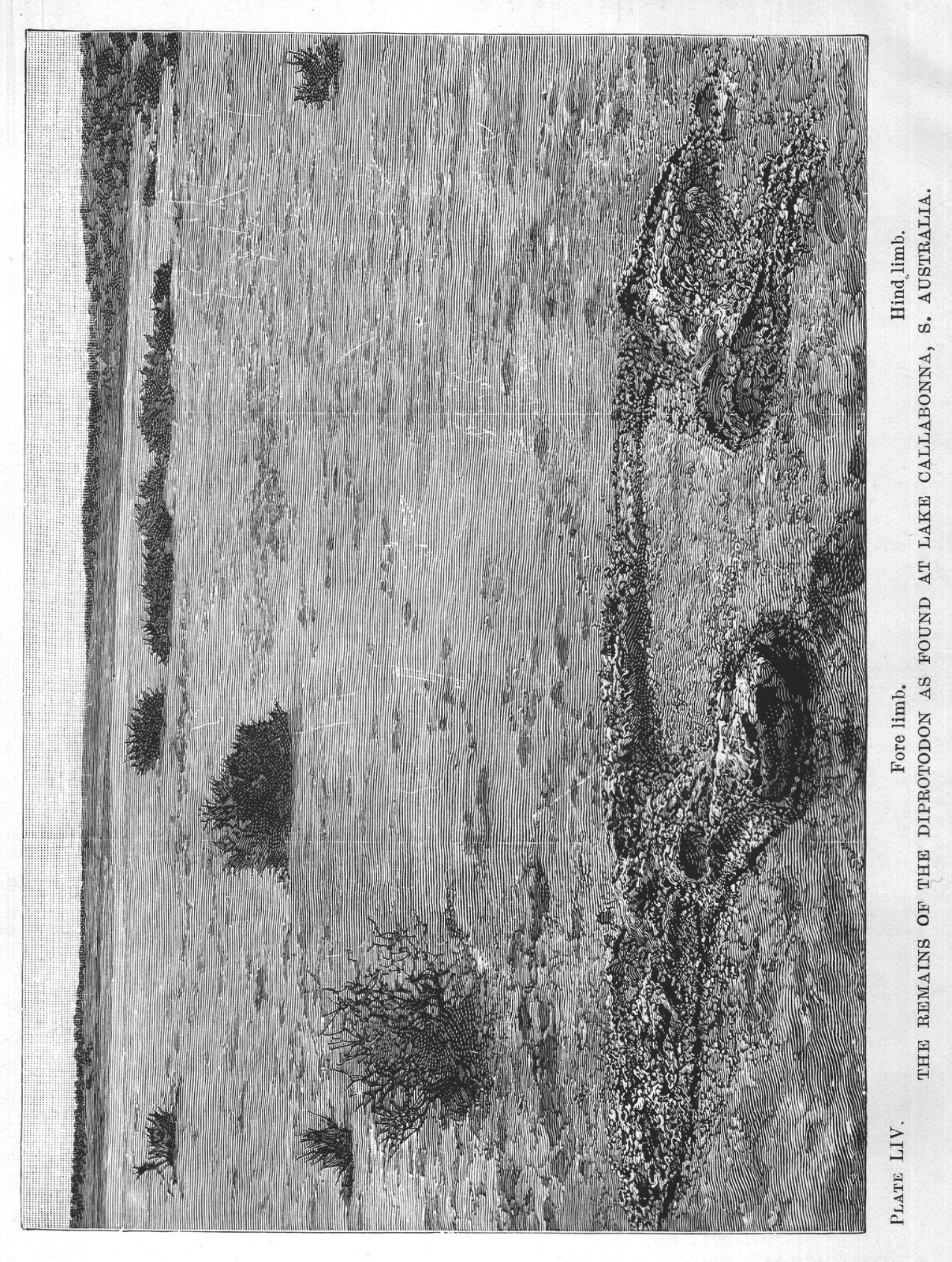
Hind limb.
THE REMAINS OF THE DIPROTODON AS FOUND AT LAKE CALLABONNA, S. AUSTRALIA. EXTINCT WHALES AND WOMBATS 309 marsupium, or pouch, have been found, and several distinct impressions of the skin of the fore foot were obtained. The locality is six hundred miles north of Adelaide, and, during the dry season, all the carting and travelling has to be done by camels, with a temperature of 111° Fahr. in the shade!-to say nothing of myriads of flies and frequent sandstorms. With regard to the geological formation of this salt-lake district of South Central Australia, Lake Mulligan is a vast level expanse of salt-encrusted, black mud, only becoming filled after very heavy rains (see Plate LIV.). It is about eight miles wide, and the bones are found somewhere about midway between the east and west edges. Usually the salt crust is not firm enough for bullock traffic, and it is probable that thousands of bullocks have at different times been bogged in crossing or attempting to cross.
Several skeletons of a large wombat, about the size of a bullock, have been unearthed, probably Phascolomys gigas; also another slender creature about the size of a sheep, which is as yet an unknown animal. The meaning of this great find of bones would appear to be that immense herds of Diprotodon and other creatures, in seeking for water in a dry season, got bogged, just as cattle do now in the North, by hundreds. Crocodiles and alligators inhabited the fresh-water lakes that once covered parts of the district, either in the Pliocene or Pleistocene period-or both.
It now only remains to relate very briefly the progress made since the present writer published the above account in the year 1894. Palæontologists have for years anxiously awaited the reconstruction of Diprotodon by Dr. E. C. Stirling, Mr. Zietz, and their colleagues of the South Australian Museum, at Adelaide.
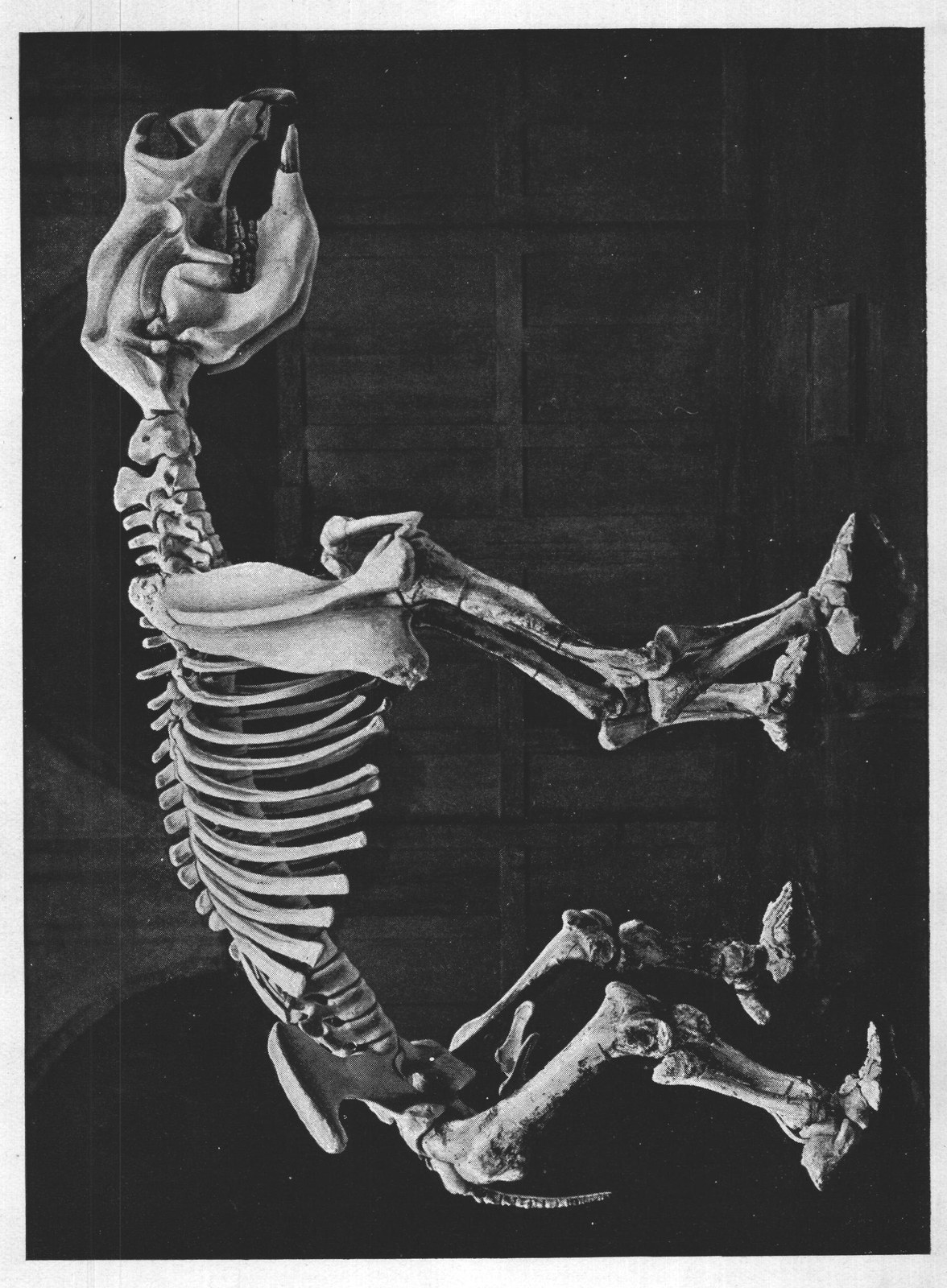
Since the year 1893 numerous complete skeletons have been found. However, very great difficulties have to be overcome in digging out these very fragile (and crushed) bones, and transporting them on the backs of camels; so that even now some parts of the skeleton are more or less unknown. As the result of years of labour, a "restoration" of the skeleton has been set up in the South Australian Museum, of which a plaster copy was presented to the Cambridge Museum of Zoology. The authorities of the former Museum have also been good enough to present to the Natural History Museum a set of actual limb-bones, and vertebræ of the tail, together with enough plaster casts to make the highly interesting restoration shown in Plate LV. In this specimen the head and the vertebræ from the neck to the sacral region (i.e. to where the hind limbs are situated) are exact copies of the Adelaide reconstruction. The skull, unfortunately, is not to be relied upon, being only a reconstructed model based on specimens from Lake Callabonna, which are all sadly crushed. Hence we are still in ignorance of the precise shape of the skull. A recent examination of the specimen from Queensland described by Owen shows that nearly all the brain-case is wanting, and that the skull was four or five inches shorter than Owen supposed. The two scapulæ, or shoulder blades, in the London model, are casts from two actual specimens from Queensland; and the feet are also casts from actual specimens. Possibly before long the whole model may be reconstructed. Meanwhile, palæontologists will await with a lively interest, the publication of a promised memoir by Dr. Stirling and Dr. Zietz. Mr. Dollo has suggested that possibly the ancestors of Diprotodon were arboreal creatures, a conclusion based on the evidence of the feet.
In conclusion, it only remains to express a hope that the reader may have been interested in our humble endeavours to describe Plate LV.
RESTORED SKELETON OF DIPROTODON AUSTRALIS.
In British Museum (Natural History), London.
EXTINCT WHALES AND WOMBATS 311 some of the largest, most strange, and wonderful forms of life that in remote ages have found a home on this planet. And perhaps a few of our readers may be induced to add a new and neverfailing interest to their lives by searching in the stony record for traces of the world's "lost creations." If so, our labour will not have been in vain.
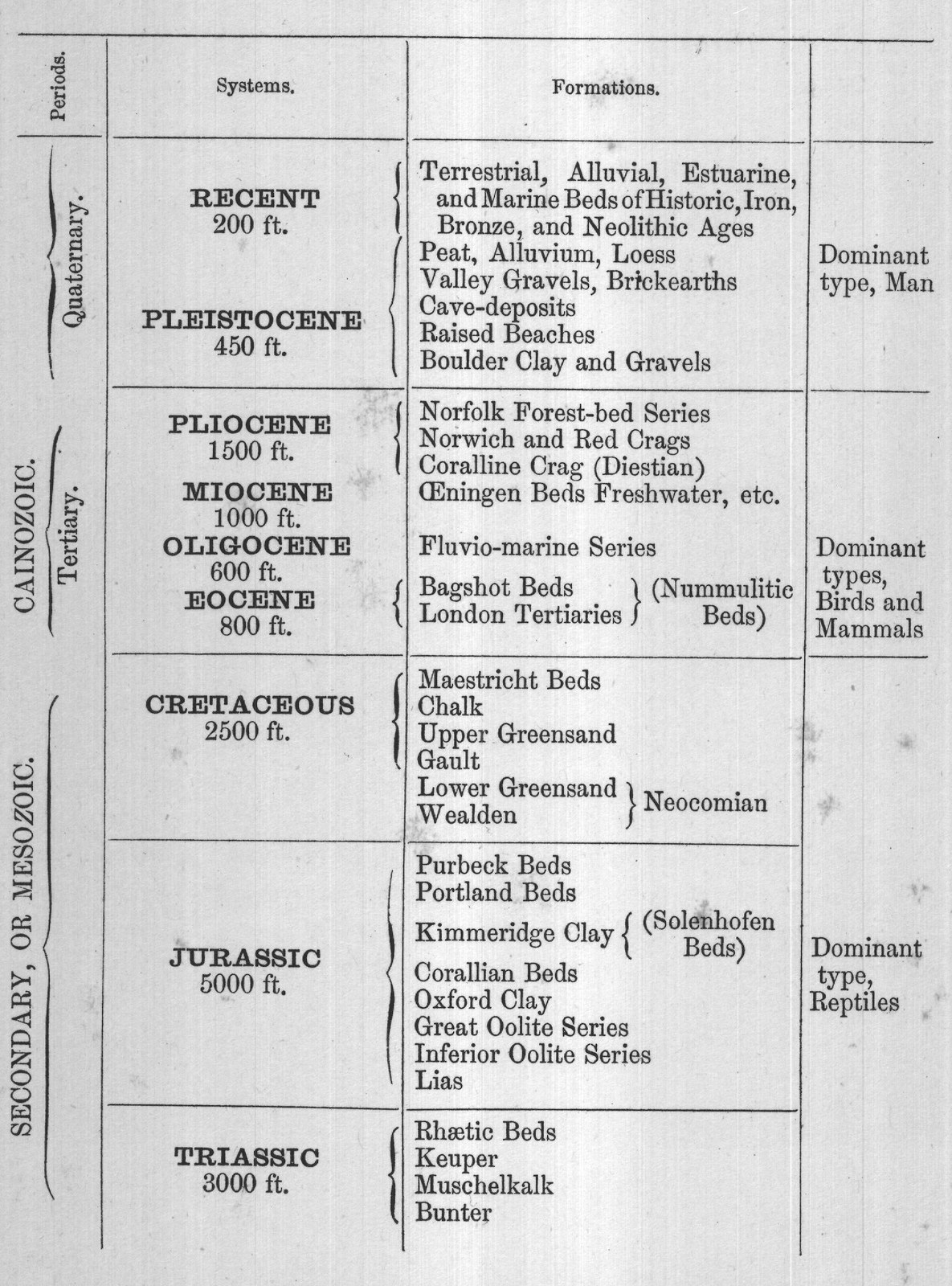
Systems.
APPENDIX I TABLE OF STRATIFIED ROCKS Formations.
RECENT 200 ft.
PLEISTOCENE 450 ft.
PLIOCENE 1500 ft.
MIOCENE 1000 ft.
OLIGOCENE 600 ft.
EOCENE 800 ft.
CRETACEOUS 2500 ft.