Home › The Dragons of Old Time-Dinosaurs › The Dragons of Old Time-Dinosaurs
The Dragons of Old Time-Dinosaurs
"What we know is but little; what we do not know is immense."-LA PLACE.
Was there ever an age of dragons? Tradition says there was; but there is every reason to believe that the fierce and bloodthirsty creatures, of which such a variety present themselves, are but creations of the imagination, useful in their way, no doubt, as pointing a moral or adorning a tale, but, nevertheless, wholly without foundation in fact. The dragon figures in the earliest traditions of the human race, and crops up again in full force in European mediæval or even late romance. But in spite of all the manifest absurdities of the dragons of various nations and times, geology reveals to us that there once lived upon this earth reptiles so great and uncouth that we can think of no other but the time-honoured word "dragon" to convey briefly the slightest idea of their monstrous forms and characters.
So there is some truth in dragons, after all. But then we must make this important reservation-viz. that the days of these dragons were long before the human period; they flourished in one of those dim geological ages of which the rocks around us bear ample records.
It is a strange fact that human fancy should have, in some cases at least, created monsters not very unlike some of those antediluvian animals that have, during the present century, been DRAGONS OF OLD TIME discovered in various parts of Europe and America. Some unreasonable persons will have it that certain monstrous reptiles of the Mesozoic era, about to be described, must have somehow managed to survive into the human period, and so have suggested to early races of men the dragons to which we have alluded. But there is no need for this untenable supposition. By a free blending together of ideas culled from living types of animals it would be very easy to construct no small variety of dragons; and so we may believe this is what the ancients did.
The announcement by Baron Cuvier-the illustrious founder of Palæontology-that there was a period when our planet was inhabited by reptiles of appalling magnitude, with many of the features of modern quadrupeds, was of so novel and startling a character as to require the prestige of even his name to obtain for it any degree of credence. But subsequent discoveries have fully confirmed the truth of his belief, and the "age of reptiles" is no longer considered fabulous. This expression was first used by Dr. G. Mantell as the title of a paper published in the Edinburgh Philosophical Journal in 1831, and serves to remind us that reptilian forms of life were once the ruling class among animals.
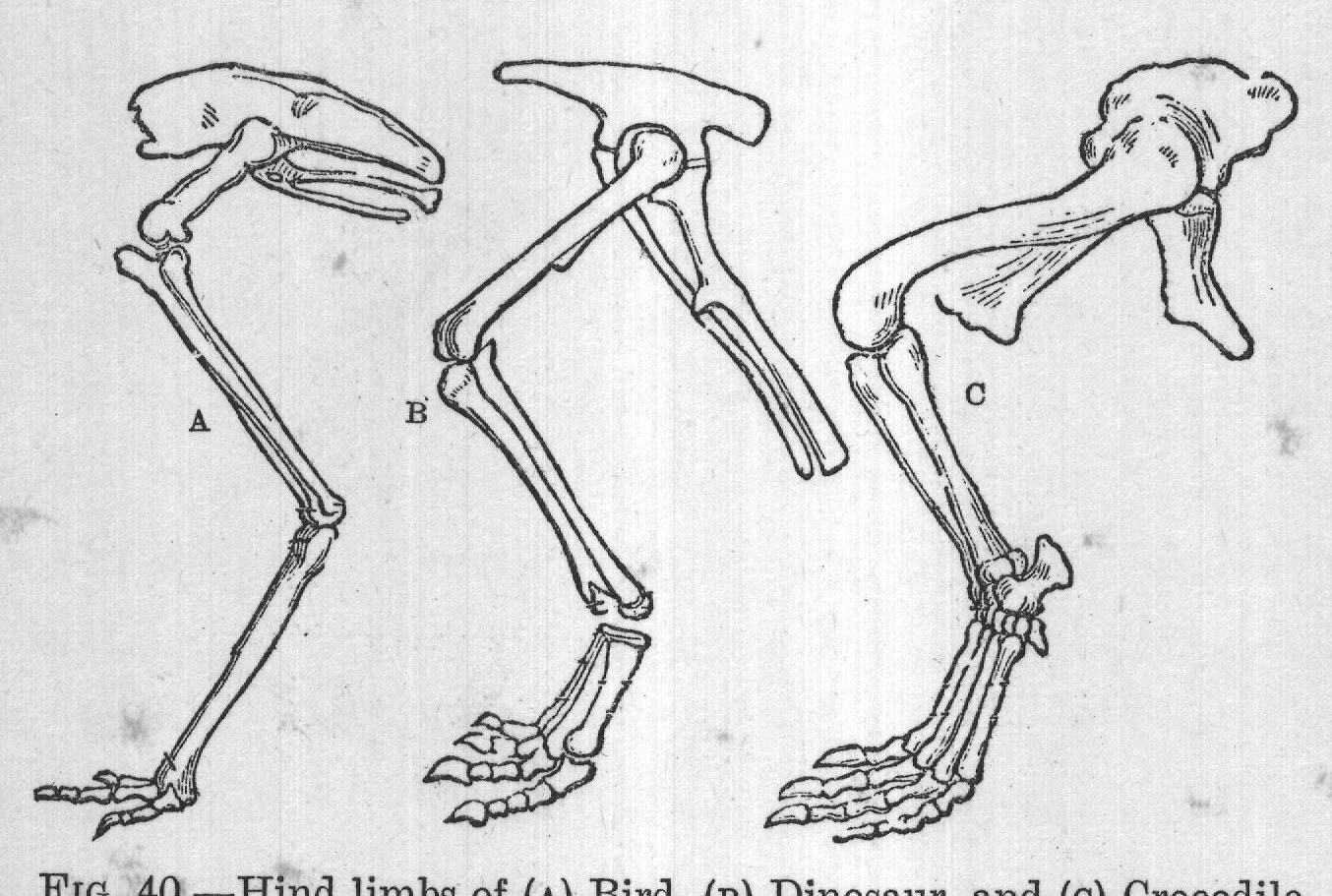
The Dinosaurs are an extinct order comprising the largest terrestrial and semi-aquatic reptiles that ever lived; and while some of them in a general way resembled crocodiles, others show in the bony structures they have left behind a very remarkable and interesting resemblance to birds of the ostrich tribe. This resemblance shows itself in the pelvis, or bony arch with which the hind limbs are connected in vertebrate or back-boned animals, and in the limbs themselves. This curious fact, first brought into notice by Professor Huxley, has been variously interpreted by anatomists; some concluding, with Professor Huxley, that birds are descended from Dinosaurian ancestors; while others, with Professor Owen, consider the resemblance accidental, and in no way implying relationship. Huxley has proposed the name Ornithoscelida, or bird-legged, for these remarkable reptiles. Dinosaurs must have formerly inhabited a large part of the primæval world; for their remains are found, not only in Europe, but in Africa, India, North and South America, and even in Australia; and the geologist finds that they reigned supreme on the earth throughout the whole of the great Mesozoic era. Their bodies were, in some cases, defended by a formidable coat of armour, consisting of bony plates and spines, as illustrated by the case of Polacanthus (p. 173), thus giving them a decidedly dragon-like appearance. The vertebræ, or bony segments of the back-bone, generally have their centra hollow on both ends, as in the Ichthyosaurus; but in the neck and tail they are not unfrequently hollow on one side and convex on the other. In some of the largest forms the vertebræ are excavated into hollow chambers. This is apparently for the sake of lightness; for a very large animal with heavy solid bones would find it difficult to move freely. In this way strength was combined with lightness.
All the Dinosaurs had four limbs, and in many cases the hind pair were very large compared to the fore limbs. They varied enormously in size, as well as in appearance. Thus certain of the smaller families were only two feet long and lightly built; while others were truly colossal in size, far out-rivalling our modern rhinoceroses and elephants.
The limbs of Cetiosaurus, for example, or of Stegosaurus, remind us strikingly of those of elephants. The celebrated Von Meyer was so struck with this likeness that he proposed the name Pachypoda for them, which means thick-footed. Professor Owen DRAGONS OF OLD TIME opposed this name; for it was misleading, and only applied to a few of them. He therefore proposed the name we have already been using, viz. Dinosauria,¹ and this name has been generally retained. We are thus led to connect them with lizards and crocodiles, rather than with birds or quadrupeds. The strange and curiously mixed characters of the old-fashioned reptiles is forcibly illustrated by these differences of opinion among leading naturalists. The late Professor Seeley, another authority, refused to consider them as reptiles, at least in the ordinary sense of the word.
Extinct forms of life are often so very different to the creatures inhabiting the world of to-day, that naturalists find it a hard task to assign them their places in the animal kingdom. The classes, orders, and families under which living forms are grouped are often found inadequate for the purpose, so much so that new orders and new families require to be made for them; and then it is often quite impossible to determine the relations of these new groups to the old ones we are accustomed to. Dinosaurs offer a good example of this difficulty. Were they related to ancient crocodiles? No one can say for certain; but it is quite possible, and even probable. Again, did certain long-legged Dinosaurs eventually give rise by evolution to the running birds, ostriches, emeus, etc.? This, although supported by weighty authority, is a matter of speculation: we ought to be very careful in accepting such conclusions. The following reflections will serve to show that the fact may be explained in another theory. Some Dinosaurs walked, in a more or less erect position, on their hind limbs. Similar habits, if continued for age after age, must tend to produce somewhat similar appearances, at least externally. Take, for example, the case of whales and 1 Greek-deinos, terrible; sauros, lizard. ? fishes; the original land mammal from which whales are descended has, in the course of time, become so fish-like in appearance that even in these modern days there are some who yet speak of them as fishes! The shape of a whale is fish-like; it has lost its hind limbs through disuse; it has changed its fore limbs into paddles, which have a certain fin-like aspect; and its cousin, the porpoise, has developed a big triangular fin on the back. To take another example: Pterodactyls are reptiles which acquired the power of flight; and some, at least, of them must have borne a resemblance to modern bats. And yet pterodactyls and bats are in no way related. The pterodactyl was a lizard that could fly; while the bat is a mammal that can do the same. There is no question of relationship. Now let us apply the same kind of reasoning to Dinosaurs and birds. For our part, we confess to being not quite convinced. Dinosaurs walked, ran, and perhaps some of the smaller ones even hopped on their hind legs; would it not follow as a matter of course that certain rather bird-like developments would follow? Let us reason the matter out. For a horizontal body, like that of a lizard, to be properly poised on two legs instead of four, the weight of the viscera must be transferred backward, and the forward, or anterior part of the body lightened. The lower bones of the region of the hips (pelvis), with the contained organs, are thrown backward, while the fore part of the body and the fore limbs are lightened and much reduced in proportionate size.
Changes such as these might be supposed capable of producing those bird-like features in Dinosaurs which we have already noticed, and on the strength of which some authorities believe birds and Dinosaurs to have had a common ancestry. It may perhaps be safer to look upon the ancestry of birds as one of those problems that remain to be solved by some future DRAGONS OF OLD TIME generation with fuller knowledge derived from first evidence. We insert here an illustration (see Fig. 40) in which are shown, side by side, the limb-bones and those of the region of the pelvis in a crocodile, a dinosaur, and a bird. (The middle drawing is not complete and the leg of the crocodile should be more bent.) Professor Marsh has described some remains of certain small and slender little Dinosaurs (Hallopus) about the size of a fowl, which, from the construction of their feet, he believes were C A B FIG. 40. Hind limbs of (A) Bird, (B) Dinosaur, and (c) Crocodile. capable of jumping. It is a question not yet decided whether Dinosaurs laid eggs.