Home › The Dragons of Old Time-Dinosaurs › The Dragons of Old Time-Dinosaurs: Marsh
The Dragons of Old Time-Dinosaurs: Marsh
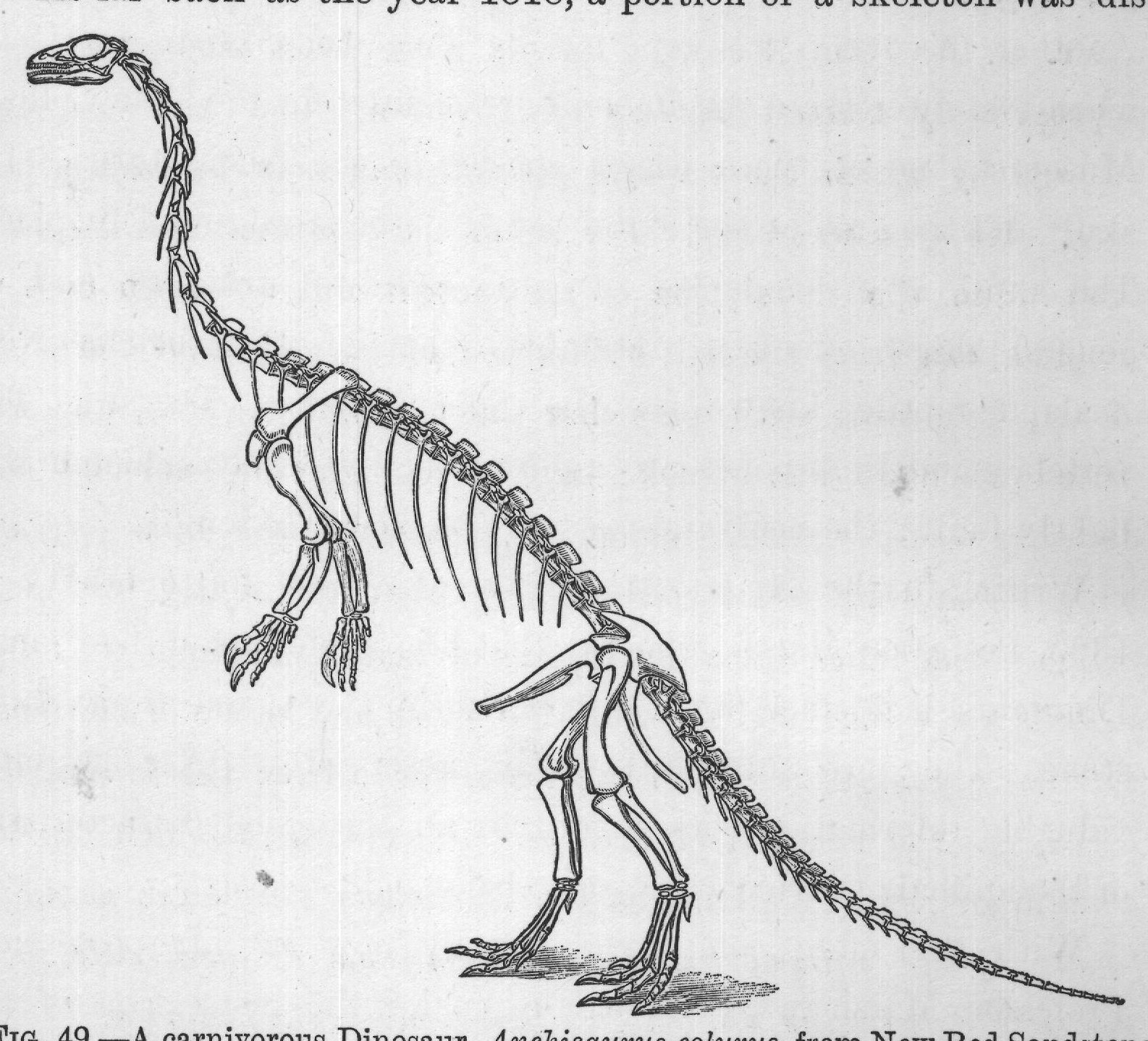
One of the oldest of the Dinosaurs seems to be the Anchisaurus ¹ of Marsh, of which he has made a restoration of the skeleton, as shown in Fig. 49. But it was only by putting together the results of several discoveries that he was enabled to give the complete outline of its skeleton as represented in the accompanying figure, so it may be well to give a brief account of the history of the discoveries that led up to this much-desired result. As far back as the year 1818, a portion of a skeleton was dis- FIG. 49. A carnivorous Dinosaur, Anchisaurus colurus, from New Red Sandstone strata, North America. (After Marsh.) covered in the Connecticut Valley, near Windsor. Another was found near Springfield, and described by Hitchcock, in 1865, under the name Megadactylus. Later on, in the year 1884, Professor Marsh announced another discovery, near Manchester Connecticut, in almost the same geological level, or "horizon," - 1 Greek-anchi, near; sauros, lizard.
DRAGONS OF OLD TIME that is to say, in strata of about the same age, -of the remains of an animal of larger size, but in many respects nearly allied to the one described by Hitchcock. Both apparently belong to the same genus. These remains seem to represent an animal about six to eight feet long; but, unfortunately, they are not complete, although when first discovered the skeleton probably was complete, and, with proper care, might have been preserved entire. Another discovery was reported by Professor Marsh, in 1891, when two interesting specimens were secured for the Yale College Museum; one of these was a species of the Anchisaurus. Its skull and the greater portion of the skeleton were found in place. The skull is of moderate size and delicate structure, and in general shape somewhat resembles that of the curious New Zealand reptile known as the Sphenodon, or Tuatara. The vertebræ and limb-bones are hollow, and the whole skeleton was lightly built; the neck and tail were of moderate length. Writing in the American Journal of Science for February of 1893, Professor Marsh reported that the skeletons of five small Dinosaurs had since been discovered in the Connecticut Sandstone. They are sufficiently well preserved to give us most valuable information with regard to all the chief characteristics of the animals to which they once belonged.