Home › The Dragons of Old Time-Dinosaurs › The Dragons of Old Time-Dinosaurs: Jurassic
The Dragons of Old Time-Dinosaurs: Jurassic
The remains of this interesting Dinosaur (Brontosaurus), which in several ways differs from other members of the "lizard-footed" group, were found in Upper Jurassic beds, near Canon City, Colorado. A second smaller species was also discovered near Morrison, Colorado. All the remains lay in the Atlantosaurus beds. These strata-the tomb in which Nature has buried up so many of her dragons of old time-can be traced for several hundred miles on the flanks of the Rocky Mountains, and are always to be known by the bones they contain. They lie above the Triassic strata and just below the Sandstone of the Dakota group. Some have regarded them as of Cretaceous age; but, judging from their fossils, there can be but little doubt that they were deposited during the Jurassic period-probably in an old estuary. They consist of shale and sandstone.
Besides the numerous Dinosaurs, Professor Marsh's colleagues have found abundant remains of crocodiles, tortoises, and fishes, with one Pterodactyl, a flying reptile (see Chap. XI.), and several small marsupials. The wonderful collection of American Jurassic Dinosaurs in the Museum of Yale College includes the remains of several hundred individuals, many of them in excellent preservation, and has afforded to Professor Marsh the material for his classification already alluded to.
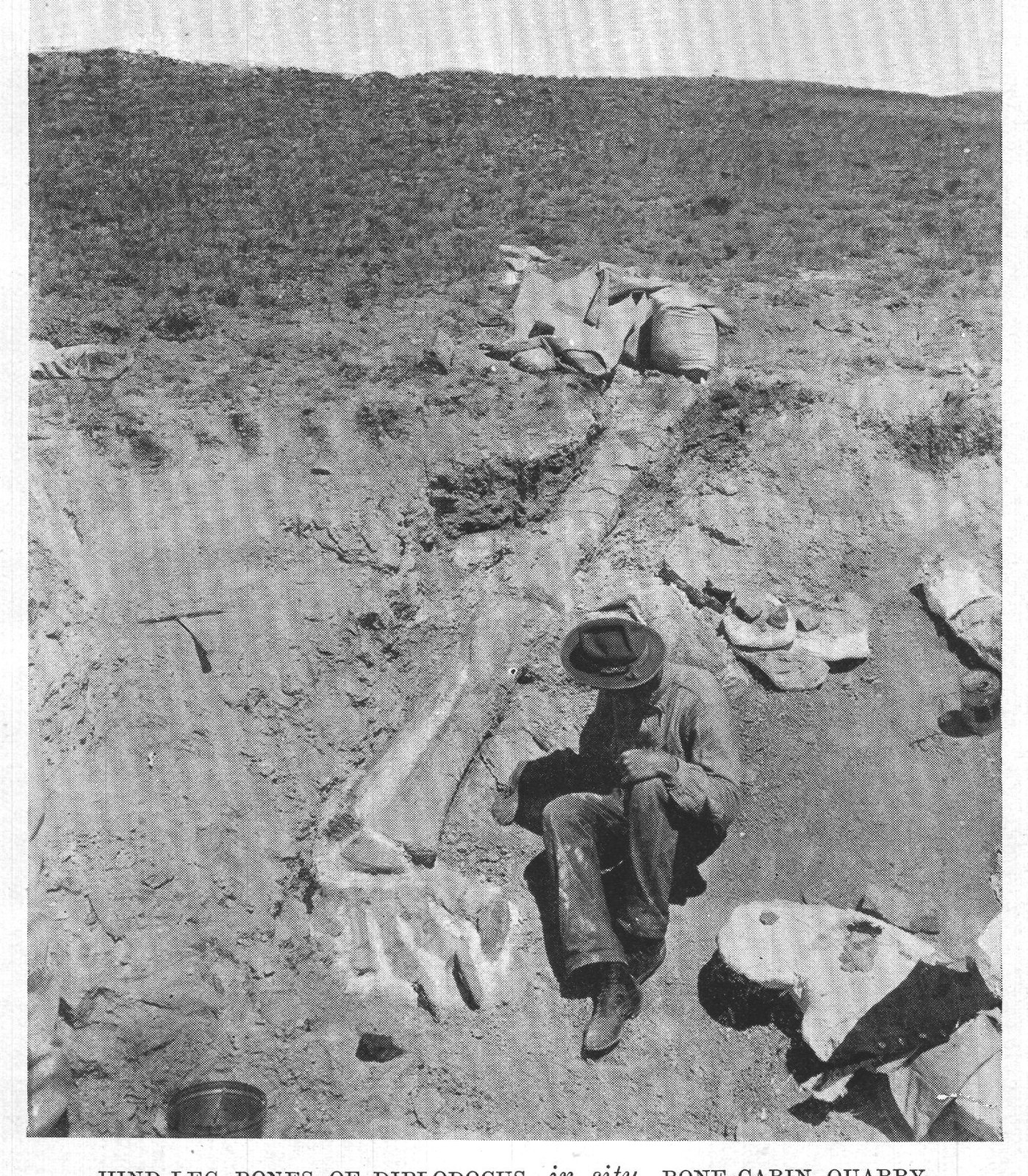
For a good many years past the State of Wyoming has been L famous as a happy hunting ground for geologists in search of prehistoric monsters. It was here that Marsh and others found the bones of creatures whose existence had never been suspected, some of which we have already described. But it was in the year 1897 that Mr. Walter Granger, of the American Museum Expedition, discovered the greatest and most wonderful site for fossil bones ever known in the whole history of Science. It simply teems with bones, Dinosaurs, crocodiles, turtles, etc.! Professor H. F. Osborn has been working on this site for six years (from 1898), and has taken therefrom bones weighing nearly 100,000 lbs. (over 44 tons). Judging from the number of thigh bones, these probably represent 73 animals of the following kinds: Giant herbivorous Dinosaurs, 44; plated herbivorous ditto, 3; large carnivorous ditto, 6; small carnivorous ditto, 3; crocodiles, 4; turtles, 5. دو But the site is not yet exhausted; it lies not far from Medicine Bow River, and is marked by a ruined hut which some shepherd had built up with blocks of stone containing petrified bones. The illustration on Plate XX. shows a hind limb of a Diplodocus nearly six feet long! from a photograph kindly lent by Professor Osborn. The site is now known as "Bone-cabin Quarry "-a building probably unique in the world's history. At the Como Bluffs (Cliffs), about ten miles off, single animals lie from twenty to one hundred feet apart; but whole skeletons are seldom found. The late Professor Marsh, however, got a nearly complete Brontosaurus here, which is now in the Yale Museum. A geologist is more likely to find a complete tail, or a long neck, or a good part of the trunk. Skulls are rare, unfortunately. Professor Osborn suggests that we have here the site of an old river-bar 1 The Century Magazine, September, 1904. The Fossil Wonders of the West, by Professor H. F. Osborn.
HIND-LEG BONES OF DIPLODOCUS, in situ, BONE-CABIN QUARRY, MEDICINE BOW, WYOMING.
Reproduced by permission of Prof. Henry Fairfield Osborn and the American Museum of Natural History.
PLATE XX.