Home › Anomalous Reptiles › Anomalous Reptiles: Sandstone
Anomalous Reptiles: Sandstone
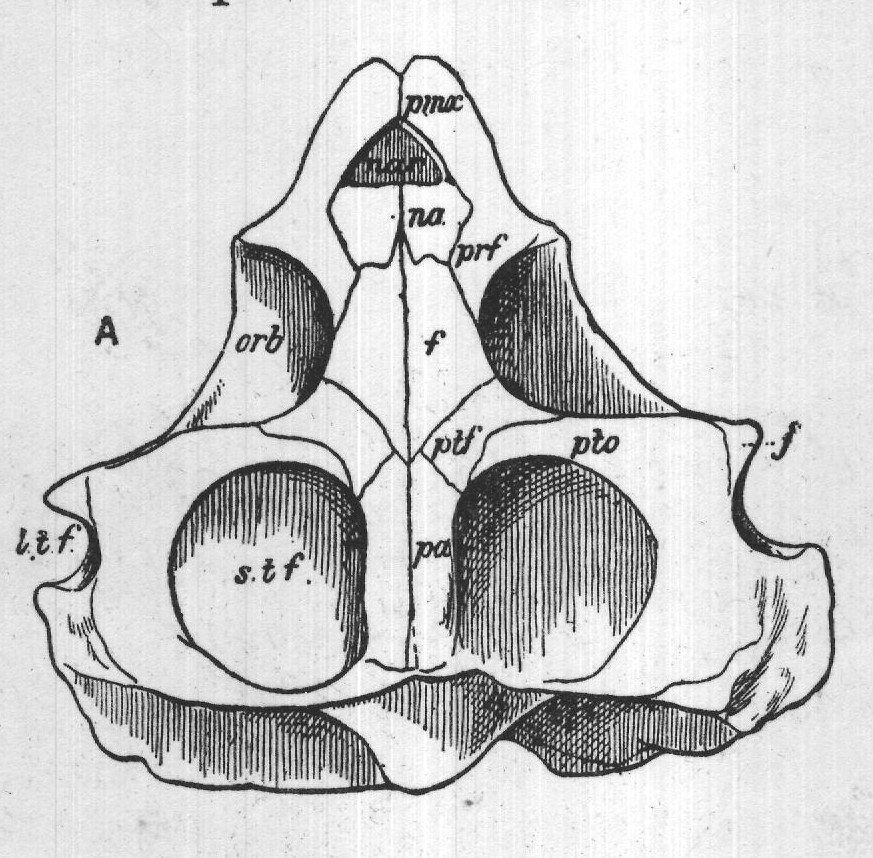
The second example of the reptilian order now under consideration is the Rhynchosaurus, discovered by Dr. O. Ward, in a quarry in the New Red Sandstone, at Grinsill, near Shrewsbury. His discovery comprised the skull and a considerable portion of the skeleton (see Fig. 36). Professor Owen also found some remains of the same animal in this quarry. 1 Published in the Journal of 1867, vol. xxiii. p. 77. The animal was about three feet in length. The general aspect of the skull differs from that of modern lizards, and resembles that of a bird or a turtle, which resemblance is increased by the apparent absence of teeth. There was, however, a single row of teeth on the palate. Professor Owen concluded that this ancient creature had its jaws encased in a bony or a horny sheath. The fortunate preservation of the skull has brought to A pinac na prf orb ptf Ltf s.tf pa B pmac pto f C FIG. 37. Skull and mandible of Hyperodapedon Gordoni. A. Upper view; в. Side view; c. Mandible. From the Elgin Sandstone of Triassic age. (After Dr. A. Smith Woodward.) light a curious modification of the lizard type of structure, that seems to lead on towards birds and turtles.