Home › Anomalous Reptiles › Anomalous Reptiles: Hyperodapedon
Anomalous Reptiles: Hyperodapedon
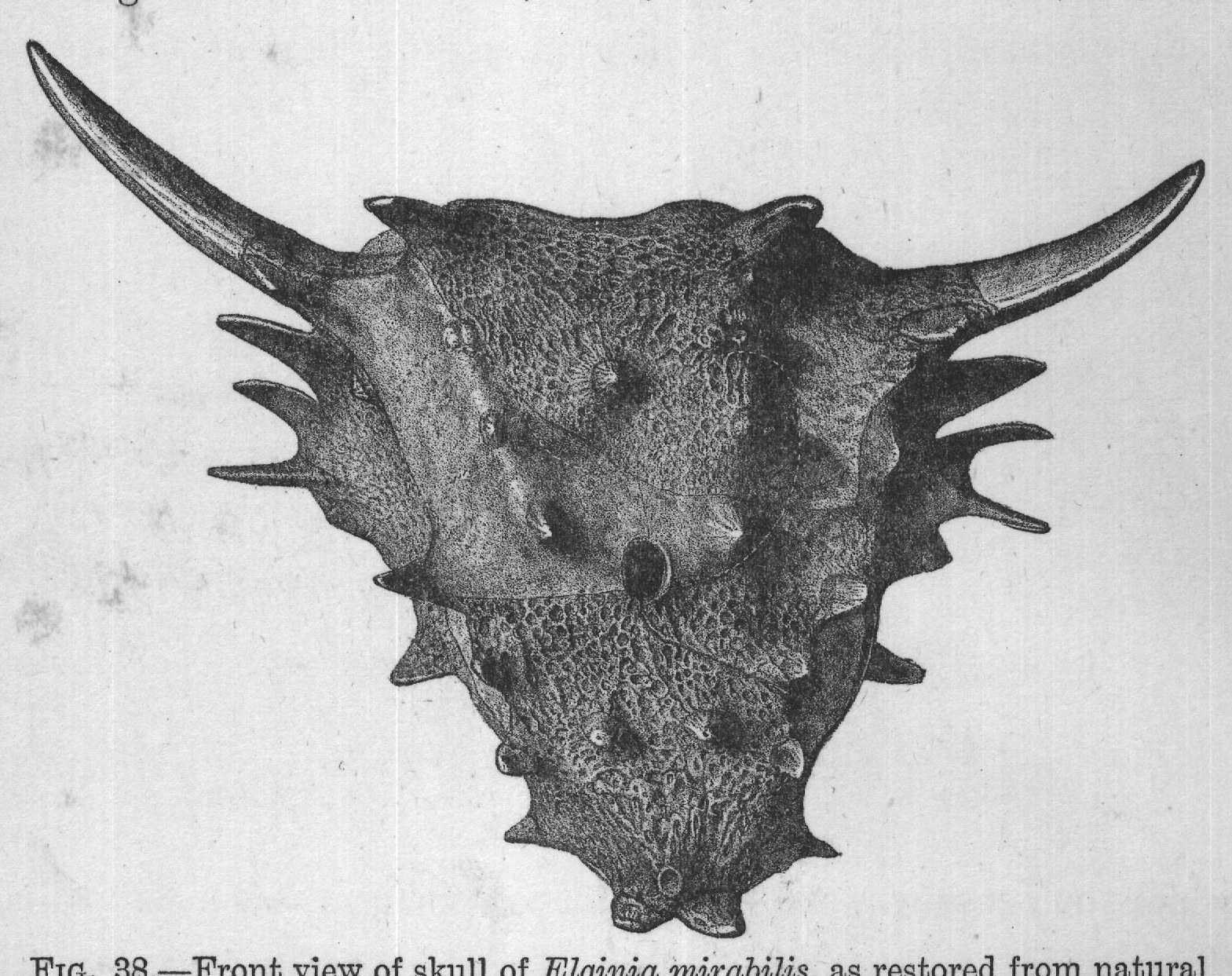
The Hyperodapedon was a much larger creature. It was a terrestrial reptile, some six or seven feet long, and does not appear to have been armed with scutes or spines of any kind. A fine specimen is to be seen at the Natural History Museum (Wall-case 9). Like the Rhynchosaurus, it had a broadly triangular form of skull, with the orbits for the eyes directed upwards, and the jaws prolonged into a sharp curved beak, so that it comes into the same order of "beak-headed lizards." But, unlike the latter reptile, it had several rows of well-developed, low, conical teeth, both on the jaws and palate. The specimen at South Kensington shows the head, neck, backbone, and ribs, together FIG. 38. Front view of skull of Elginia mirabilis, as restored from natural moulds in the Elgin Sandstone, by Mr. E. T. Newton. with some of the limb-bones. We have therefore ventured on a restoration by Mr. Smit (see Plate IX.), in order to give the reader an idea of its curious head and beaked jaws. (The limbs might be larger.) Hyperodapedon must have had a wide geographical range during the period of the Trias; for its remains have also been found in the centre of England (Warwickshire), in Devonshire, and in Central India. A much larger species from India is reckoned to have attained a length of seventeen feet.
Professor Huxley concluded that Hyperodapedon and Rhynchosaurus do not depart from the ordinary lizard type of structure more than some of our modern lizards do-such as the Monitor, Chameleon and Gecko, to which both are allied. He thinks that, even in Triassic times, the lizard type had become highly specialised.
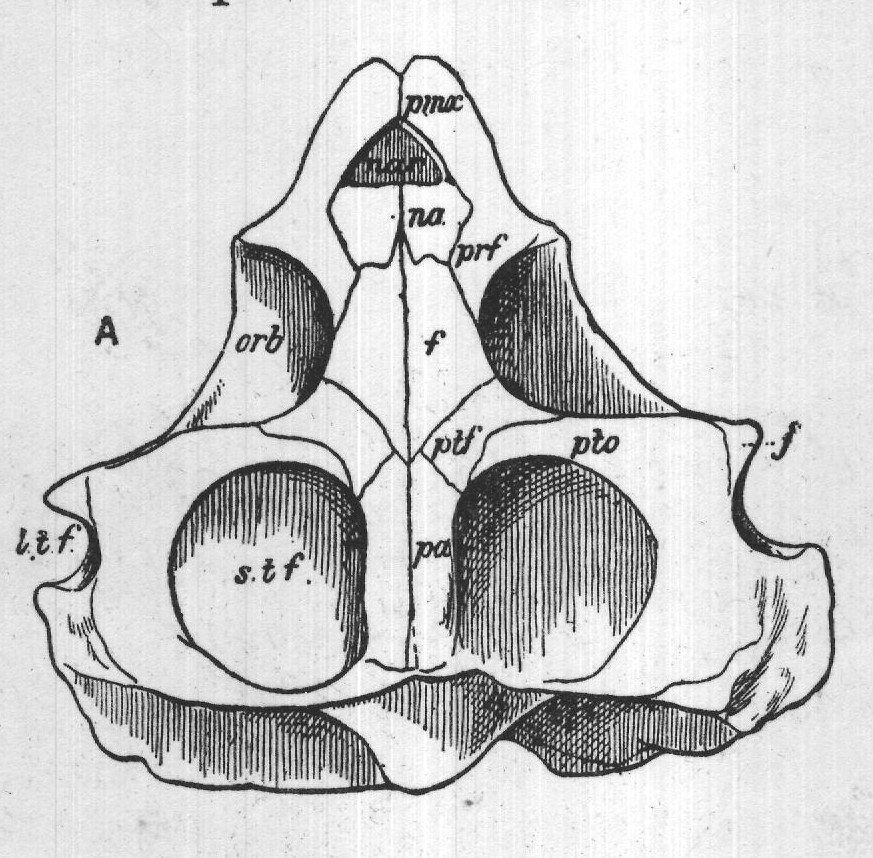
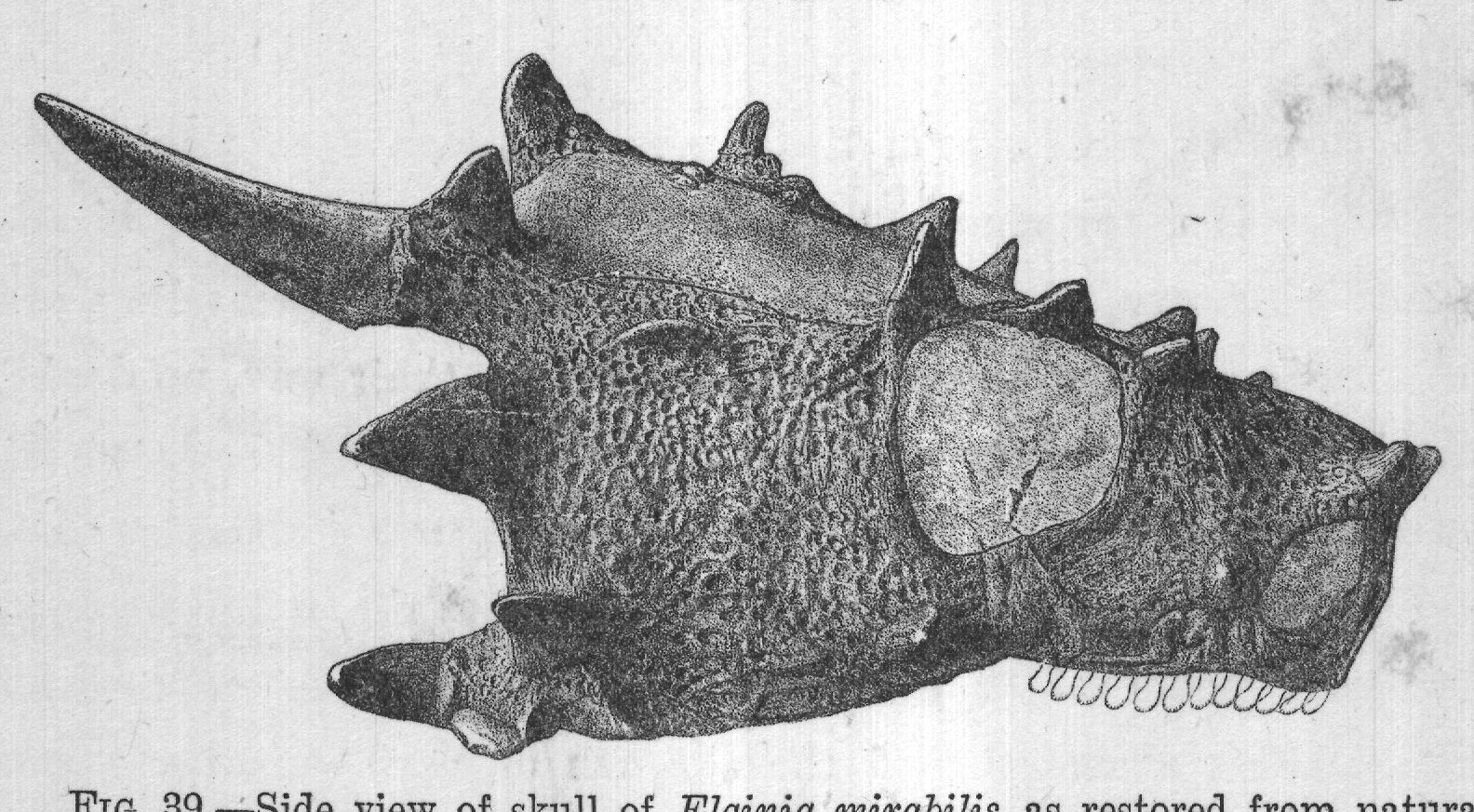
Elginia mirabilis is the name proposed for the skull of a reptile C FIG. 39. Side view of skull of Elginia mirabilis, as restored from natural casts in the Elgin Sandstone, by Mr. E. T. Newton. which, on account of the extreme development of horns and spines, reminds one of the living lizards, Moloch and Phrynosoma. The skull of this ancient saurian (see Figs. 38, 39) is unlike that of any living or fossil form, and seems to show affinities with both the Labyrinthodonts and the lizards. All the remains are in the form of hollow moulds in blocks of stone, but Mr. Newton has, with wonderful skill and patience, made casts in guttapercha and so reconstructed the skull, as shown in our illustrations. The Elginia was closely related to Pareiasaurus.