Home › Anomalous Reptiles › Anomalous Reptiles: Tuatara
Anomalous Reptiles: Tuatara
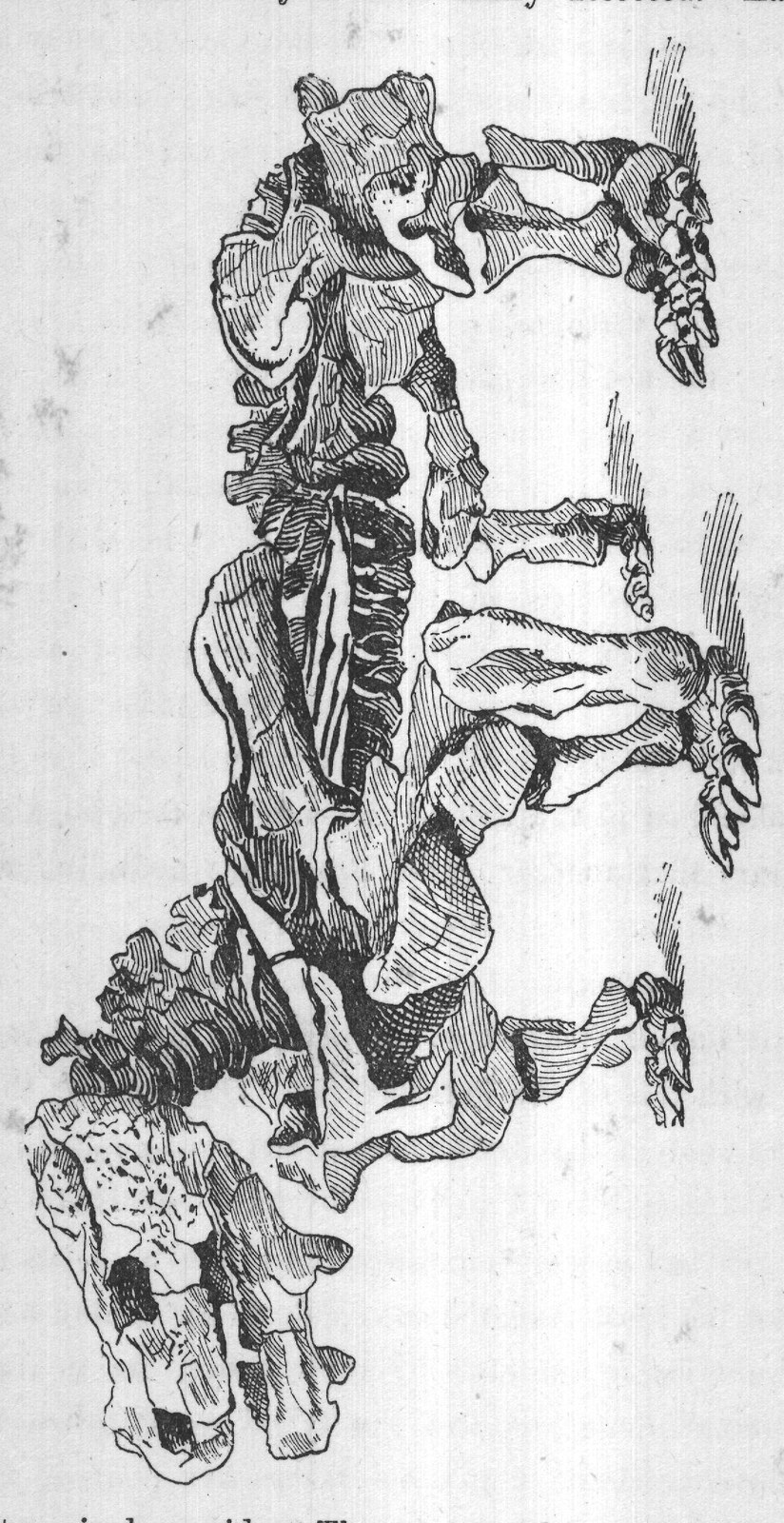
The creature must have been fully nine feet long when alive. The great width and squareness of the animal is a feature that strikes one at once. The skull decidedly resembles that of a Labyrinthodont, and, even to a casual observer, has a frog-like look. But internally it is like that of the Tuatara, or Sphenodon, of New Zealand, which is a survival from very old times, and throws much light on several orders of Triassic reptiles. The backbone, or vertebral column, also resembles that of the little Tuatara, and not that of a Labyrinthodont. In the shoulder girdle we see a resemblance to the Anomodonts, as also in the pelvis, or region of the hips, which is remarkably mammalian. Every one who looks at the skeleton must be struck with the great strength and massiveness of the limb-bones. The arm-bone suggests two very triangular wedges fastened together; so does the femur, or thigh-bone. The present writer suggested three years ago that all this strength may have been for the purpose of supporting a massive shield as in the case of the common tortoise, and now, 1909, he hears that another genus Propappus actually had such an armoured shield. For the sake of comparison, a specimen of the Tuatara (Sphenodon) is placed in a case close by (Wall-case 9). Visitors will find it instructive to compare the skeleton of a Sphenodon with that of the Pareiasaurus. On so doing, they will see a resemblance in the limb-bones of the two creatures. How fortunate that this little lizard should have survived so many geological ages-as it were on purpose to give us some help in studying the long-lost Anomodonts! Professor Seeley considers that the limbs, as represented by their bones, are intermediate between those of mammals and the tailed amphibians, such as newts and salamanders. But the creature was more of a reptile than an amphibian, as is shown by the fact that its skull articulated with the first joint of the backbone by means of one condyle, 1. MODEL OF PAREIASAURUS KARPINSKII.