Home › The Great Fish-Lizards › The Great Fish-Lizards
The Great Fish-Lizards
"Berossus, the Chaldæan saith: A time was when the universe was darkness and water, wherein certain animals of frightful and compound forms were generated. There were serpents and other creatures with the mixed shapes of one another, of which pictures are kept in the temple of Belus at Babylon."- The Archaic Genesis.
VISITORS to Sydenham, who have wandered about the spacious gardens so skilfully laid out by the late Sir Joseph Paxton, will be familiar with the great models of extinct animals on the "geological island." These were designed and executed by that clever artist, Mr. Waterhouse Hawkins, who made praiseworthy efforts to picture to our eyes some of the world's lost creations, as restored by the genius of Sir Richard Owen and other famous naturalists. His drawings of extinct animals may yet be seen hanging on the walls of some of our provincial museums; but of these many are far from correct. The difficulties were much greater in those early days. Mr. Karl Hagenbeck is now setting up "Restorations" in his famous Zoological Garden at Hamburg. Lazily basking in the sun, when it condescends to shine, and resting his clumsy carcase on the ground that forms the shore near the said geological island at Sydenham, may be seen the old fish-lizard, or Ichthyosaurus, that forms the subject of the present chapter. He looks awkward on land, as if longing to get into his native element once more, and cleave its waters with his powerful tail-fin. His "flippers" seem too weak to enable him to crawl on land. Moreover, the most recent discoveries of Dr. Fraas lead us to conclude that the Ichthyosaur never ventured to leave the "briny ocean" to bask upon the land. This great uncouth beast presents some curious anomalies in his constitution, being planned on different lines to anything now living, and presenting, as so many other extinct animals do, a mixture, or fusion, of types that greatly puzzled the learned men of the time when his remains were first brought to light, after their long entombment in the Lias rocks forming the cliffs on the coast of Dorset. Some have christened him a "seadragon," and such indeed he may be considered. But the name Ichthyosaurus, given above, has received the sanction of high authority, and, moreover, serves to remind us of the fact that, although in many respects a lizard, he yet retains in his bony framework the traces of a remote fishy ancestry. So we will call him a fish-lizard.
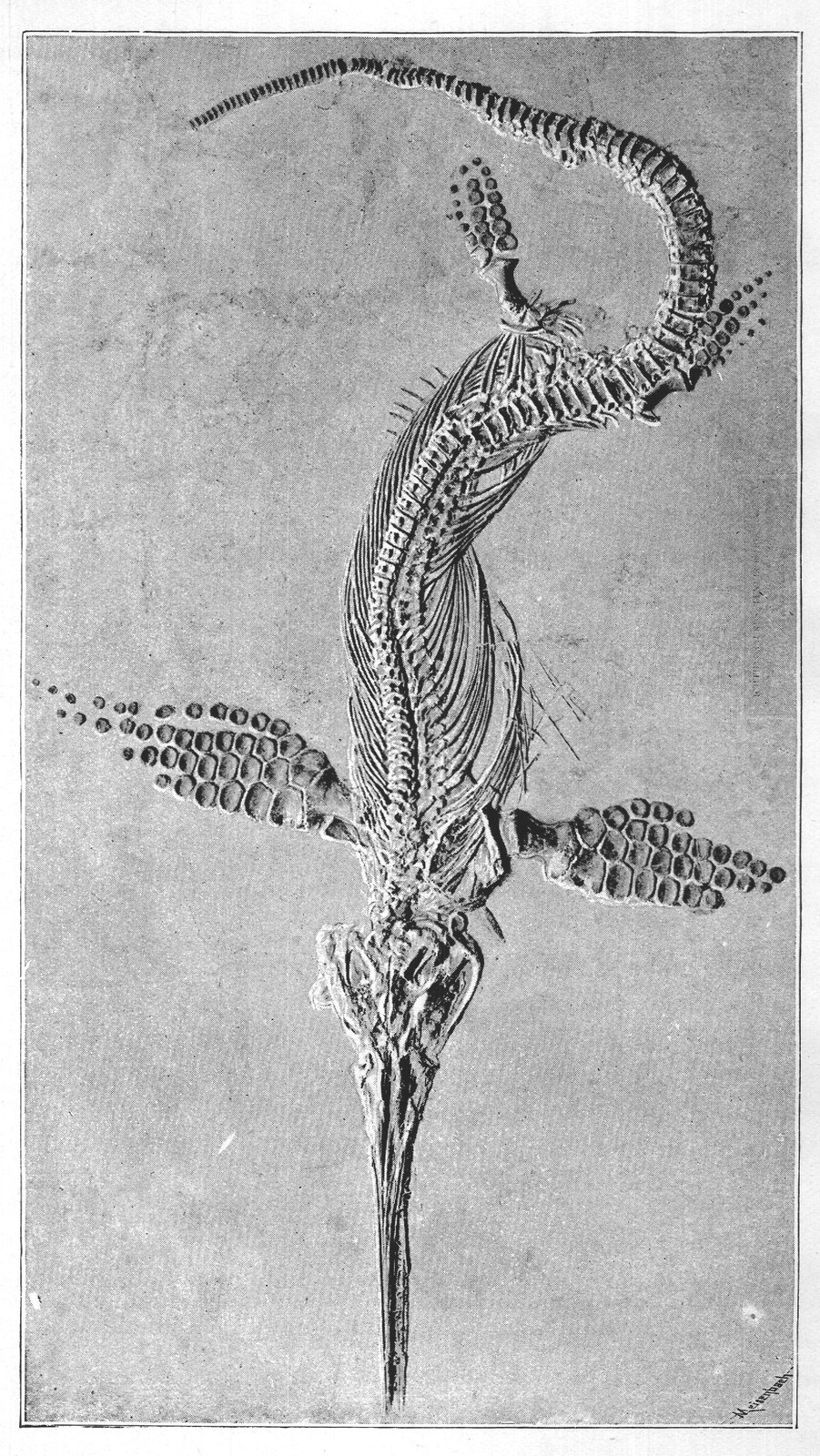
The curious quotation given at the head of the present chapter refers to a widespread belief, prevalent among the highly civilised nations of antiquity, that the world was once inhabited by dragons, or other monsters "of mixed shape" and characters. To the student of ancient history traces of this curious belief will be familiar. Sir Charles Lyell refers to such a belief when he says, in his Principles of Geology, "The Egyptians, it is true, had taught, and the Stoics had repeated, that the earth had once given birth to some monstrous animals that existed no longer." It may be surprising to some, but it is undoubtedly the fact, that modern scientific truths were partly anticipated by the civilised nations of long ago.
The illustrious Cuvier, in his day, considered the fish-lizard to be one of the most heteroclite and monstrous animals ever discovered (see p. 74). He said of this creature that it possessed the snout of a dolphin, the teeth of a crocodile, the head and PLATE III. 100000 000 SKELETON OF ICHTHYOSAURUS TENUIROSTRIS IN THE NATURAL HISTORY MUSEUM, LONDON. breast-bone of a lizard, the paddles of a whale or dolphin, and the vertebræ of a fish! No wonder that naturalists and palæontologists, whose realm is the natural history of the past, were obliged to make a new division, or order, of reptiles to accommodate the fish-lizard. It is obvious that a creature with such very "mixed" relationships would be out of place in any of the four orders into which living reptiles, as represented by turtles, snakes, lizards, and crocodiles, are divided. Here is what our late friend Professor Blackie said of the Ichthyosaurus- "Behold, a strange monster our wonder engages!
If dolphin or lizard your wit may defy.
Some thirty feet long, on the shore of Lyme-Regis, With a saw for a jaw, and a big staring eye.
A fish or a lizard? An ichthyosaurus, With a big goggle eye, and a very small brain, And paddles like mill-wheels in chattering chorus, Smiting tremendous the dread-sounding main."
A glance at our restoration, Plate IV., will show that the fishlizard was a powerful monster, well endowed with the means of propelling itself rapidly through the water as it sought its living prey, to seize it within those cruel jaws. The long and powerful tail was its chief organ of propulsion; but the paddles would also be useful for this purpose, as well as for guiding its course. The pointed head and generally tapering body suggests a capability of rapid movement through the water; and since we know for certain that it fed on fishes, this conclusion is confirmed, for fishes are not easily caught now, and most probably were not easily caught ages ago.
The personal history of the fish-lizard, merely as a fossil or "remain" is interesting; so much so, that we may perhaps be allowed to relate the circumstances of his début before the scientific world, in the days of the ever-illustrious Cuvier, to whom we have already alluded. But England had its share of illustrious men, too, though lesser lights compared to the founder of comparative anatomy, -such as Sir Richard Owen, on whom the mantle of his friend Cuvier has fallen; Conybeare, De la Beche, Dean Buckland, and Huxley.
These scientific men, aided by the untiring labours of many enthusiastic collectors of organic remains, have been the means of solving the riddle of the fish-lizard, and of introducing him to the public. By this time there is, perhaps, no creature among the host of Antediluvian types better known than this reptile. The remains of fish-lizards have attracted the attention of collectors and describers of fossils for nearly two centuries past. The vertebræ, or "cup-bones," as they are often called, of which the spinal column was composed, were figured by Scheuchzer, in an old work entitled Querelæ Piscium; and, at that time, they were supposed to be the vertebræ of fishes. In the year 1814 Sir Everard Home described the fossil remains of this creature, in a paper read before the Royal Society, and published in their Philosophical Transactions. This fossil was first discovered in the Lias strata of the Dorsetshire coast. Other papers followed till the year 1820. We are chiefly indebted to De la Beche and Conybeare for pointing out and illustrating the nature of the fishlizard; and that at a time when the materials for so doing were far more scanty than they are now. Mr. Charles König, Mr. Thomas Hawkins, Dean Buckland, Sir Philip Egerton, and Professor Owen have all helped to throw light on the structure and habits of these old tyrants of the seas of that age, which is known as the Jurassic period. They lived on, however, to the succeeding or Cretaceous period, during which our English chalk was forming; but the Liassic age was the one in which they flourished most abundantly, and developed the greatest variety.
In the year 1814 a few bones were found on the Dorsetshire coast between Charmouth and Lyme Regis, and added to the collection of Bullock. They came from the Lias cliffs, undermined by the encroaching sea. Sir Everard's attention being attracted to them, he published the notices already referred to. The analogy of some of the bones to those of a crocodile, induced Mr. König, of the British Museum, to believe the animal to have been a saurian, or lizard; but the vertebræ, and also the position of certain openings in the skull, indicated some remote affinity with fishes, but this must not be pressed too far. The choice of a name, therefore, involved much difficulty; and at length he decided to call it the Ichthyosaurus, or fish-lizard. Mr. Johnson, of Bristol, who had collected for many years in that neighbourhood, found out some valuable particulars about these remains. The conclusions of Dean Buckland, then Professor of Geology at Oxford, led Sir Everard to abandon many of his former opinions. The labours of the learned men of the day were greatly assisted by the exertions of Miss Anning, an enthusiastic collector of fossils. This lady, devoting herself to science, explored the frowning and precipitous cliffs in the neighbourhood of Lyme Regis, when the furious spring-tide combined with the tempest to overthrow them, and rescued from destruction by the sea, sometimes at the peril of her life, the few specimens which originated all the facts and speculations of those persons whose names will ever be remembered with gratitude by geologists.