Home › Anomalous Reptiles › Anomalous Reptiles (Endeavour to complete)
Anomalous Reptiles (Endeavour to complete)
"In the endeavour to complete the Natural History of any class of animals, the mind seeks to penetrate the mystery of its origin, and, by tracing its mutations in time past, to comprehend more clearly its actual condition, and gain an insight into its probable destiny in time to come."-SIR R. OWEN. HAVING, in our previous chapter, discussed the Labyrinthodonts, we now pass on to consider some of their descendants in the shape of a very peculiar group of reptiles hailing from South Africa and elsewhere. Perhaps the chief peculiarity, among many others, presented by these very antique and old-fashioned inhabitants of the world, is to be found in their teeth. In fact, so irregular and anomalous are they in regard to these organs, and so at variance with all our preconceived ideas with regard to what proper, well-behaved reptiles, whether living or extinct, ought to be like, that their vagaries in this respect have led to their being christened by the name of Anomodonts, or "anomalously toothed' reptiles.¹ Needless to say, they occupy a distinct order, with several sub-orders, in the classifications adopted by palæontologists. They are also by some authorities named Theromorphs and Theriodonts. The moral of all this is, as we shall better understand later on, that it would be well for students of extinct forms of life to enter this domain of Science without any preconceived ideas at all! It would save a great 1 Greek-anomos, without law; odous, odontos, tooth. deal of confusion and trouble in the end; and, moreover, would be far more truly scientific. For what right has any one, however great his knowledge or his ability, to dictate to Nature, and to say this or that is impossible that no reptile, for instance, could possibly have flown; or that such and such teeth were impossible for a reptile?
We now know that there was a time when certain reptiles did fly (although many people with some pretensions to knowledge doubted the evidence). And so with regard to reptilian teeth; fossil evidence shows that some old reptiles had teeth more like those of modern mammals! Facts such as these should teach caution, and every student of palæontology will do well to remember the saying of Agassiz: "The possibilities of existence run so deeply into the extravagant that there is scarcely any conception too extraordinary for Nature to realise." The chief characters of the Anomodonts may be briefly stated as follows: In this order the body is lizard-like, and the limbs are adapted for walking. The skull is comparatively short, and the nasal openings are large. The teeth are generally placed in distinct sockets (thecodont). The bodies of the vertebræ are hollow at both ends (amphiccelous), and in some cases are only partly converted into bone-a character which is common to the Labyrinthodonts. The whole structure of the foot is distinctly on the mammalian plan. Recent researches show that these animals are descended from Labyrinthodonts, and more especially the family of which Archegosaurus is a member (see p. 96). Certain important characters show (strange as it may seem) affinity with mammals; and it is probable that they are related to the lowest group of them, as represented at the present day by that remarkable creature the Spiny Ant-eater of Australia (Echidna), and the wonderful Duck-mole (Ornithorhynchus), which lays eggs like a reptile. These two creatures belong to the Monotreme order.
Now the Anomodont reptiles are divided into several groups, sub-orders, and families, of which we will take first those known as Dicynodonts,¹ because they illustrate the anomalous nature of the teeth, to which we referred just now.
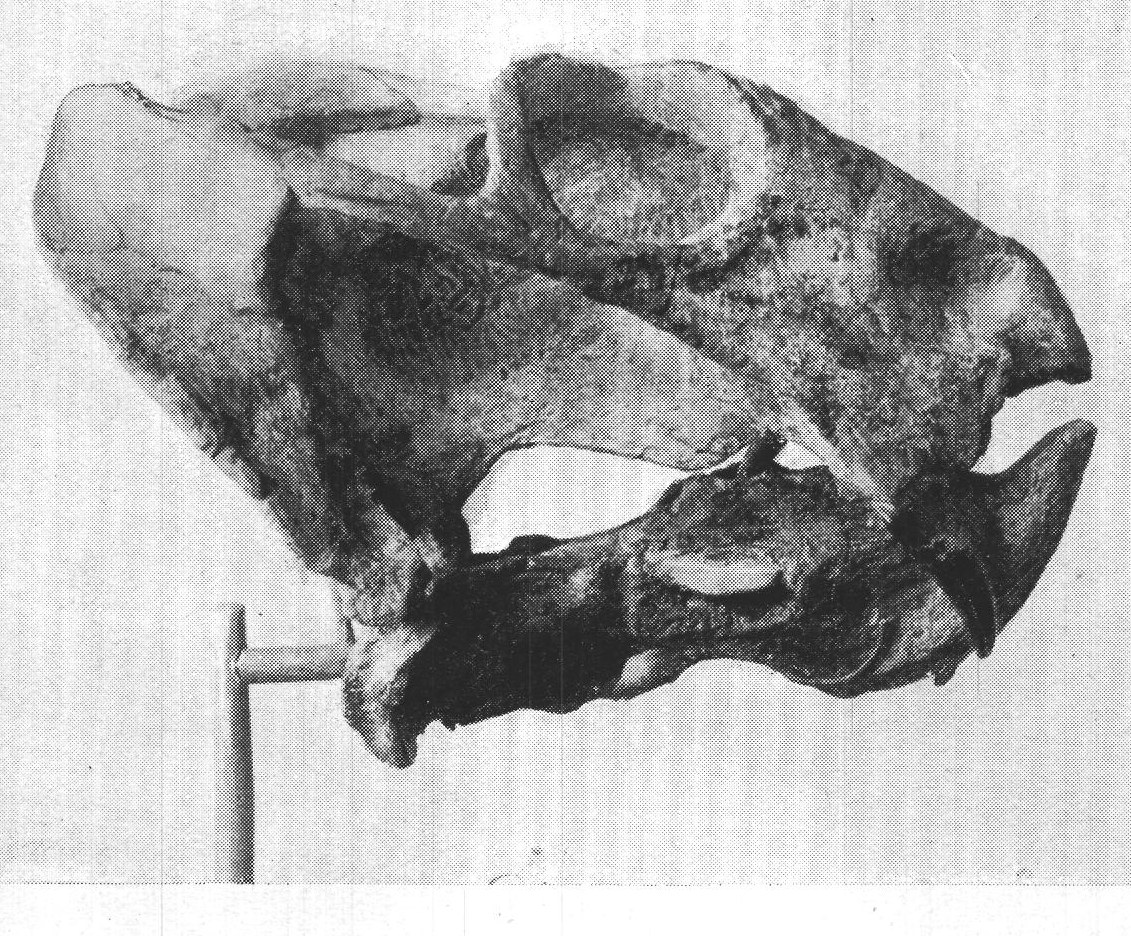
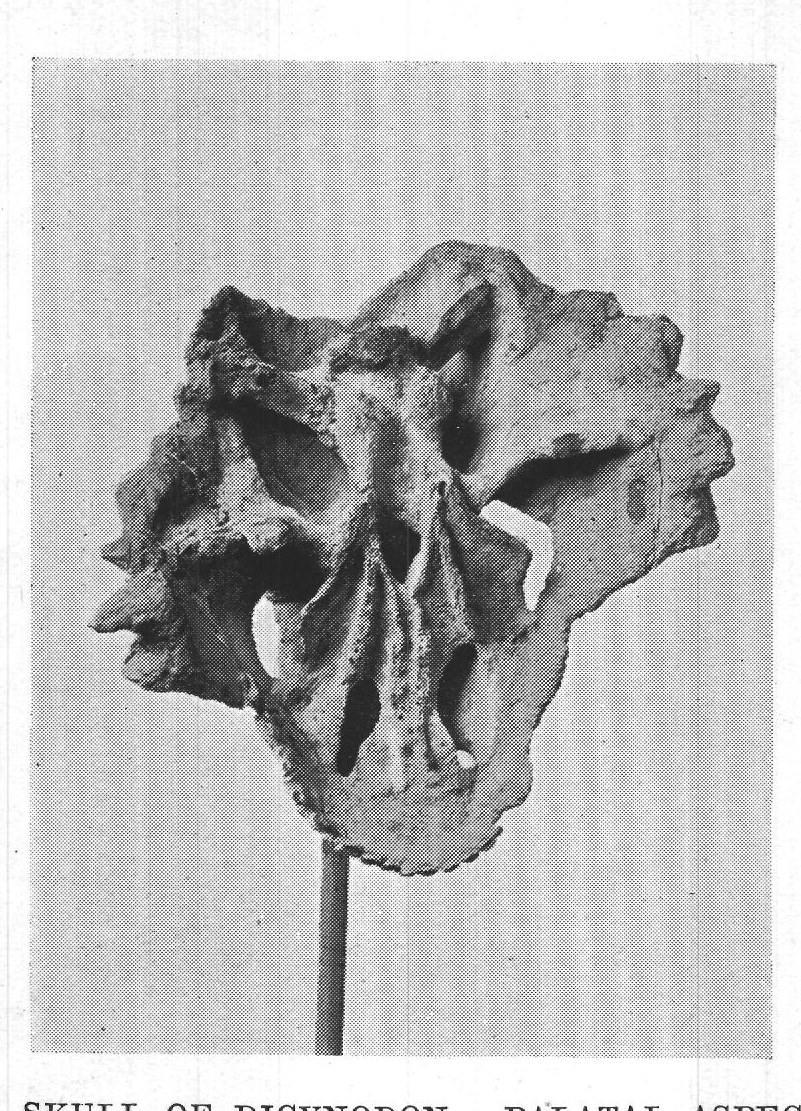
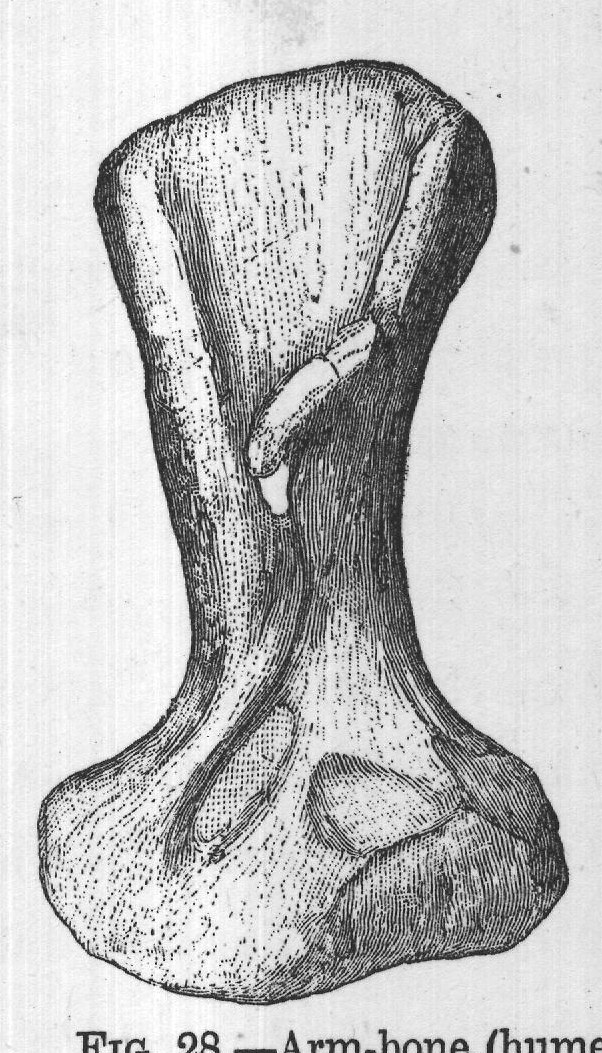
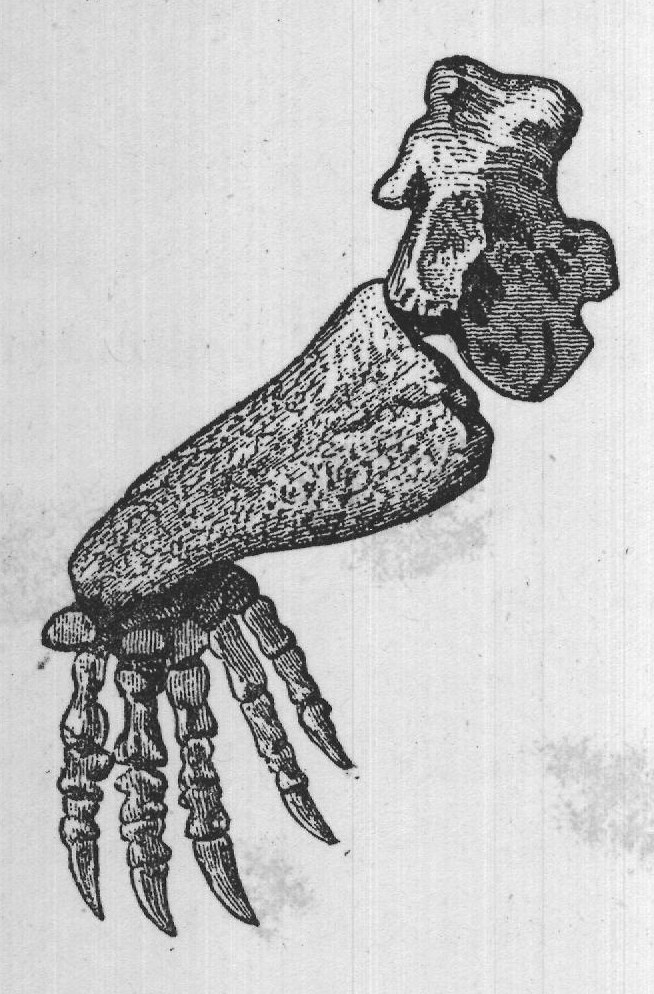
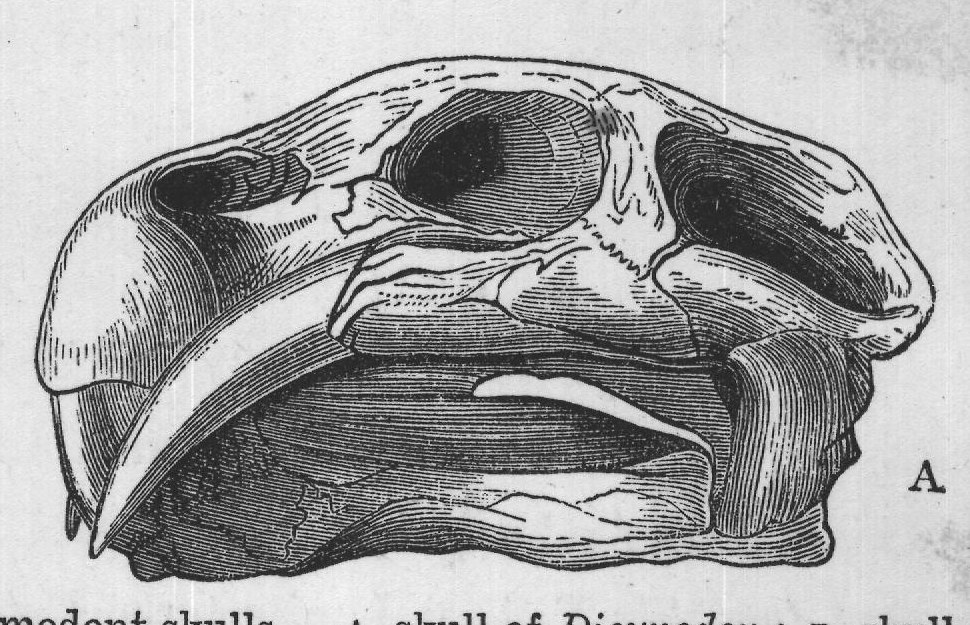
Sir R. Owen, after a careful study of these interesting remains concluded that there had formerly existed in South Africaprobably in a great lake or inland sea-a race of reptiles presenting, in the construction of their skulls, characters presented by the crocodile, the tortoise, and the lizard, but possessing a pair of long tusks implanted in distinct sockets, like those of the walrus. No other kind of teeth had they; and, as in the case of a tortoise, the lower jaw appears to have been armed by a trenchant sheath of horny matter. The tusks are of a finer texture than that of the crocodile's teeth, and almost as dense as in the hyæna (see Plate X.). These illustrations are taken from photographs very kindly sent by Professor Amalitzky, of Warsaw, who has of late years laboriously worked out nodules containing bones, skulls, etc., from Permian strata on the banks of the Northern Dwina, near Archangel; the results of his researches are of great value (see Sir E. Ray Lankester's Extinct Animals, p. 212). The head is shown in Fig. 26, and the fore limb in Figs. 27, 28. As it is, at present, hardly possible to restore the skeleton with any degree of certainty, we have not ventured to show the Dicynodon in our Plate of New Red Sandstone Reptiles (see Plate IX.). A carnivorous genus is shown in Plate XI. 1 The genus Dicynodon is so called from two Greek words: dis, twice; and kunodos, dog-toothed, on account of the two tusk-like canine teeth in the upper jaw. 2 Professor Owen's Memoir on the Dicynodon, Geol. Trans., second series, vol. vi., with plates.
Some of the arguments used by Owen in his Memoir, above referred to, may be briefly condensed as follows: The creatures to which these skulls belonged were not mammals (although to an evolutionist they are a foreshadowing of that class), both on account of the double nasal apertures, one of which is seen in Fig. 26; and also because no mammal has a brain-cavity so relatively small. They were not crocodiles, as indicated by certain other features of the skull. They were not turtles or B A FIG. 26.-Anomodont skulls. A, skull of Dicynodon; B, skull of Oudenodon, from Karoo strata, South Africa. (After Owen.) tortoises, for all such reptiles have a single nasal opening placed in the middle of the fore part of the skull. They could not be fishes, for fishes breathe in quite a different way. Neither could they be batrachians (frogs, etc.), nor yet snakes, as is also proved by the structure of their skulls. Certain other features of the skull show a relationship with the Lacertilians, or true lizards. The skulls are mostly of small size; but that of Dicynodon tigriceps is as much as twenty inches in length. That of PLATE X. 1. SKULL OF DICYNODON. PALATAL ASPECT. 2. SKULL OF DICYNODON TRAUTSCHOELDI.
From photographs kindly sent by Prof. Amalitzky of Warsaw. D. lacerticeps ("lizard-headed," Fig. 26) is only six inches long. Dicynodonts have since been found in the Gondwana series in Central India, and in the Elgin Sandstone, Scotland. The vertebræ, or joints of the backbone, are hollow on both sides (biconcave)-a feature common to fishes and Labyrinthodonts. Probably they were good swimmers, and spent much of their time in the water; but it is quite clear that they FIG. 27. Fore limb of Dicynodon. (After Owen.) FIG. 28.-Arm-bone (humerus) of Dicynodon. 1/4 natural size. (After Owen.) were air-breathers, and so must have come up to the surface to breathe.