Home › Giant Sloths and Armadillos › Giant Sloths and Armadillos: Buenos
Giant Sloths and Armadillos: Buenos
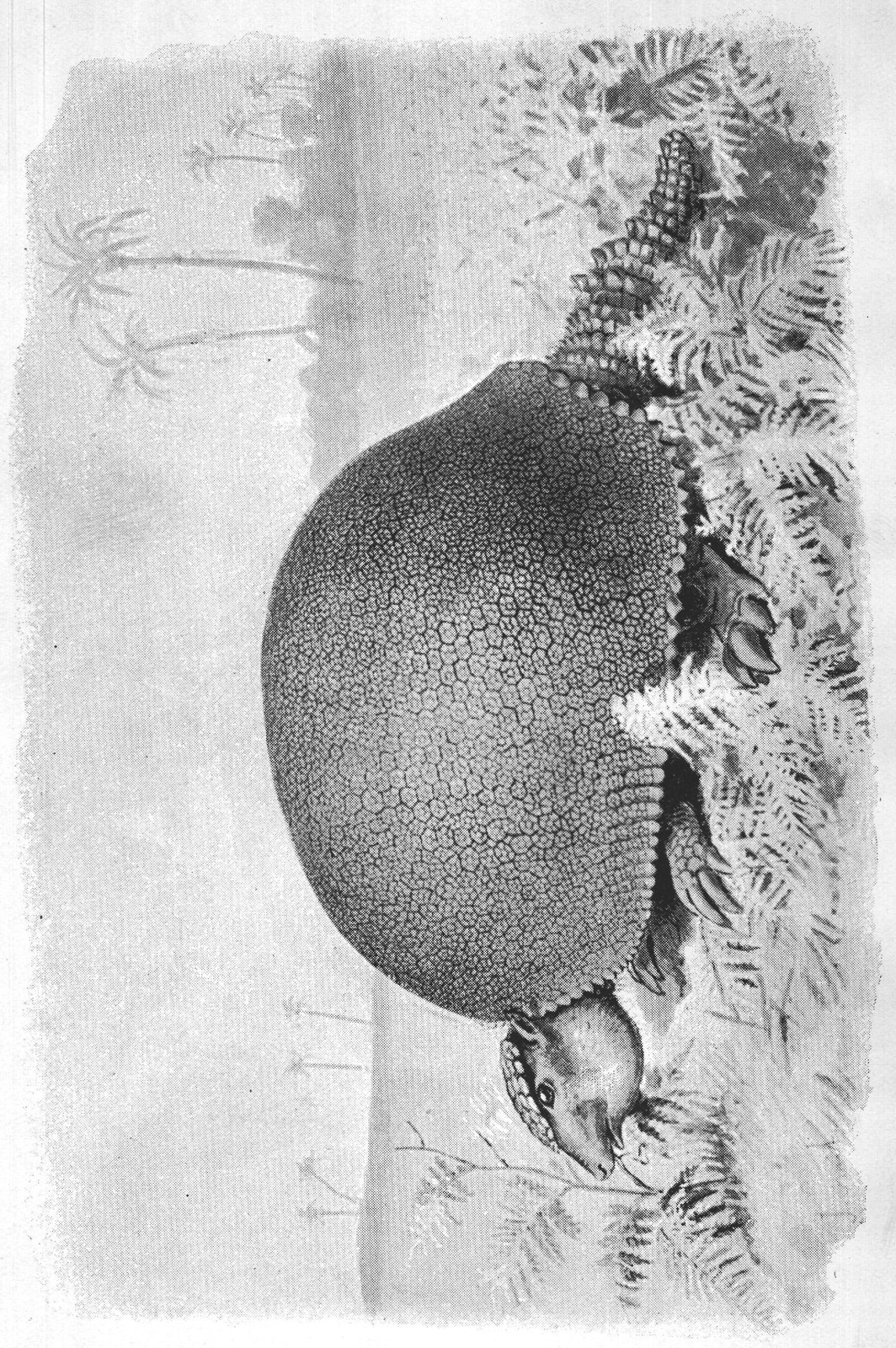
Plate LII. represents Glyptodon clavipes (Owen) from the Pleistocene deposits of Buenos Ayres; but the reader will gain a much better idea of the animal by inspecting the splendid specimen of Glyptodon asper in the Natural History Museum, near the centre window at the East end of the Gallery of fossil mammals. Plate LIII. is a restoration of another species by our artist.2 In the Museum of the Royal College of Surgeons (which the reader is recommended to visit) there are several most valuable specimens of these extinct armadillos from South America. 1 Greek-Hoplon, armour; phero, I bear. 2 This plate is based on a beautiful drawing in a Spanish work, Anales del Museo publico de Buenos Aires. G. Burmeister, M.D., Phil. D. Tomo Segundo. PLATE LIII.
A GIGANTIC ARMADILLO, GLYPTODON ASPER. PLEISTOCENE PERIOD. SOUTH AMERICA. From Buenos Aires. Length 8 feet 7 inches. 1 Armadillos belong, with sloths and ant-eaters, to the same family of so-called toothless animals (edentata) with no front teeth, though one or two forms really are toothless. Those of the present day have their bony armour divided up into a series of bands, so that they can roll themselves up, more or less, into balls. They burrow under the ground, where they get their food to a certain extent, and live a safe life, protected by their casque of mail. Their only enemies seem to be the monkeys, and one of the tricks of the young monkeys in the American forests is, when they find an armadillo away from home, to pull its tail unmercifully, and try to drag it about. Snakes cannot hurt them. Mr. W. H. Hudson, in his most interesting book, A Naturalist in La Plata, narrates how he watched an armadillo kill a snake and then devour it.
If we examine the anatomy of the armadillo, we shall find that its bones greatly resemble those of the sloth, but still there are a few differences. It is a burrowing animal, and therefore requires great power of scratching and tearing the ground. Why the colossal forms of armadillo should have become extinct and only small ones survived to the present time, is one of the many and perplexing problems presented by the study of extinct animals. One would have thought from its size and strength that the Glyptodon had been built, like Rome, for eternity.¹ 1 The reader who is interested in evolution is strongly recommended to read the very interesting and suggestive address of Dr. A. Smith Woodward, F.R.S., to the Geological section of the British Association, 1909 (Winnipeg Meeting). • In this paper the writer speaks of the symptoms of old age in races. One of these is loss of teeth, shown in tortoises, birds, monotreme mammals of Australia, and in the Ichthyosaurs. Another is degeneration into eel-like forms, and another is a superfluity of dead matter in the shape of spines or bosses, armour plate, and big horns, like those of the Irish deer (Cervus giganteus).
M