Home › Ancient Salamanders › Ancient Salamanders: Texas
Ancient Salamanders: Texas
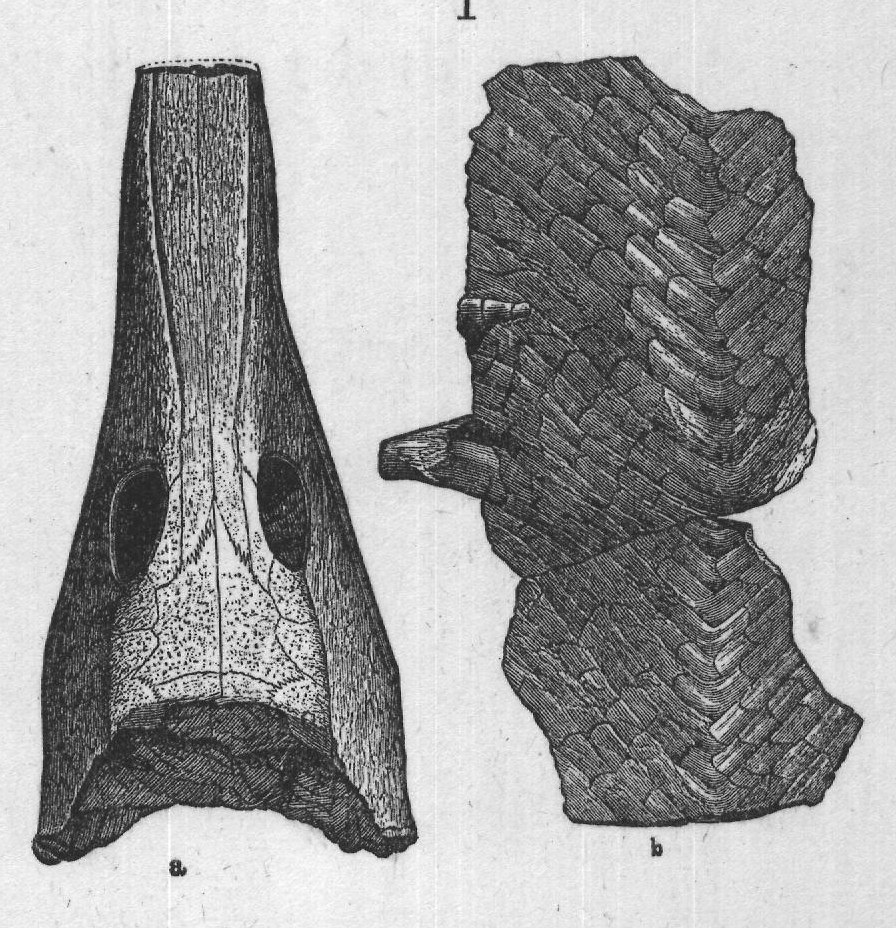
Cricotus is an American genus described by Professor Cope, from the Permian strata of Texas. The skull and some of the scales belonging to the under surface of the body are shown in Fig. 19. The Eryops, of which the skull is shown in the same figure, is considered by Professor Seeley to belong to a higher, though related group, the Anomodonts (Chap. VII.). The one group is much connected with the other, and the question of the H classification of their various members is a difficult one, which only time and further discoveries can settle.
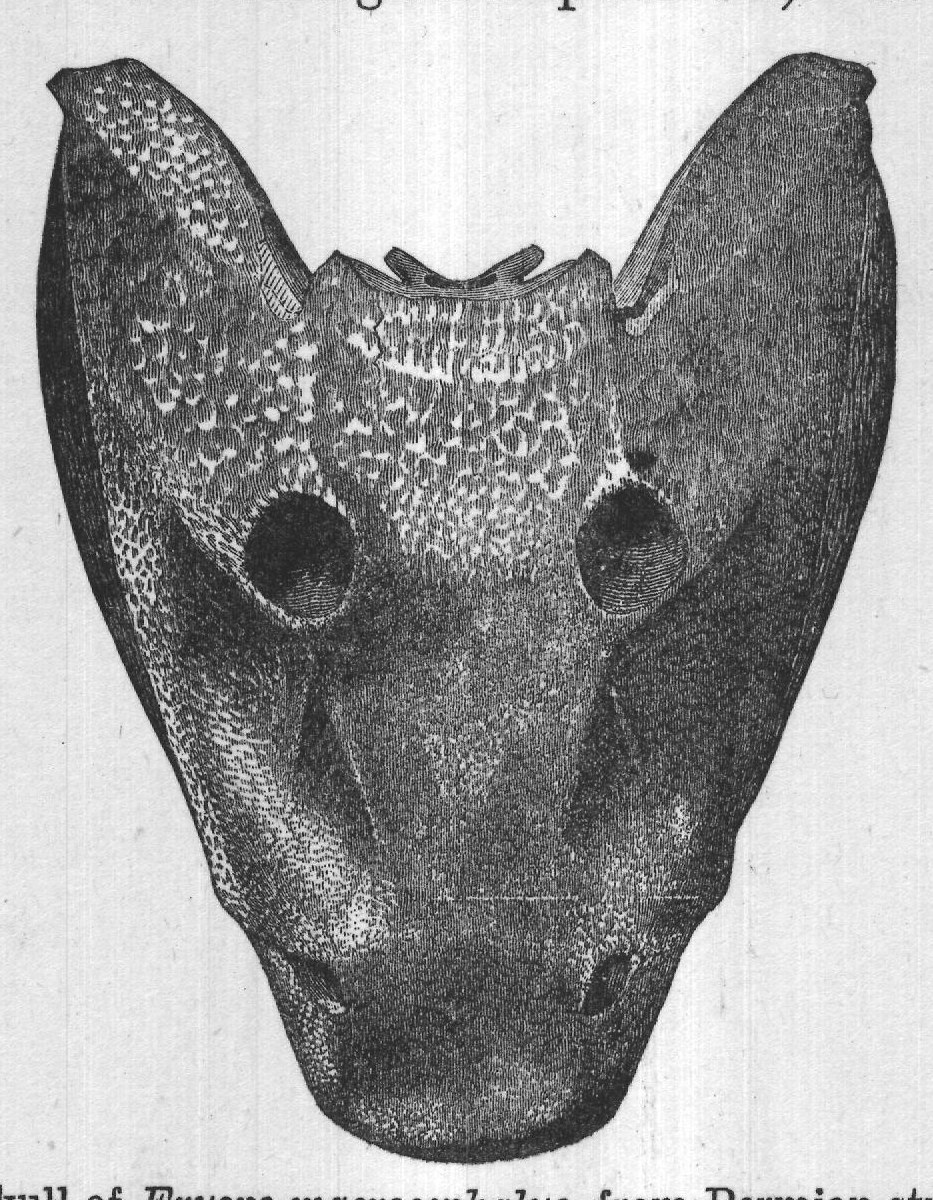
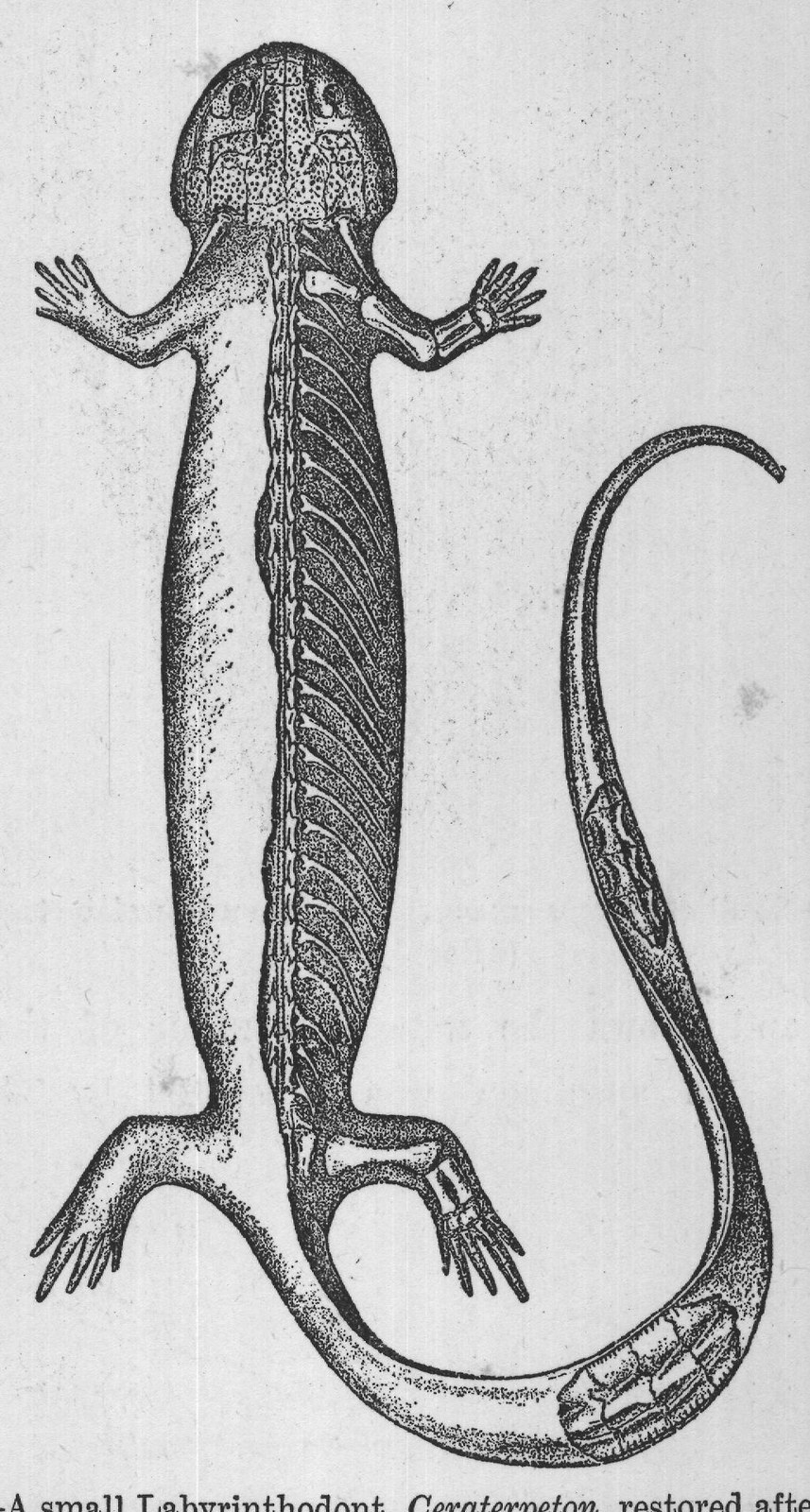
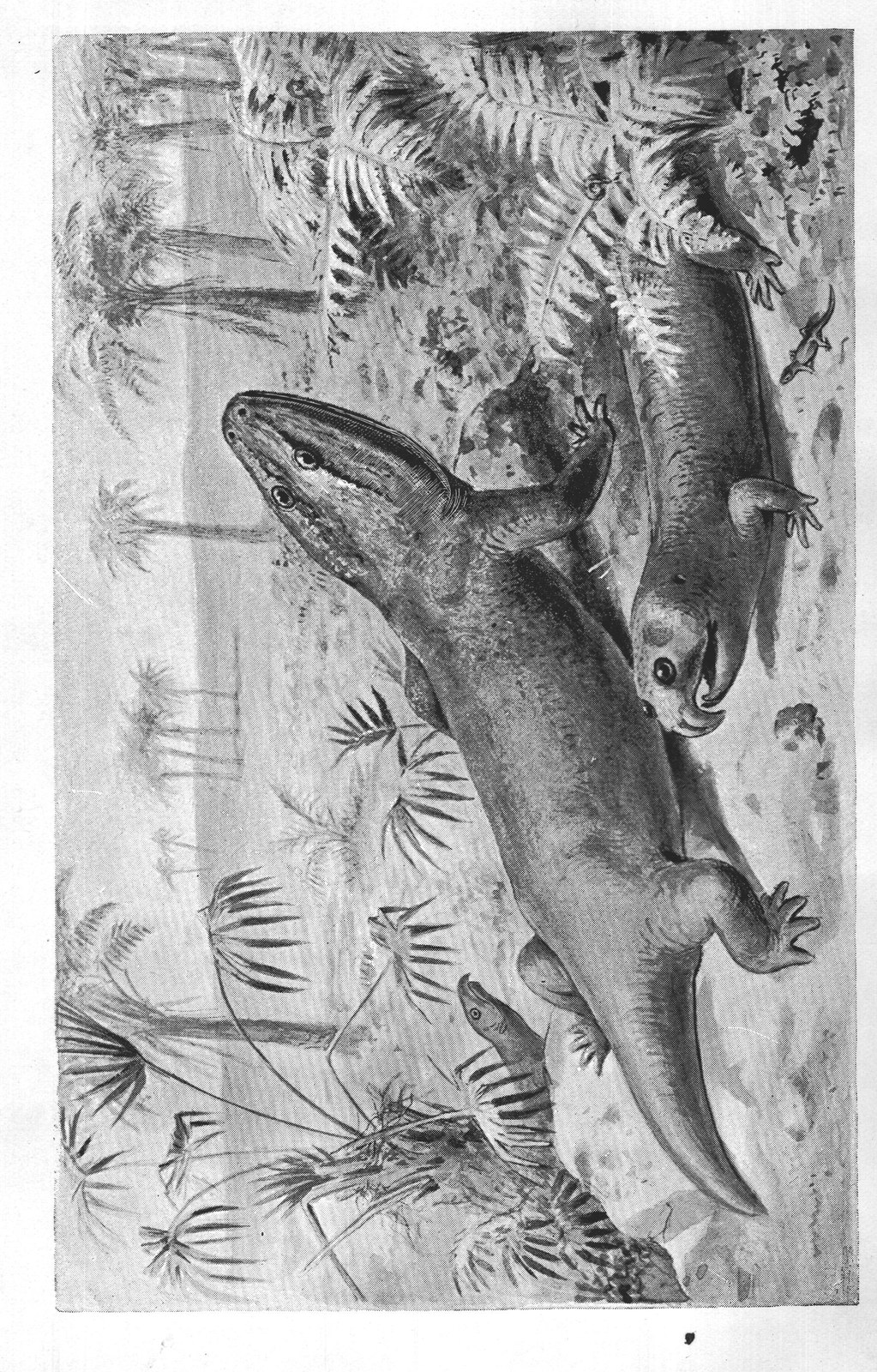
Loxomma is another genus of the Coal period, but only the head is known (see Plate VII.). It was named by Professor Huxley, who, during a visit to Edinburgh in 1862, made a study of the large collection of vertebrate fossils from Burdie House and Gilmerton in the Museum of Edinburgh. looking through the collection for fossil fishes, he came upon some specimens which were of quite a different character, and 1 While 2 FIG. 19.-Labyrinthodonts. 1, a, b, Cricotus. 2. Skull of Eryops. From Permian strata, Texas. (After Cope.) among these found part of the skull of a Labyrinthodont, which he named Loxomma. A very beautifully preserved specimen of the skull of this creature, from the coal-measures of Shropshire, is to be seen at the Natural History Museum (Gallery No. V. of the Geological Department). It is fortunately FIG. 20. Skull of Eryops macrocephalus, from Permian strata, Texas. (After Cope.) uncrushed, and shows the natural contour of the skull and lower jaw. The specimen was presented by George Maw, Esq., F.G.S. 0 FIG. 21. Skeleton of a Labyrinthodont, Actinodon, from Permian strata. (Partly after Gaudry.) In Actinodon the skull is short and wide, the nostrils are large, and the muzzle is broad. Fig. 21 is a drawing of the complete skeleton, and in the wall-case 19, Gallery V., will be found a skull preserved on a slab of shale from Permian strata in FIG. 22. A small Labyrinthodont, Ceraterpeton, restored after Fritsch, from Permian strata, Bohemia.
France. A restoration of the creature when alive is shown in Plate VII.
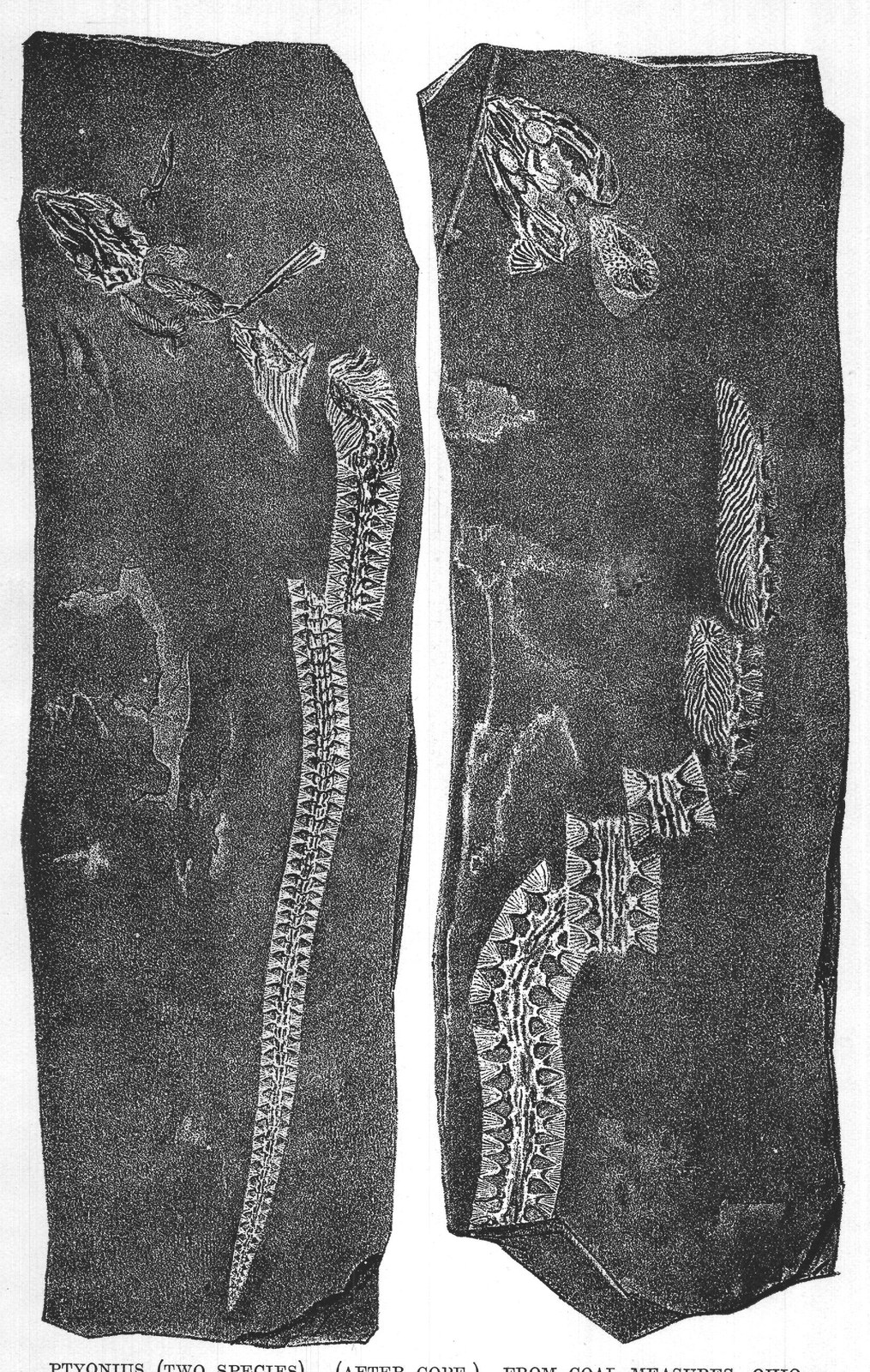
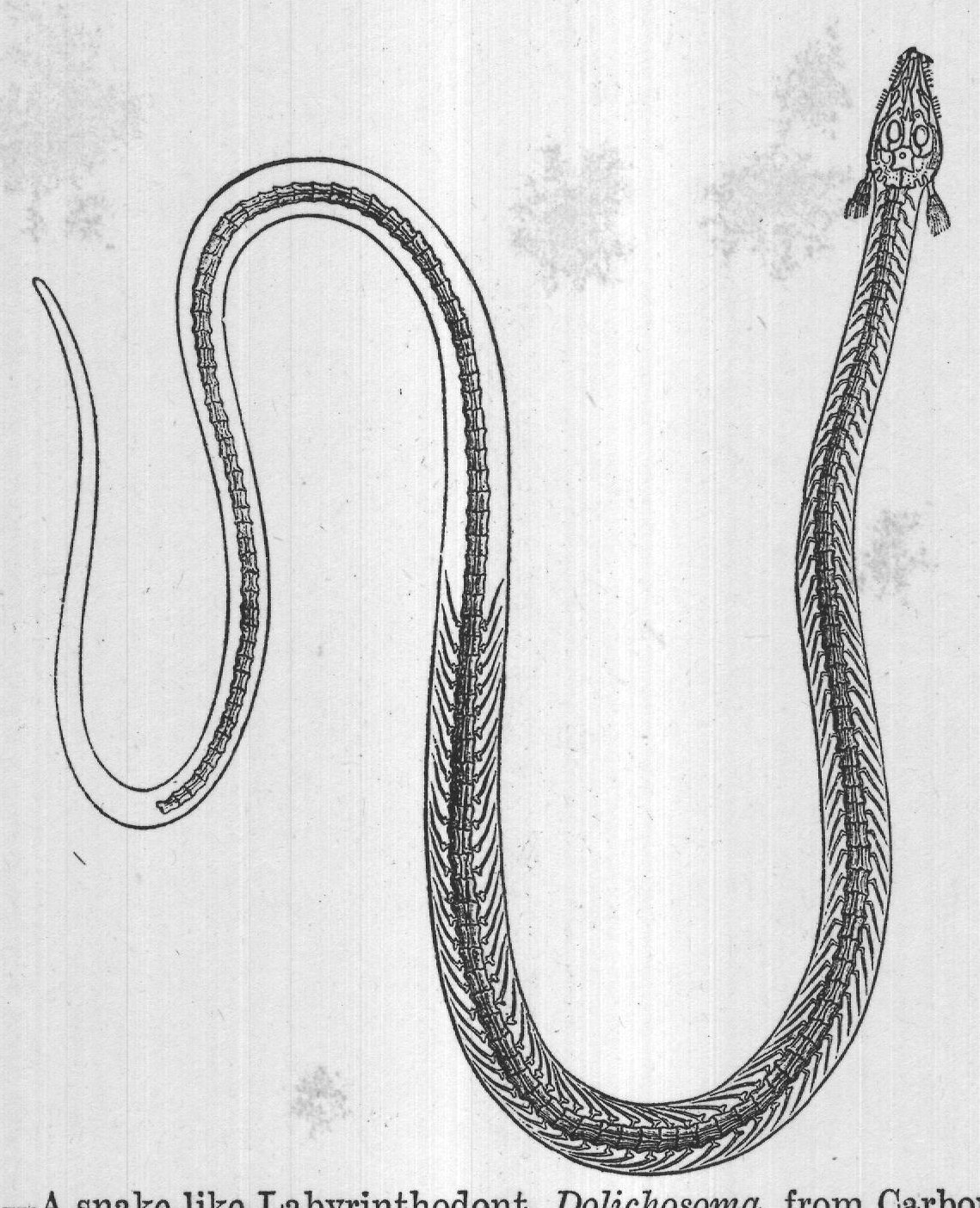
A number of small Labyrinthodonts, somewhat like salamanders, have been found in Ireland and in Bohemia. Those PTYONIUS (TWO SPECIES). (AFTER COPE.) FROM COAL MEASURES, OHIO. PLATE VIII. from the latter country are very exhaustively described by Dr. Fritsch, in a valuable monograph,¹ with many excellent illustrations. We have reproduced two of these, the Ceraterpeton and the snake-like Dolichosoma 2-both restored in Plate VII., and their skeletons shown in Figs. 22, 23. Speaking of snake-like forms, it may be mentioned that one of them-the Palæosiren FIG. 23. A snake-like Labyrinthodont, Dolichosoma, from Carboniferous strata, Bohemia. (After Fritsch.) ("ancient siren") -is estimated to have attained a length of forty-five feet. Professor Cope has written an account of a number of Labyrinthodonts from the coal-measures of Ohio, where both Professor Newberry and Professor Wyman have obtained specimens. These show great variety of form. Some resemble 1 Fauna der Gaskohle, Dr. A. Fritsch. 2 Greek-dolichos, long; soma, body.
IO2 DS 처 J P 7 R P P P Se F 3 P Sa CL ५८ P.
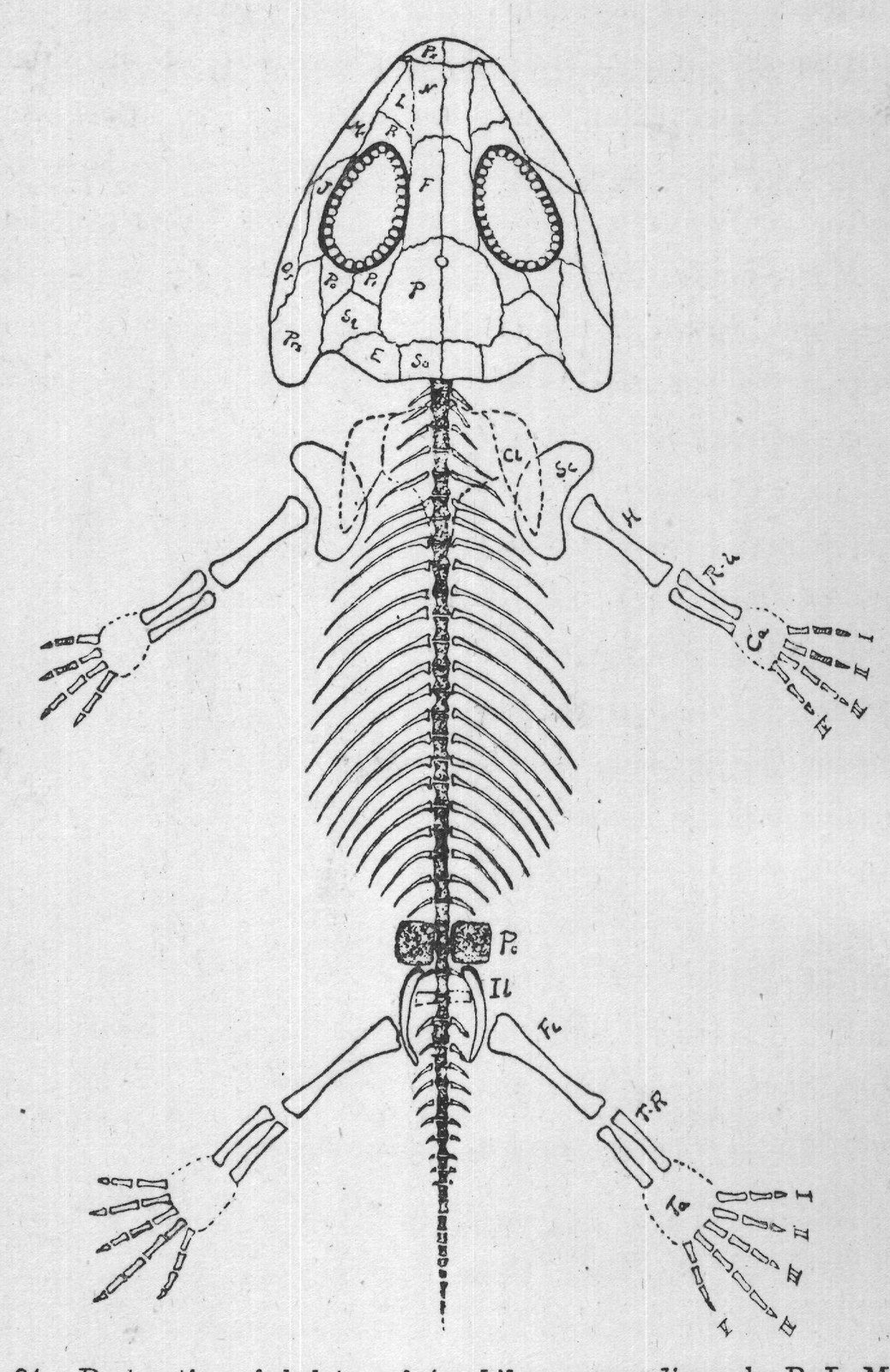
IL FL TA I I TR لم A I FIG. 24. Restoration of skeleton of Amphibamus grandiceps, by R. L. Moodie. (Journal of Geology, vol. 17.) long-limbed lizards; some have short limbs. Others, like Ptyonius (see Plate VIII.), were very elongate. The members of the Labyrinthodont order flourished over a large part of the earth's surface, from the time of the coal-forests to that of the Triassic sandstones. Their remains are found in all the great continents. The late Professor Seeley considered them to have been the ancestors of the crocodiles. Large skulls of Labyrinthodonts, such as Mastodonsaurus and Capitosaurus, have for a long time past been found in the Upper Triassic (Keuper) strata of Germany. They appear to resemble very closely a generalised Anomodont (see next Chapter).
In the writer's previous work, Creatures of Other Days, p. 70, he reproduced a restoration of the skeleton of Labyrinthodon by Professor Wiedersheim, based on a discovery made in the year 1864 in Riehen, Switzerland.
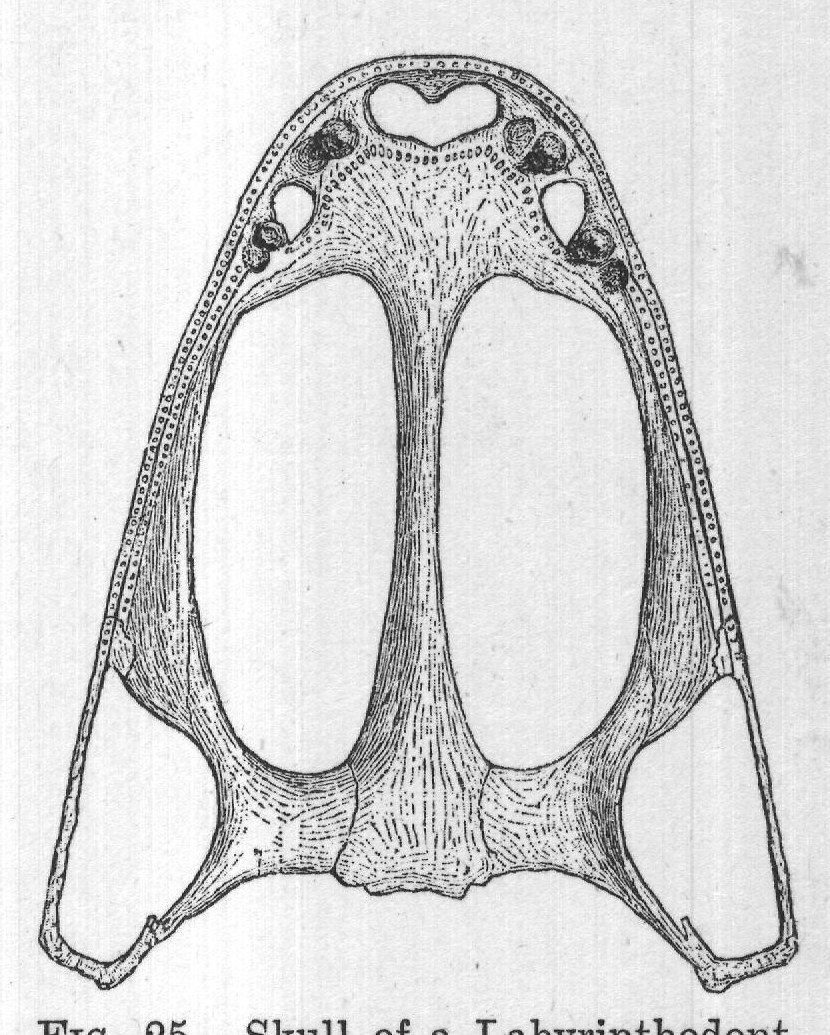
The specimen, now in the Museum at Basle, was somewhat fully described. Recent FIG. 25. -Skull of a Labyrinthodont, Cyclotosaurus (under side). researches have shown that the interpretation given by Wiedersheim was wrong, and that the bones (rather badly preserved), represent a reptile of the Anomodont order, described in Chapter VII. This figure is now replaced by a recent restoration of the skeleton of another Labyrinthodont amphibian, viz. the Amphibamus of Mr. R. L. Moodie. Let the reader compare this with the skeleton of a true reptile, and he will at once see how primitive it is.
True Salamanders are known in a fossil state. There is the famous Andrias Scheuchzeri, about three feet long, found in 1725, and described by Scheuchzer as the skeleton of a man. He called it Homo Diluvii Testis, or, "the man who witnessed the Deluge." Cuvier, in 1811, announced its true nature. REPTILES AND AN AMPHIBIAN OF THE NEW RED SANDSTONE PERIOD. Rhynchosaurus.
Mastodonsaurus.
Hyperodapedon.
Telerpeton.
PLATE IX.