Home › Armoured Dinosaurs and the Iguanodon › CHAPTER IX: Hylæosaurus
Armoured Dinosaurs and the Iguanodon: Hylæosaurus
The next monster to be described is one that has fortunately left to posterity a good record of itself, and probably was not very unlike the Hylæosaurus of Mantell. This is the 1 The sacrum may be thus defined: the Vertebræ (usually fused together) which unite with the haunch-bones (ilia) to form the pelvis. DINOSAURS 1 Scelidosaurus: so named by Professor Owen from the indications of greater power in the hind legs than in most saurians. It is the only known example of an almost entire skeleton of an English Dinosaur, and the history of its discovery is rather curious. Some time previous to 1861, Mr. J. Harrison, of Charmouth, obtained from the Lower Lias of that neighbourhood portions of the hind limb of a Dinosaur, and, later on, a nearly complete skull. These specimens were described by Owen, and the genus was founded on them. Mr. Harrison, whose discovery aroused great interest, continued to search on the same spot, and was rewarded by finding all the rest of the skeleton, except most of the neck vertebræ. This was extracted in several blocks, and these, after careful "development" of the bones, were fitted together so as to exhibit the whole skeleton. This most valuable specimen can now be seen at South Kensington in a separate glass case, and is one of the treasures of the unrivalled gallery of fossil reptiles. (The case is placed so that both sides of the specimen can be seen.) Its length is about twelve feet; perhaps the individual it represents was not fully grown, but, on account of the absence of most of the neck vertebræ, it is impossible to give the exact length. Both hind limbs are entire and well seen, but of the fore limbs the hands are wanting. The former were provided with four "functional" toes-that is, toes that were used, and one "rudimentary" or unused one. There were two big spines, one placed on each shoulder, and a series of long plates arranged in lines along the back and side.
Another Dinosaur, of considerable dimensions, which flourished during the Wealden period was the Hylæosaurus, discovered by Dr. Mantell, and so named by him because it came from the Weald. 1 From Greek-scelis, limb, and sauros, lizard.
Between 1832 and 1837 he discovered three specimens showing ribs, limb-bones, vertebræ (of the tail), bony plates, and spines. Unfortunately the skull and teeth are unknown; but the tail appears to have been nearly six feet long. Mr. Waterhouse Hawkins's model in the grounds of the Crystal Palace, at Sydenham, near that of the Iguanodon, is rather a premature attempt at restoration.
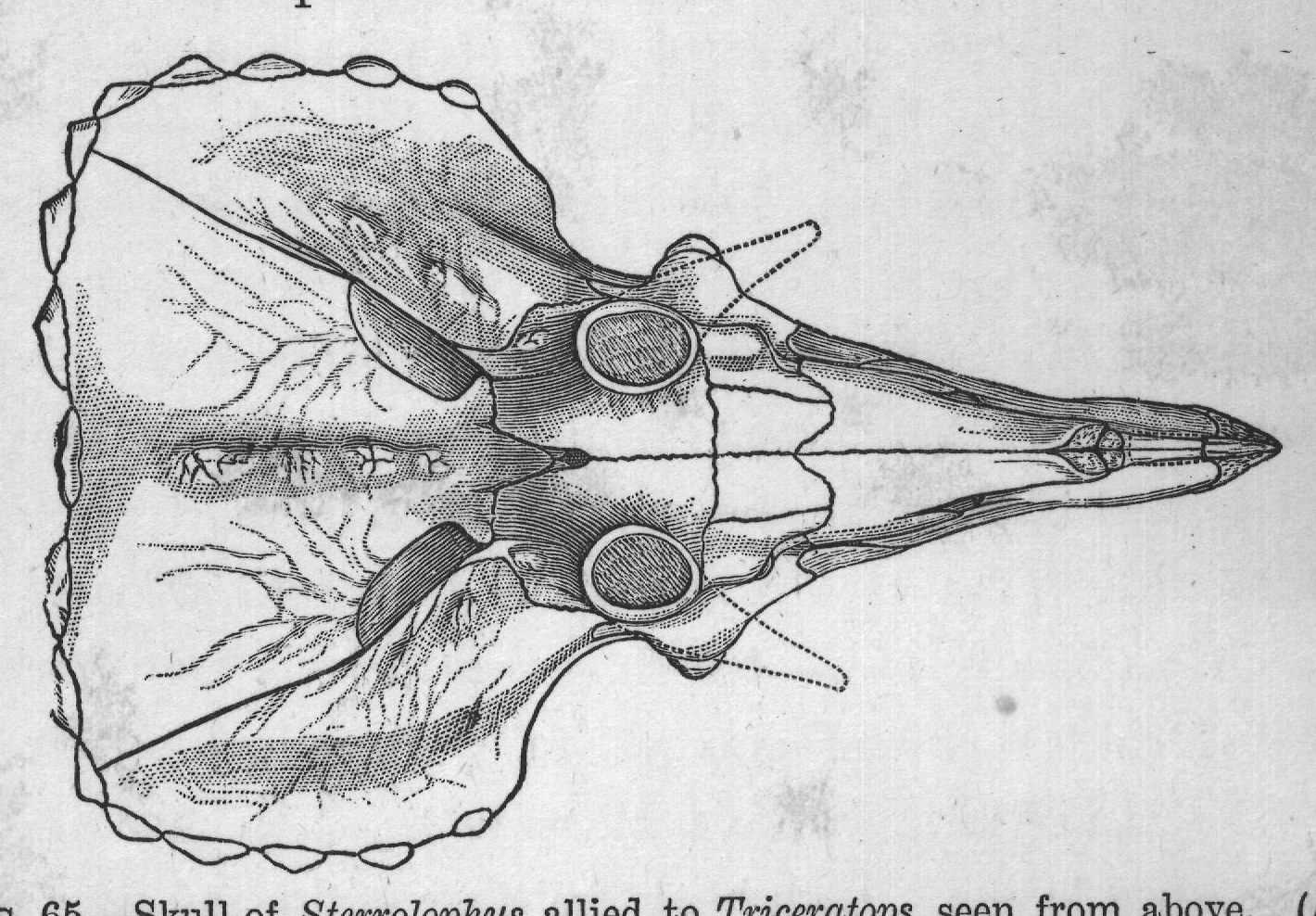
The last, and in some ways the strangest of the Dinosaurs, was the Triceratops¹ that flourished in America at the end of the FIG. 65. Skull of Sterrolophus allied to Triceratops, seen from above. (After Marsh.) long Mesozoic era, during the Cretaceous period. The name refers to the three horn-cores found on the skull, which probably supported true horns like those of oxen. Whereas the Stegosaur was provided with quite a small skull, this monster had one of huge dimensions and remarkable shape (see Fig. 65 and Plates XXVII. and XXVIII.). In the younger ones it was about six feet long, but in an old individual must have reached a length of seven or eight feet. Such a skull is only surpassed by some whales of 1 Greek-treis, three; ceras, horn; ops, face.