Home › Armoured Dinosaurs and the Iguanodon › CHAPTER IX: Iguanodon
Armoured Dinosaurs and the Iguanodon: Iguanodon
Dr. Mantell also was the first to prove, from the nature of the Wealden strata, that they were deposited in or near the estuary of a mighty river. With regard to the aspect of the country in which the Iguanodon flourished, he showed that coniferous trees probably clothed its Alpine regions; palms and arborescent ferns, and cycadaceous plants (i.e. plants resembling the modern zamia or "false palm") constituted the groves and forests of its plains and valleys; and in its fens and marshes the equisetacea (mare's tails) and plants of a like nature prevailed. Since the days of Dr. Mantell, the remains of Iguanodon or other closely allied genera have been found on the Continent, in England, and North America, in strata of various ages, from the Trias or New Red Sandstone to the Chalk (see Table of Strata, Appendix I.). The American Hadrosaurus must have been an allied form.
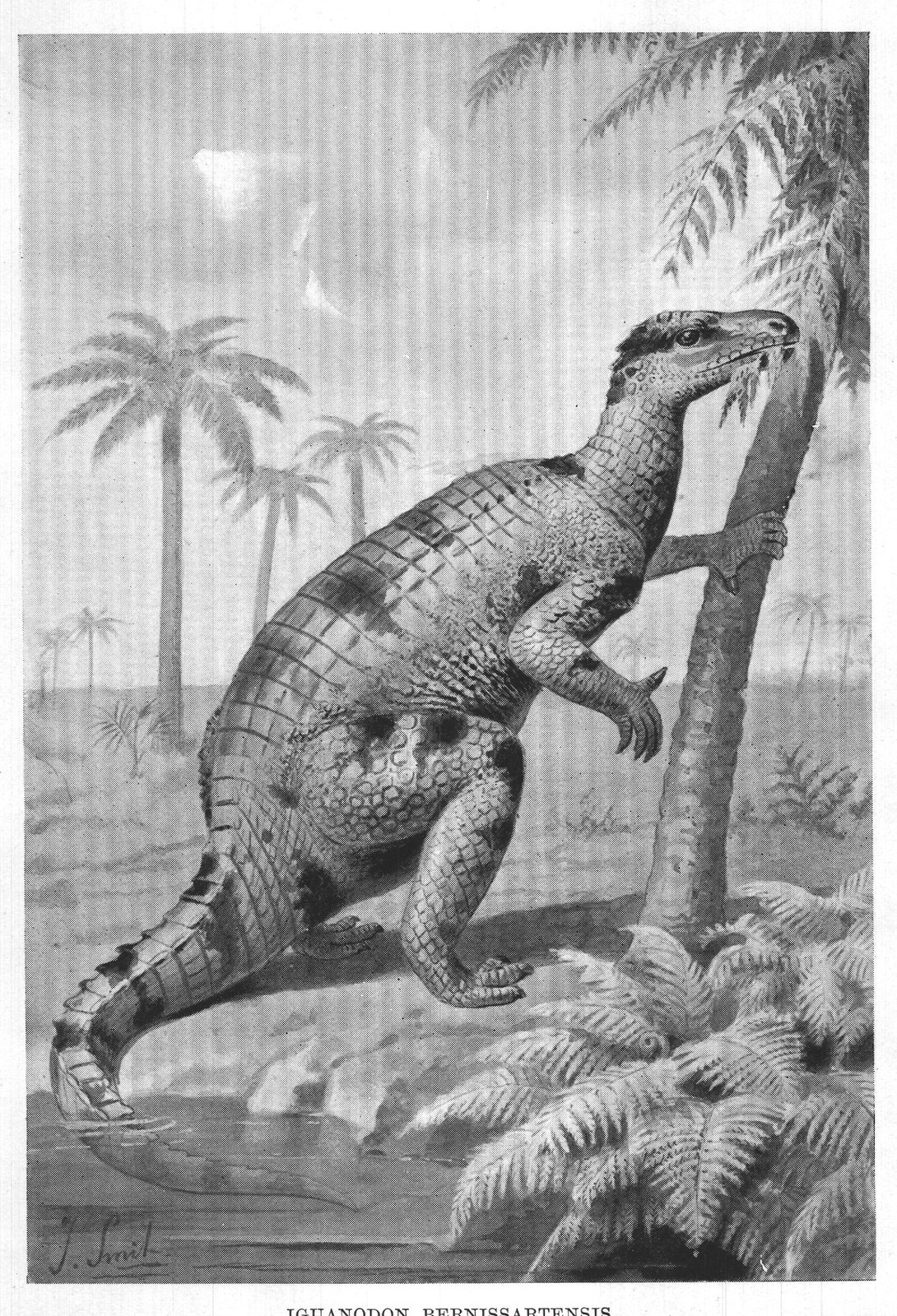
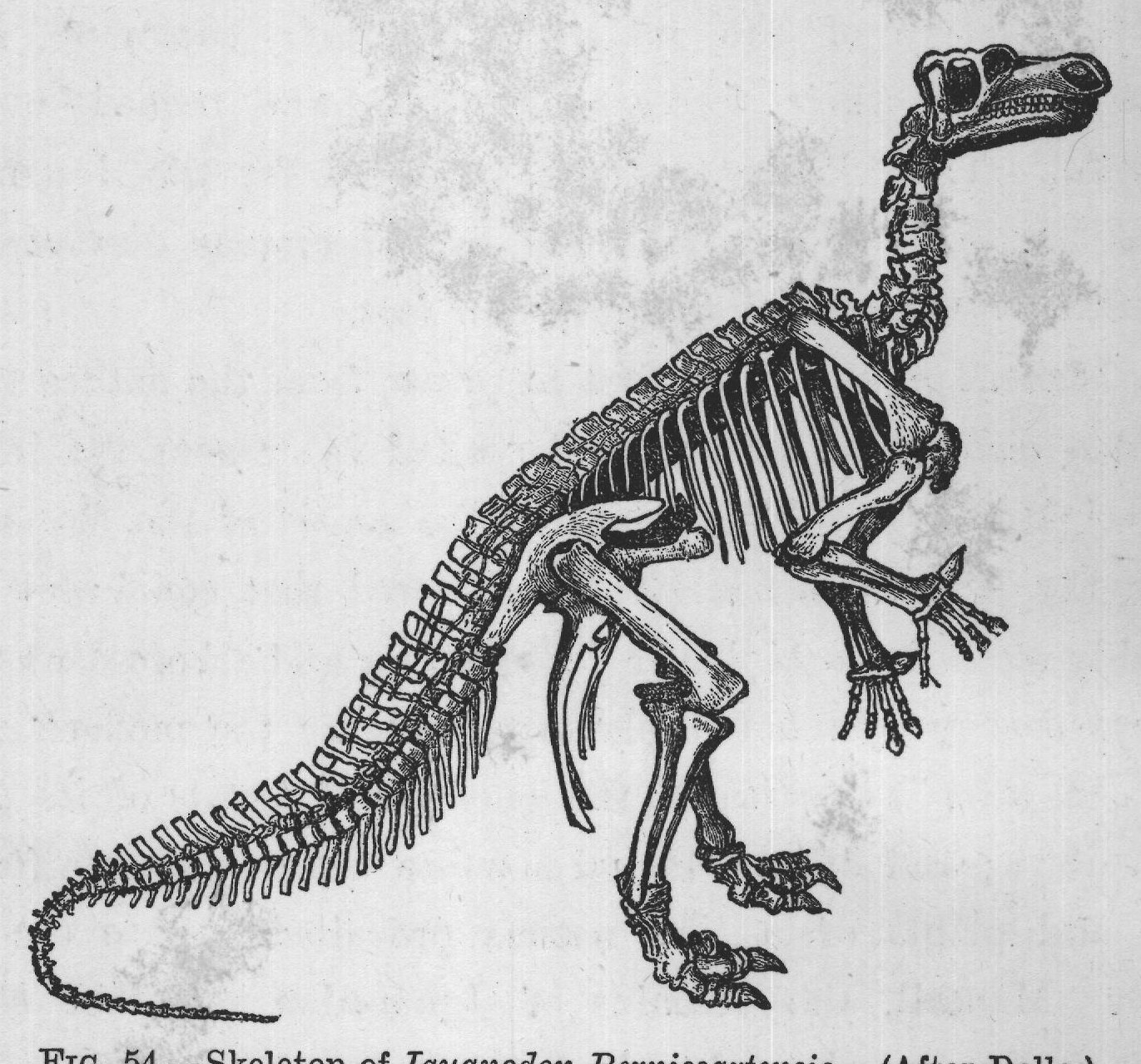
In the year 1878 was announced one of the most fortunate discoveries known in the whole history of geological sciencea discovery unique of its kind, and one which throws considerable light on the nature of the monster first discovered by Dr. Mantell. In that year came the good news that no less than twentythree Iguanodons had been found in the colliery of Bernissart, in Belgium, between Mons and Tournai, near the French frontier. The specimens so skilfully set up by M. de Pauw represent two distinct species. The larger one, Iguanodon Bernissartensis, cannot be less than fifteen feet high, and, measured from the tip of the snout to the end of the tail, is rather over thirty feet long, FIG. 54. Skeleton of Iguanodon Bernissartensis. (After Dollo.) covering nearly twenty-four feet of ground in its erect position (see Fig. 54). Iguanodon Mantelli is smaller and more slender looking, with a height of over ten feet, and a length of about twenty feet. (See Fig. 55.) The huge three-toed impressions found in Sussex (see p. 166) prove that the monster, although owning a body as large as that of an elephant, habitually walked on its hind legs! Some of the thigh-bones found by Dr. Mantell measured between four and five PLATE XXIII.
IGUANODON BERNISSARTENSIS.
Length about 30 feet.