Home › The Dragons of Old Time-Dinosaurs › The Dragons of Old Time-Dinosaurs: Megalosaurus
The Dragons of Old Time-Dinosaurs: Megalosaurus
To begin with Megalosaurus. In the year 1824 that keen observer and original thinker, the Rev. Dr. Buckland, described to the Geological Society of London some remains of a very strange and formidable reptile found in the Limestone of Stonesfield, near Woodstock (about twelve miles from Oxford). This rock, known as "Stonesfield slate" from its property of splitting up into thin layers, has long been celebrated for its fossil remains, and from it have been also obtained the bones of some early mammals. It is a member of the Lower Oölitic group.
The portions of skeleton originally discovered consisted of part of a lower jaw, with teeth, a thigh bone (femur), a series of vertebræ of the trunk, a few ribs, and some other fragments. The name Megalosaurus, or "great lizard," suggested itself both to Dr. Buckland and Baron Cuvier, because it was evident from the size of the bones that the creature must have been very big. It is true these bones were not found together in one spot; but Professor Owen came to the conclusion that they all belonged to the same species. ) A LARGE-HORNED DINOSAUR, CERATOSAURUS, FROM NORTH AMERICA. JURASSIC PERIOD. PLATE XIV.
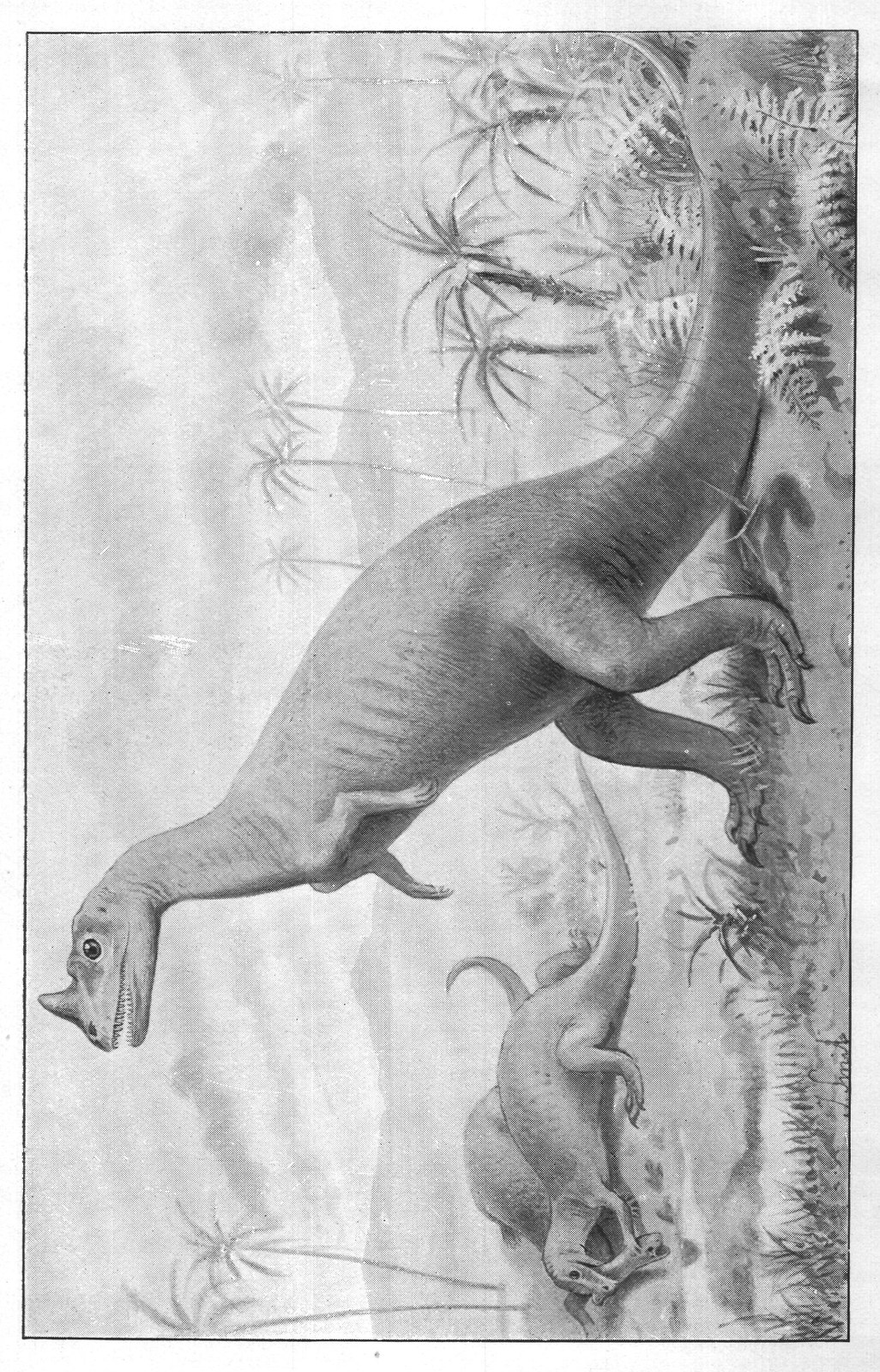
DRAGONS OF OLD TIME No entire skeleton of the Megalosaur has ever been found, but there was enough material to enable Dr. Buckland, Professor Owen, and Professor Phillips to form a very fair idea of its general structure. But Ceratosaurus (p. 137) is completely known. It should be mentioned here that Dr. Mantell, the enthusiastic geologist to whose labours palæontologists are greatly indebted, had previously discovered similar teeth and bones in the Wealden strata of Tilgate Forest. Sherborne, in Dorset, is another locality which has yielded a fine specimen of parts of both jaws with teeth. A cast of this may be seen in the geological collection at South Kensington.
FIG. 42. Lower jaw-bone of Megalosaurus, with teeth. The portion of a lower jaw in the Oxford Museum is twelve inches long, with a row of nine teeth, or sockets for teeth.
The structure of the teeth leaves no doubt as to the carnivorous habits of the creature. With a length of perhaps thirty feet (see p. 139), capable of free and rapid movement on land, with strong hind limbs, short head, with long pointed teeth, and formidable claws to its feet, the Megalosaur must have been without a rival among the carnivorous reptiles on this side of the world. It probably walked for the most part on its hind legs, as depicted in our illustration, and Professors Huxley and Owen, on examining the bones in the Oxford Museum, were much impressed with the bird-like character of some parts of the skeleton, showing an approach to the ostrich type. The form of the teeth, as pointed out by Dr. Buckland, exhibits a remarkable combination of contrivances.
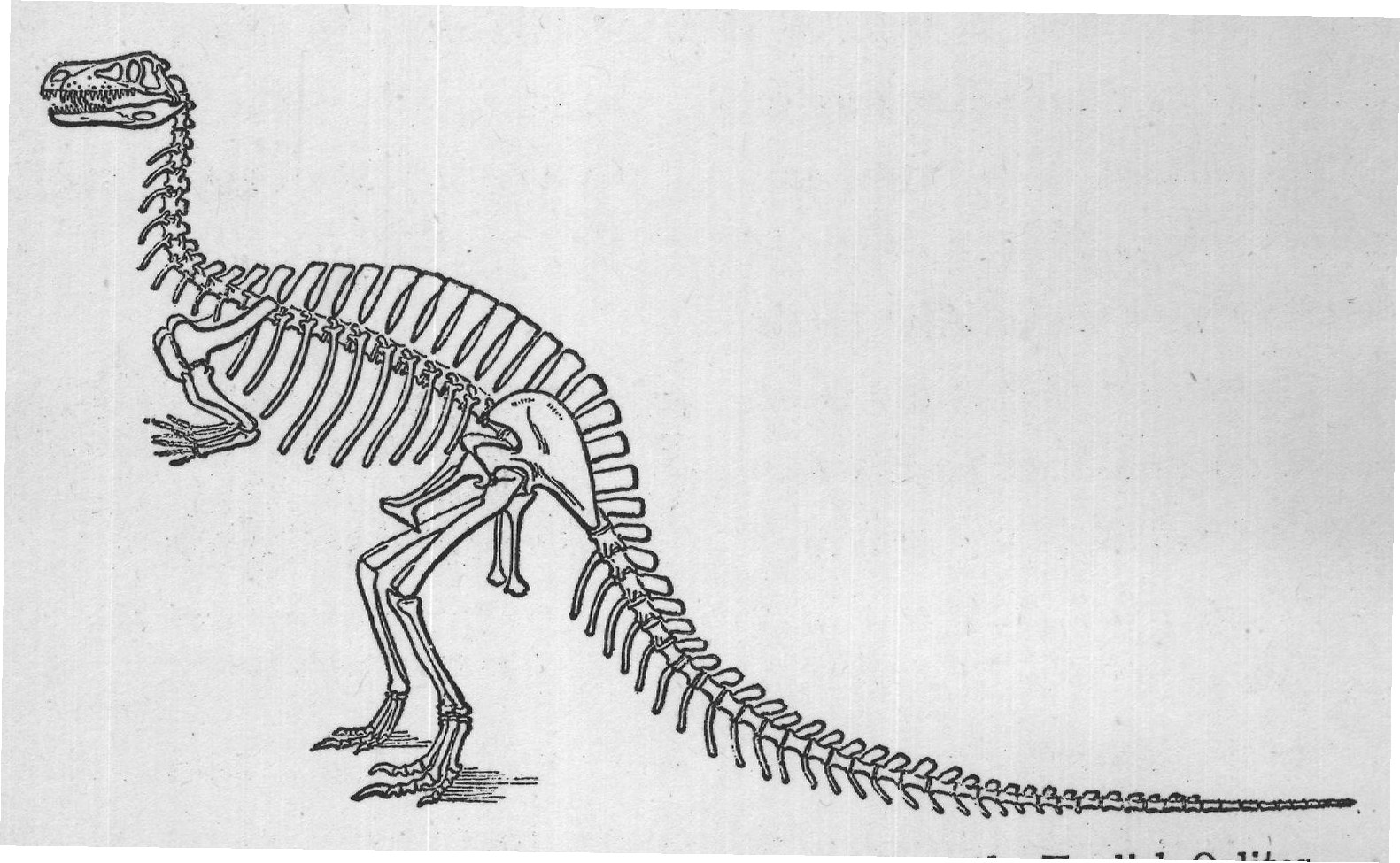
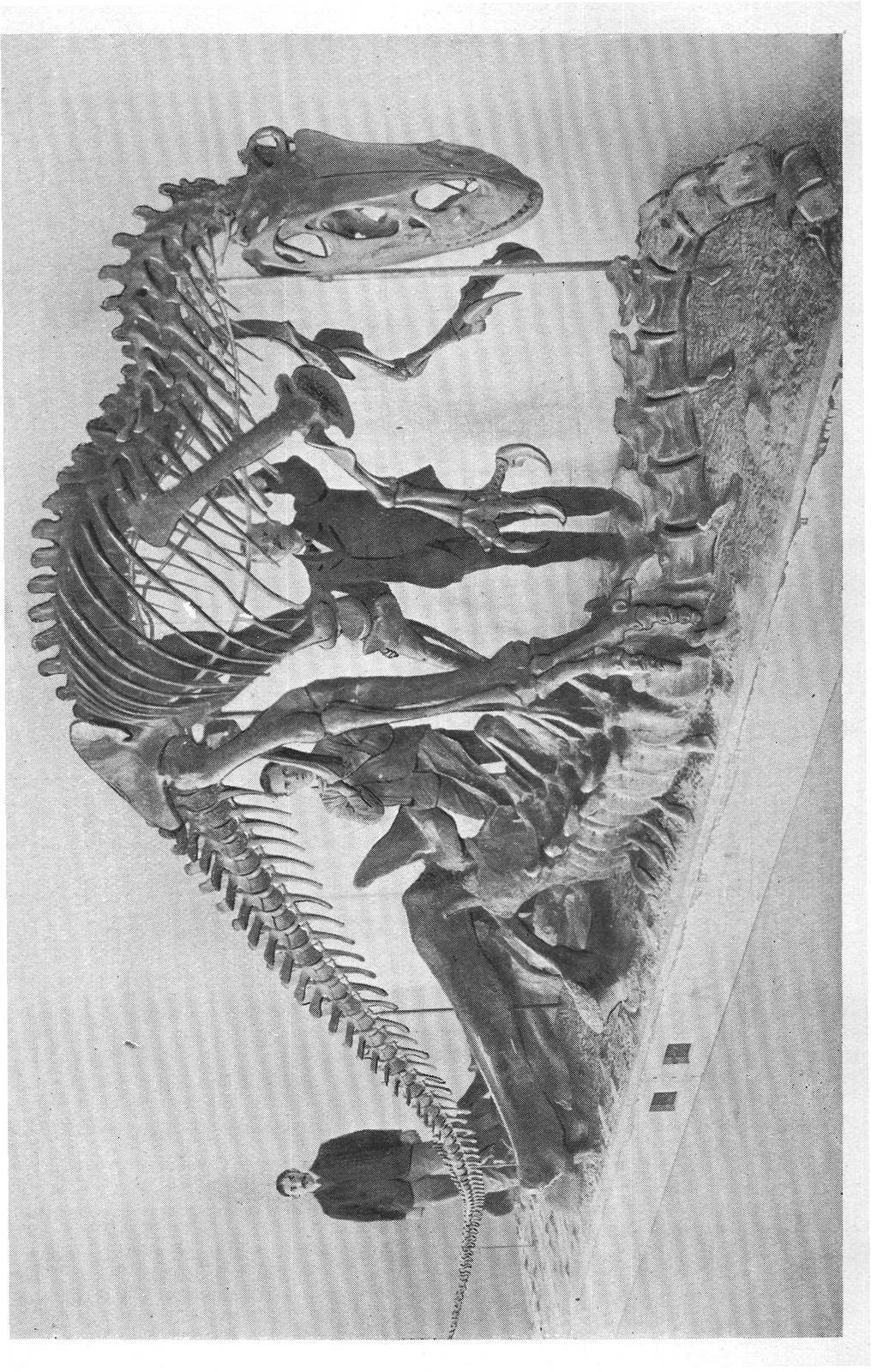
The genus Megalosaurus-now rendered classic through the labours of Professors Buckland, Phillips, Owen, and Marshmay be regarded as the type of the carnivorous Dinosaurs; and it affords an excellent and instructive instance of the gradual restoration of the skeleton of a new monster from more or less fragmentary remains. Certain very excusable errors were at first made in the restoration, but these have since been rectified by a comparison with the allied American forms, such as Allosaurus (see Plate XV.), of which nearly entire skeletons have of late been discovered in strata of Jurassic age-in fact, the same rock in FIG. 43. Skeleton of Megalosaurus, restored from the English Oolites. Colorado as that in which the huge Atlantosaurus bones lay hid. The accompanying woodcut (Fig. 43) shows how the skeleton has been restored in the light of these later discoveries of Professor Marsh. The large bones of the limbs were hollow, and many of the vertebræ, as well as some of those of the feet, contained cavities, or were otherwise lightened in order to give a greater power of rapid movement.
It is not very difficult to imagine a Megalosaur lying in wait for his prey (perhaps a slender, harmless little mammal of the PLATE XV.
SKELETON OF HUGE CARNIVOROUS DINOSAUR, ALLOSAURUS.
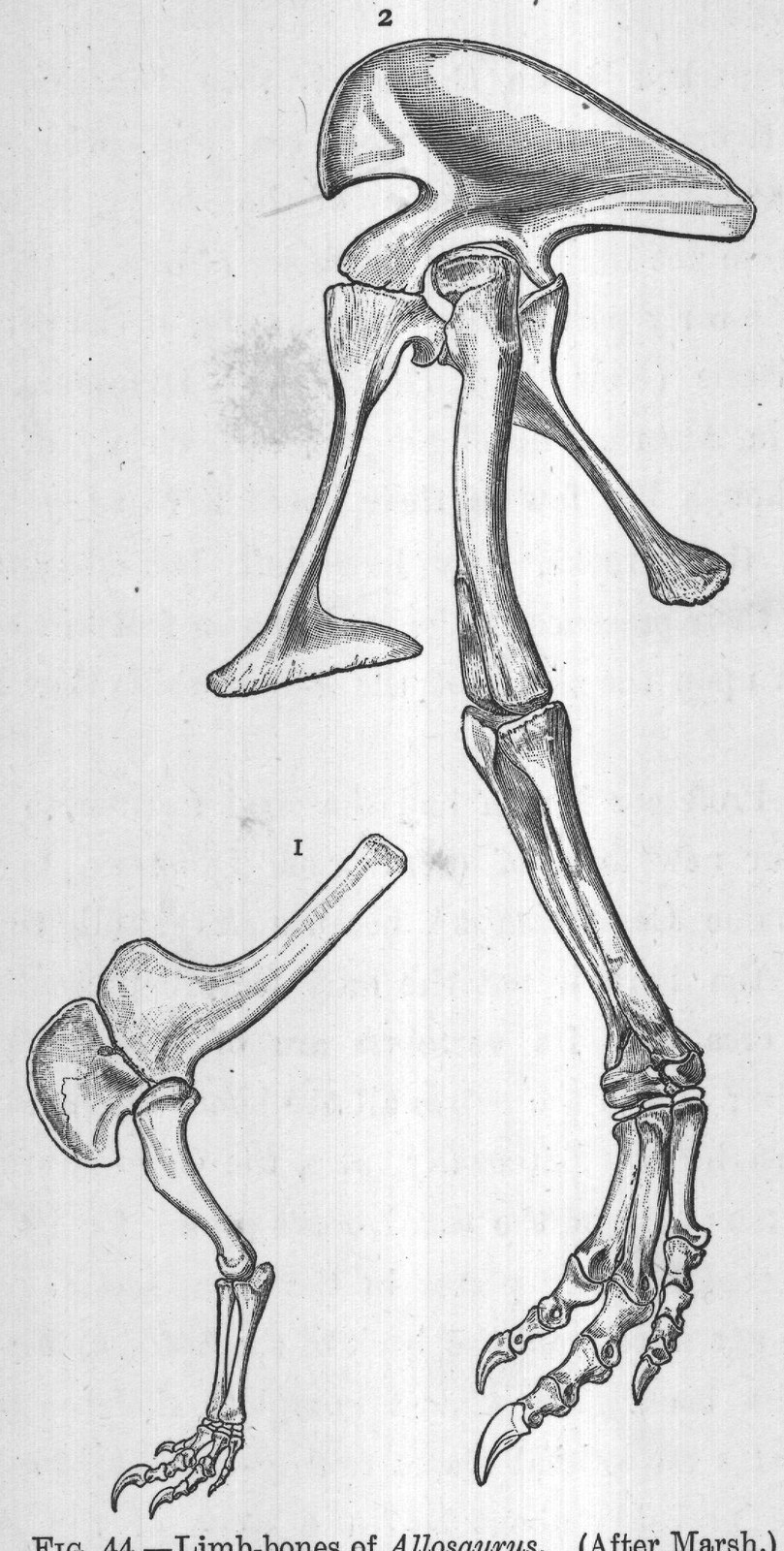
Reproduced by permission of the American Museum of Natural History and Prof. Henry Fairfield Osborn. DRAGONS OF OLD TIME ant-eater type) with his hind limbs bent under his body, so as to bring the heels to the ground, and then with one terrific bound 2 I FIG. 44. Limb-bones of Allosaurus. (After Marsh.) 1. Fore leg. 2. Hind leg. from those long legs springing on to the prey, and holding the mammal tight in its clawed fore limbs, as a cat might hold a mouse. Then the sabre-like teeth would be brought into action by the powerful jaws, and soon the flesh and bones of the victim would be gone!
As we remarked before, the carnivorous Dinosaurs were the lions and tigers of the Mesozoic era, and, what with small mammals and numerous reptiles of those days, it would seem that they were not limited in their choice of diet.
During the early part of the Mesozoic era, at the period known as the Triassic (New Red Sandstone), Dinosaurs flourished vigorously in America, developing a great variety of forms and sizes. Although but few of their bones have as yet been discovered in those rocks, they have left behind unmistakable evidence of their presence in the well-known footprints and other impressions upon the shores of the waters which they frequented (see p. 48).