Home › The Dragons of Old Time-Dinosaurs › The Dragons of Old Time-Dinosaurs: Ceratosaurus
The Dragons of Old Time-Dinosaurs: Ceratosaurus
The late Professor Marsh had the good fortune to discover a very peculiar new form of carnivorous Dinosaur, to which he gave the name Ceratosaurus, because its skull supported a horn. But the horn is not the only feature presented by this interesting creature. Its vertebræ are of a strange and unexpected type; and in the pelvis all the bones are fused together, as in modern birds. Externally, also, the Ceratosaurus differed from other members of the carnivorous group, for its body was partly protected by long plates in the skin, such as crocodiles have: these extended from the back of the head, along the neck, and over the back. An almost complete skeleton was found which indicates an animal about twenty-two feet long. When alive it was probably about half the bulk of the Allosaurus mentioned above. (See Fig. 44.) 1 Greek-keras, horn; sauros, lizard. Some authorities consider it to be identical with Megalosaurus.
DRAGONS OF OLD TIME Seen from above, its skull resembles in general outline that of a crocodile, the facial portion being elongated and gradually FIG. 45. Skull of Ceratosaurus nasicornis. Top view. (After Marsh.) tapering to the muzzle, with the nasal openings separate, and placed near the end of the snout.
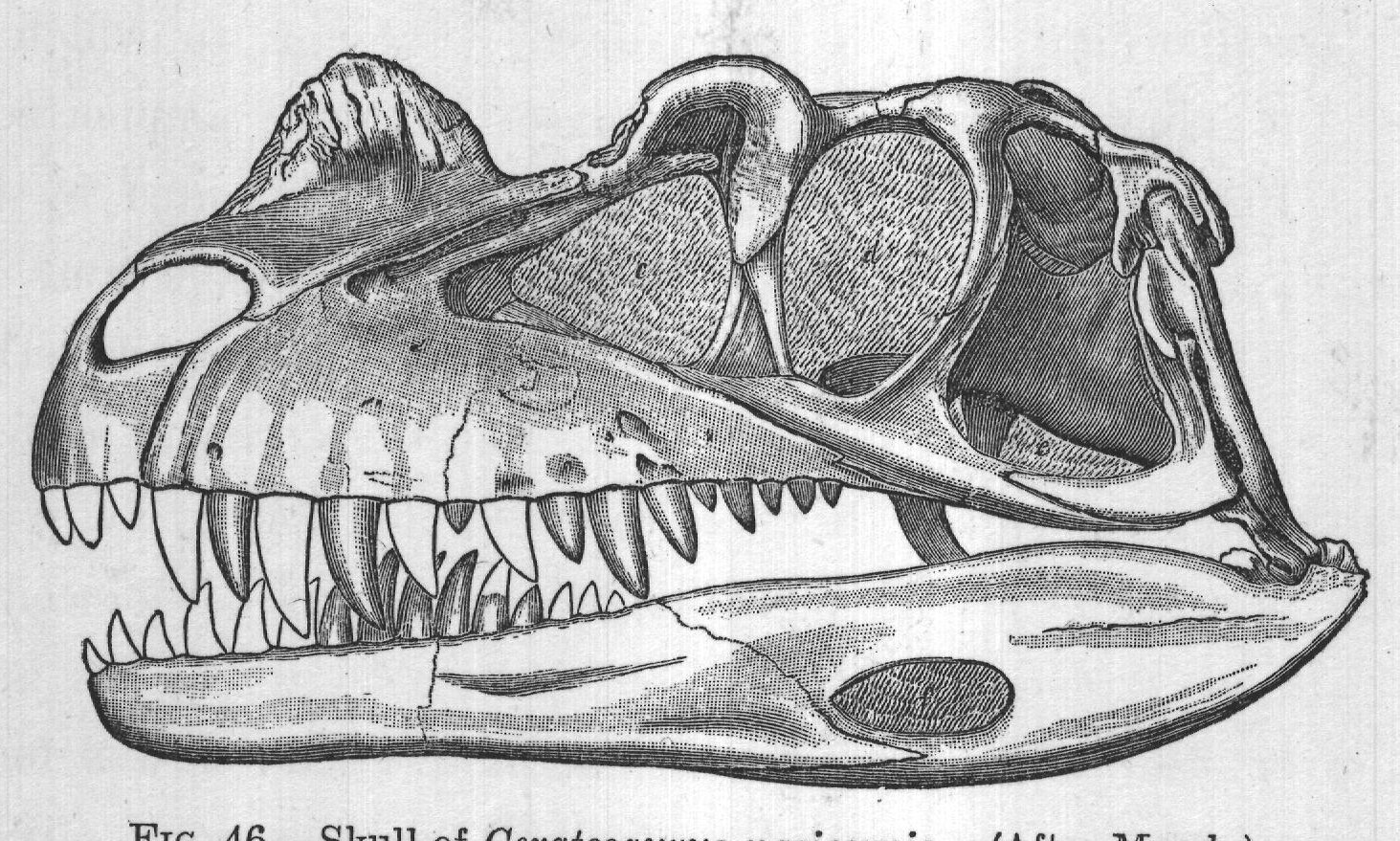
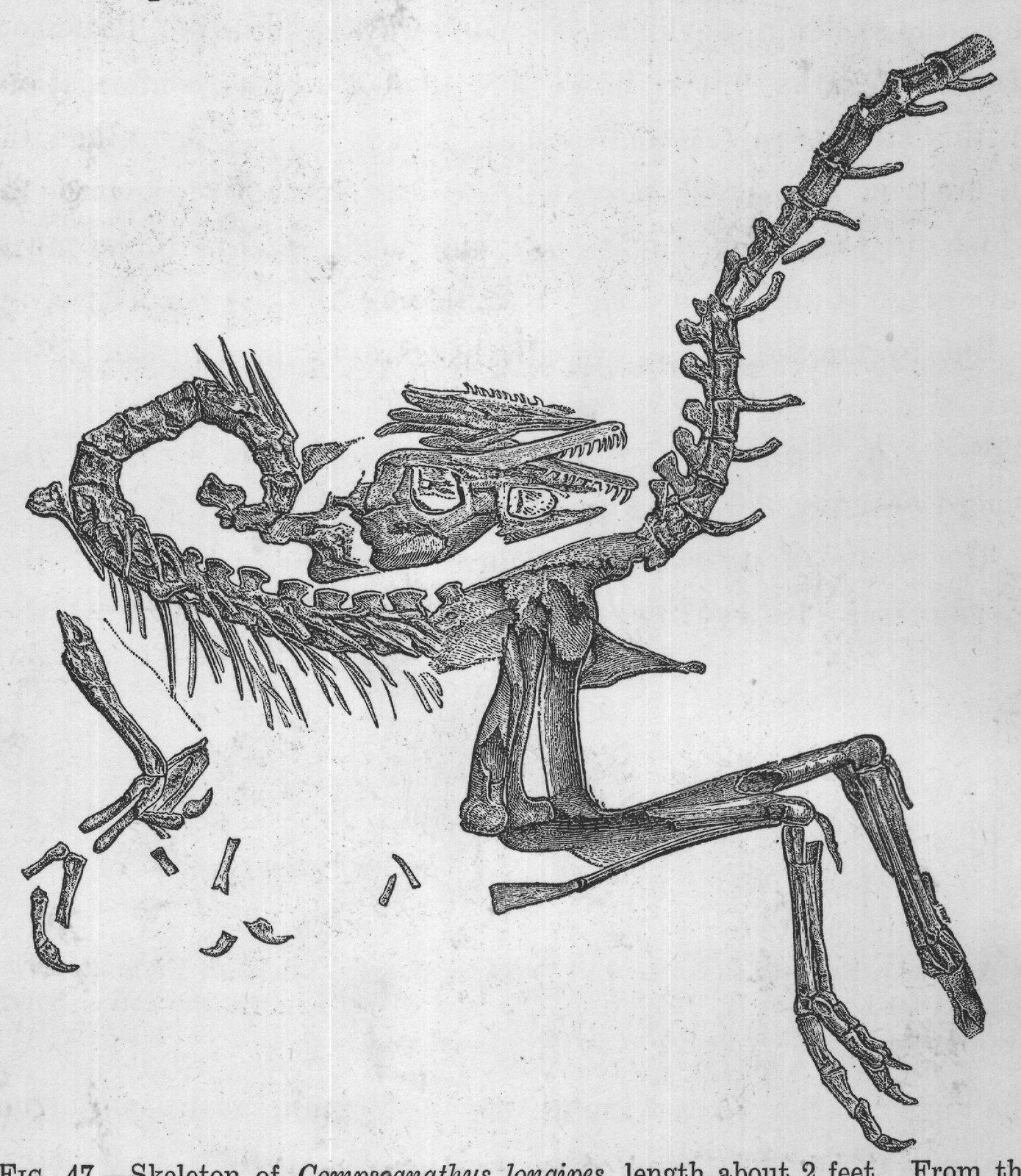
The teeth of this horned Dinosaur resemble those of the Megalosaur. Its eyes were protected by protuberances of the FIG. 46. Skull of Ceratosaurus nasicornis. (After Marsh.) skull just above the cavity in which the eye was placed (see Figs. 45 and 46). The brain was a good deal larger in proportion to the size of the animal than in Brontosaurus and its allies; so perhaps we may infer that it was endowed with greater intelligence, as it certainly was more active in its habits. The fore limbs, as in Megalosaurus, were small, and some of the fingers ended in powerful claws, which no doubt it could use to good FIG. 47. Skeleton of Compsognathus longipes, length about 2 feet. From the Solenhofen limestone. purpose. This skeleton so much resembles that of Megalosaurus that Mr. Lydekker considers they should be both included in the genus Megalosaurus.
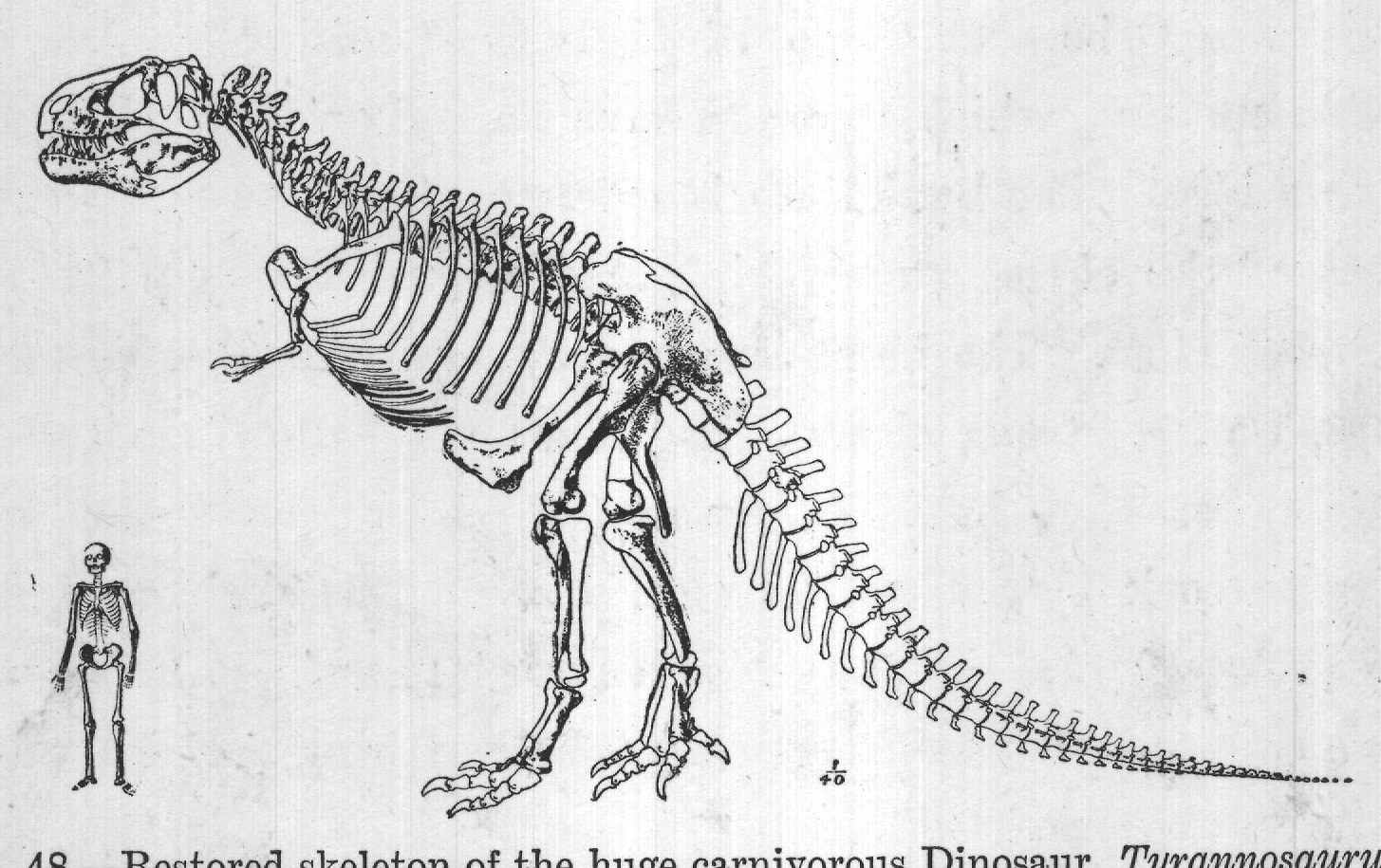
Perhaps the most remarkable of all the Dinosaurs was a DRAGONS OF OLD TIME diminutive creature only two feet in length, which was related to those we have just been considering, and whose skeleton has been found almost entire in the now famous Lithographic Stone of Solenhofen in Bavaria. Of this unique type, the Compsognathus, the skeleton of which is in many ways so bird-like, Professor Huxley remarks, "It is impossible to look at the conformation of this strange reptile and to doubt that it hopped, or walked, in an erect or semi-erect position, after the manner of a bird, to which its long neck, slight head, and small anterior limbs must have given it an extraordinary resemblance." (See Fig. 47.) But by far the greatest of all the carnivorous Dinosaurs was 2 1dem 5M 4M 3M 2M LIM FIG. 48.--Restored skeleton of the huge carnivorous Dinosaur, Tyrannosaurus rex. (After Professor H. F. Osborn.) The shaded portions are the actual bones discovered. A scale of meters is given at the side. the huge and fierce beast known now as Tyrannosaurus rex, a true example of a "terrible lizard," as the word Dinosaur denotes. Its length was about thirty-nine feet, and height about seventeen feet! Plate XV. is a photograph from a restored skeleton of Allosaurus and Fig. 48 gives a diagrammatic view of Tyrannosaurus, with a human skeleton for comparison, and shows which parts were actually discovered, and which are restored, the latter being only in outline. It was discovered in 1902 in Montana, U.S., by the members of an expedition for the American Museum of Natural History in Cretaceous rocks below the Laramie beds. Previous discoveries were made in 1856, 1866, 1868, 1876, 1892, and 1900. A specimen found in the last-named year was described under the name of Dynamosaurus, thus indicating the strength of the beast. It seems to have been contemporary with the Ceratosauria, to be described later on (p. 184). Allosaurus and Laelaps were related forms. The limb-bones in all these forms are hollow.