Home › The Dragons of Old Time-Dinosaurs › The Dragons of Old Time-Dinosaurs: Carnegie
The Dragons of Old Time-Dinosaurs: Carnegie
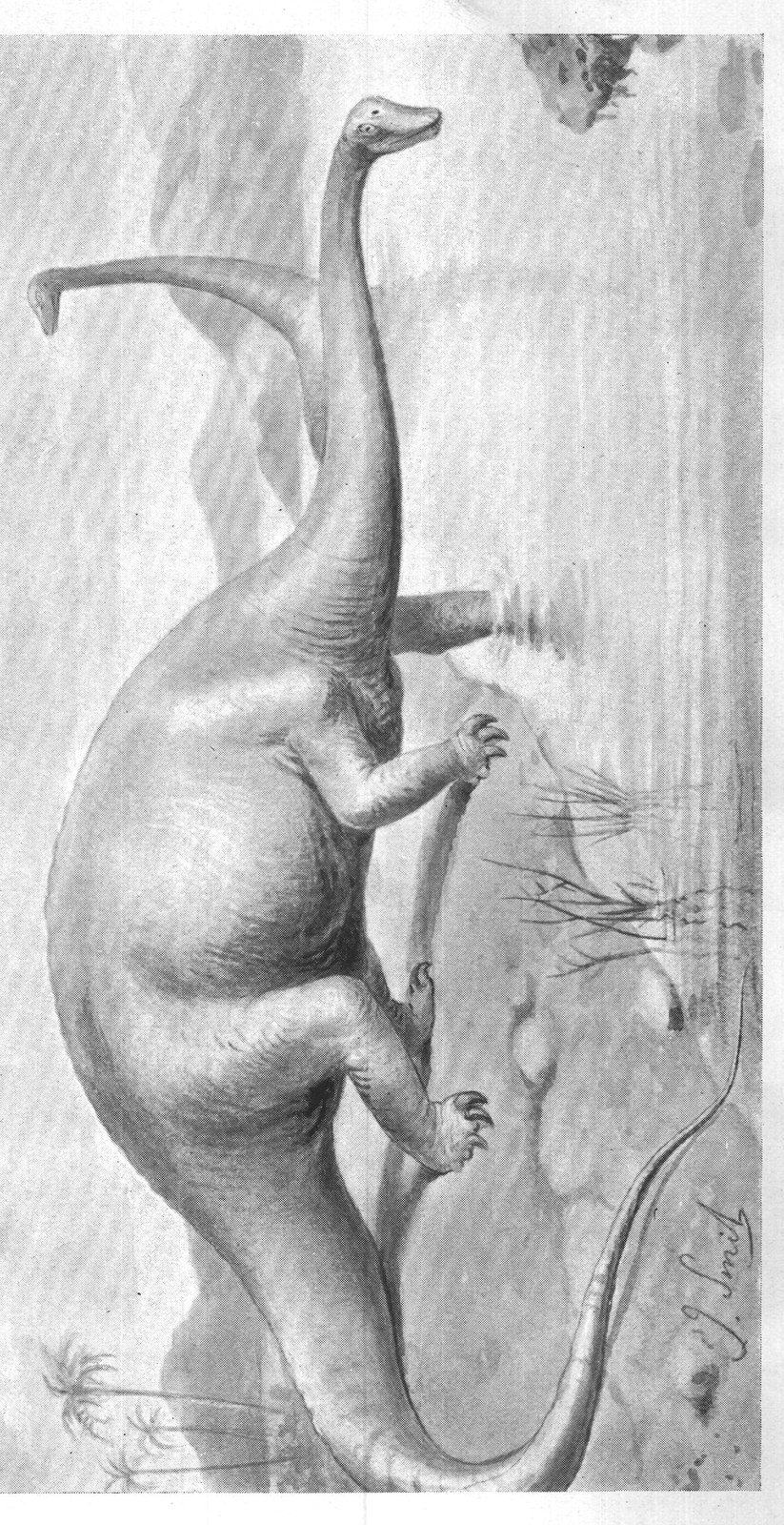
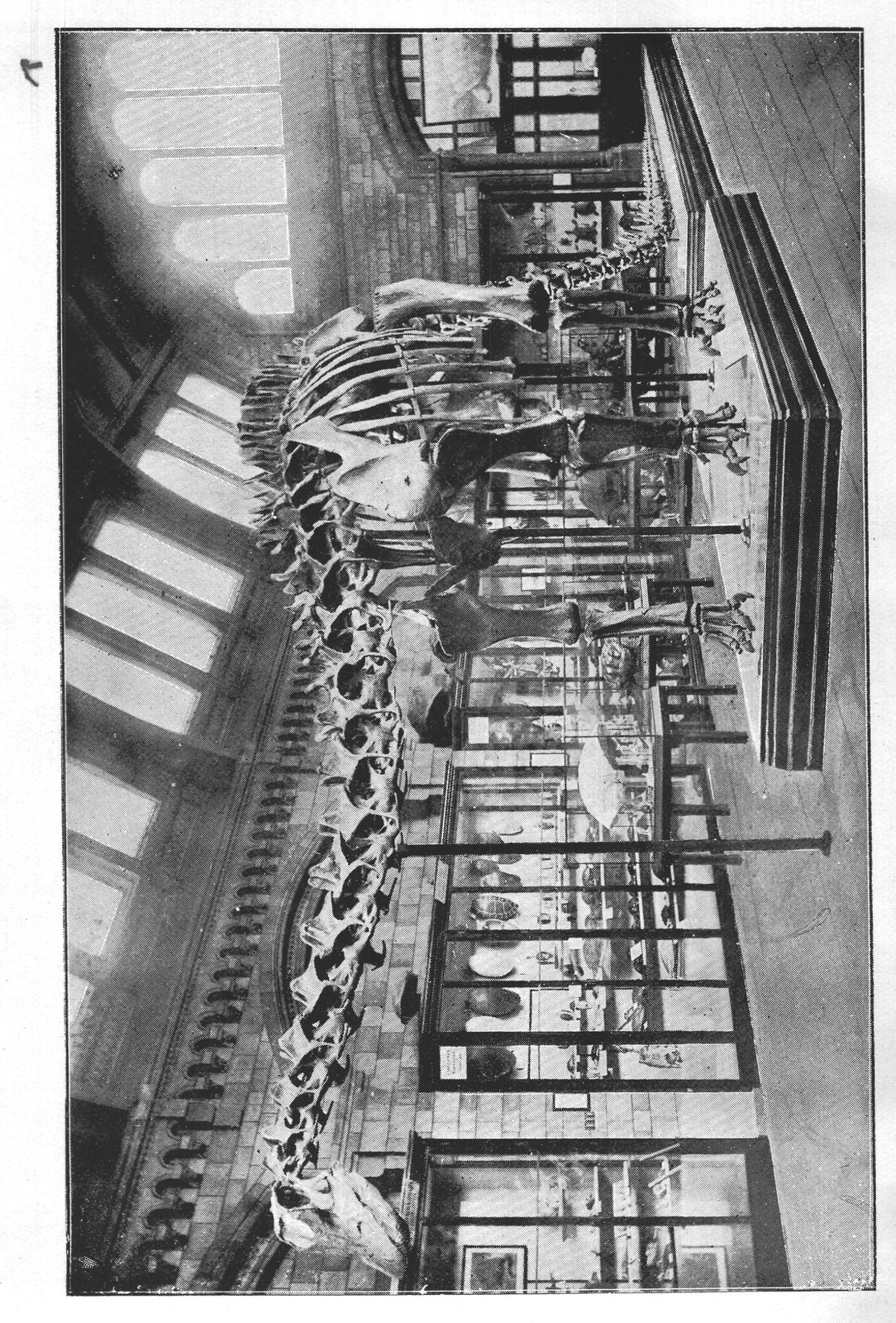
C of the skeleton of this truly wonderful giant reptile, as shown in Plate XXI. It is a cast in plaster-of-Paris-the gift of Mr. Andrew Carnegie, who, by his generous gifts, is doing much to further scientific researches in various directions. This model when first set up in the gallery devoted (chiefly) to modern reptiles attracted a great deal of attention. Not unnaturally, for it is so stupendous. A reptile 845 feet long was something quite new to the public. This model is an exact copy of the original composite skeleton, to be seen in the Carnegie Museum, Pittsburgh. Each bone was cast in a separate mould made from the original bone, so that for all practical purposes this model is as good as the original. It seems a pity that there is no room for it in the fossil reptile gallery, along with Cetiosaurus and other allies. Both geologists and naturalists are hoping that some day our Government will give a grant for the extension of the British Museum (Natural History) in Cromwell Road, and then we might have a spacious gallery entirely devoted to fossil reptiles. Failing that, there is still a hope that some rich man may come forward to supply the funds for this great improvement. The material for this reconstruction, made under the direction of Dr. W. J. Holland, director of the Carnegie Museum, Pittsburgh, comes from four incomplete skeletons: One was found by Dr. J. L. Wortman, in an expedition made in the year 1899, another by Mr. O. A. Peterson, in another expedition the following year. Both specimens came from the same quarry, in Sheep Creek, in Albany, County Wyoming, which had previously yielded so much material to Dr. Wortman. Later on another two, or more, turned up, each incomplete. No complete skull has yet been found: Marsh had two incomplete skulls, and the Carnegie Museum has another. The American Museum of Natural History has two others (see Fig. 52) also incomplete. In these circumstances a restoration had to be made from the material at hand, and missing parts supplied by a study of the skull of Brontosaurus, which is a near relation. This seems justifiable; and we may add that the tail, consisting of 70 vertebræ, has been found complete: a large part of the trunk also. So, with the neck, Diplodocus had a height of 14 feet, if it stood erect as shown in Plate XXII. Professor Tornier, however, thinks the legs were more or less bent. This view is partly expressed in our restoration. The teeth are small and weak, probably serving to collect succulent vegetation. The nostrils open quite in the top PLASTER-CAST OF SKELETON OF A DINOSAURIAN LAND-REPTILE (Diplodocus carnegii), OVER 80 FEET IN LENGTH, FROM PLATE XXI, UPPER JURASSIC, WYOMING, U.S.A. (Gallery of Reptiles, Natural History Museum, London.) DRAGONS OF OLD TIME of the head, a position which would be convenient to an airbreathing animal that spent most of its time in the water. With regard to what may be called the architecture of this huge skeleton, Professor Osborn says: "The backbone is indeed a marvel. The fitness of the construction consists, like that of the American truss-bridge, in attaining the maximum of strength with the minimum of weight."
Morosaurus is an allied form, also from the Atlantosaurus beds of Wyoming, with a long neck and small head. But no complete skeleton has yet been found.
Unfortunately, there are at present no complete skeletons known of English Dinosaurs related to the American forms above described. But, since the English fossils were first in evidence by many years, and Marsh's discoveries have confirmed in a remarkable way conclusions drawn by Owen, Huxley, Hulke, and Seeley, and others from materials that were rather fragmentary, it may be worth while to give some account of these remains and the interpretations they have received.
Dr. Buckland, in his Bridgewater Treatise, 1836, referred to a limb-bone in the Oxford Museum, from the great Oölite formation near Woodstock, which was examined by Cuvier, and pronounced to have once belonged to a whale; also a very large rib, which seemed whale-like. In 1838 Professor Owen, when collecting materials for his famous Report on the Fossil Reptiles of Great Britain, inspected this remarkable limb-bone, and could not match it with any bones known among the whale tribe; and yet its structure, where exposed, was like that of the long bone (humerus) of the paddle of a whale. Later on, he abandoned the idea that it once belonged to a whale, and it was thought that the extinct animal in question might have been a reptile of the crocodilian order. In time, a fine series of limb-bones and vertebræ was added to the Oxford Museum by Professor Phillips (Dr. Buckland's successor at Oxford), who pronounced them to be Dinosaurian. The name "Cetiosaurus" (or Whale-lizard), originally given by Owen, was unfortunate, because there is really nothing whale-like about it, except a certain coarse texture of some of the bones.
In 1848 Dr. Buckland announced the discovery of another limb-bone (a femur), which Owen referred to Cetiosaurus; it was four feet three inches in length. Between 1868 and 1870, however, a considerable portion of a skeleton was discovered in the same formation at Kirtlington Station, near Oxford. These remains were the subject of careful examination by Professors Owen and Phillips. The femur this time was five feet four inches long. Their studies threw much light on the nature and habits of Cetiosaurus.
Of late years, Mr. Alfred N. Leeds, who has so zealously collected fossil bones from the Oxford clay near Eyebury (especially those of Plesiosauri, see p. 79) has brought together a large number of bones of the Cetiosaurus. These have been acquired by the British Museum (Natural History Department), and may be seen at South Kensington, where a large part of a skeleton may be seen mounted. It consists of most of the tail, the left hind limb, and the right fore limb. The height at the hip is ten feet six inches, and the total length probably was sixty feet. The skull is not known. Here again it is possible that the legs were more or less bent outwards as in lizards and crocodiles. It is evident that Cetiosaurus was closely allied to the American Brontosaurus (p. 150); and so these earlier English discoveries have gained much in interest from the light thrown upon them by Professor Marsh's huge Saurian.
Another English Saurian of this group was the Ornithopsis, PLATE XXII.
J. Smit THE GREATEST KNOWN DINOSAUR (Diplodocus carnegii).
Length 84 feet.
DRAGONS OF OLD TIME from Wealden strata in the Isle of Wight, which has been the subject of careful study by Mr. Hulke and Professor Seeley. Their conclusions, based on the examination of separate portions of the skeleton (such as vertebræ), have been singularly confirmed by the discovery of Brontosaurus. In Ornithopsis the vertebræ of the neck and back, though of great size, were remarkably light, and yet of great strength. One of the vertebræ of the back had a body, or centrum, ten inches long. Hoplosaurus and Pelorosaurus were evidently reptiles closely allied to the above types; but at present are so imperfectly known that we need not consider them here. On a recent visit to Berlin the writer was informed by Professor Brauer of the discovery in German East Africa of immense quantities of Dinosaurian bones. Among these one femur exceeds in length that of Diplodocus by several inches.