Home › Ancient Salamanders › Ancient Salamanders: English
Ancient Salamanders: English
To find the oldest known amphibian we must go back as far as those "dark ages" when a large portion of the surface of what is now Europe was overgrown with vast areas of dismal coalforests, something like the mangrove swamps of which we read in books of African travel; they must have been dark compared to an English meadow on a summer day, and therefore the expression "dark ages" is all the more appropriate. Our knowledge of the earliest air-breathing creatures is no doubt small, but of late years it has been considerably extended, thanks to the labours of several English, American, and Continental workers, such as Owen, Huxley, Miall, Seeley, Gaudry, Fritsch, Cope, and others, who have all carefully studied and described the fossil remains submitted to them, to say nothing of the numerous eager collectors who have brought away from the bowels of the earth numerous specimens of great value. Their services, although of a more humble order, are quite indispensable; and it should be borne in mind that it is in the power of all of us, however ignorant we may be of comparative anatomy, and therefore unable to write learned papers for the Geological Society, to render valuable service to the cause of Science simply by using our eyes and not neglecting opportunities of collecting specimens wherever we may go.
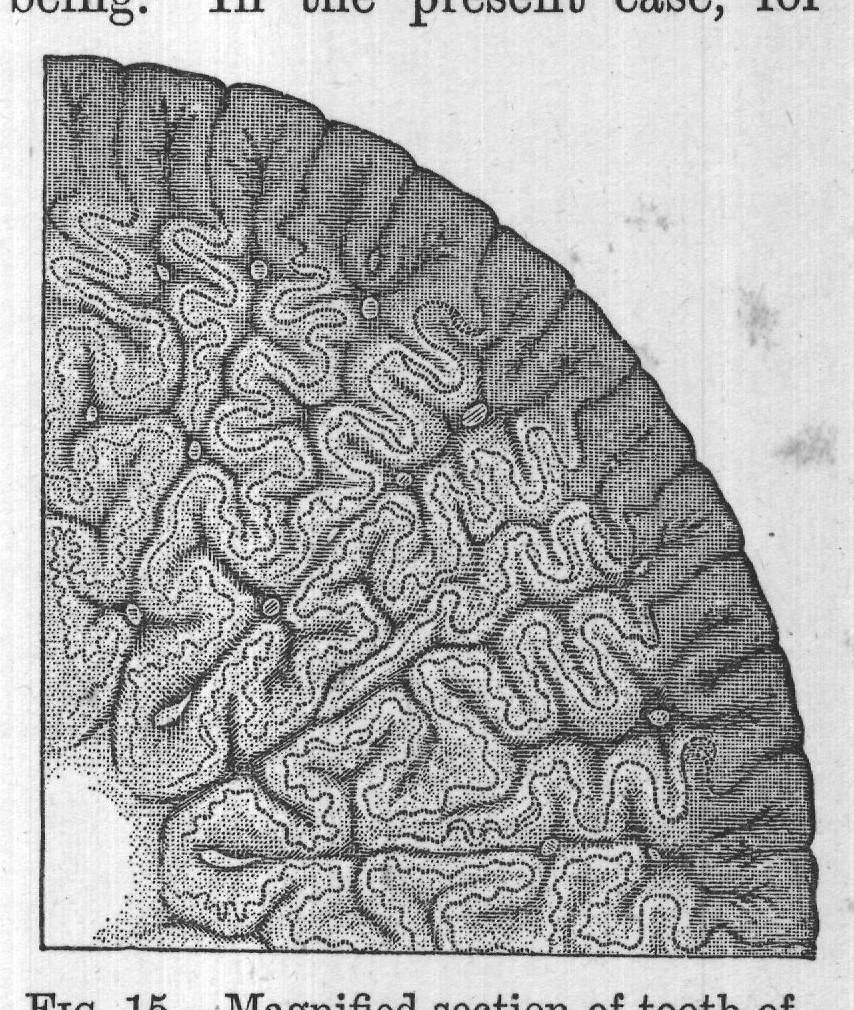
But before proceeding it will be necessary to introduce a new name for our old amphibians. It is rather a long one, we admit, but useful, because it partly serves to describe them. Scientific men are said to be very fond of long Latin and Greek names, but such can hardly be avoided; and there is this to be said for them that the names they use are much more exact than the popular ones by which plants and animals are commonly known, and, moreover, they often convey a great deal of information in a brief manner. Now, the name given to the creatures we are about to describe is Labyrinthodonts. It was Sir Richard Owen who first accurately described the fossil amphibians, and they received this name from him. Let us see what the name means and how it applies. Sir Richard Owen's acquaintance with these remarkable forms of ancient life began in the year 1840, when he first examined certain teeth from the New Red Sandstone of Coton End quarry, Warwickshire. In external character these fragmentary teeth corresponded with those which had been previously discovered in Germany (in Würtemberg) by Professor Jaeger, and which had been called by him Mastodonsaurus. This name was not a happy one, because it suggested an association with an extinct elephant, the Mastodon, with which this amphibian, it is hardly necessary to say, had no connection, real or imaginary. Owen examined the teeth of the fossils from Germany, as well as those from Warwickshire, and found that, when cut across into transverse sections for the microscope, they revealed a very remarkable and complicated structure; the whole of the internal portion was seen to be made up of a complex series of foldings, forming a peculiar structure, suggesting a labyrinth the external layer of cement belonging to the tooth converging in numerous folds towards the pulp-cavity. And so the name Labyrinthodonts reminds us that all, or nearly all, the fossil animals included under the above general term possess teeth having this peculiarity. They are the Labyrinth-toothed amphibians (see Fig. 15).
At first sight it might perhaps seem to the uninitiated as if the internal and minute structure of a tooth were a matter of comparative unimportance; but it is recognised by all anatomists that teeth are highly important as indicating the place of an animal in the scale of being. In the present case, for instance, the possession of teeth with the labyrinthine structure indicates an affinity with certain ganoid fishes, which also possess similarly infolded teeth. Again, there is a peculiarly low type of reptiles, known as the Ichthyosaurus, or " fish-lizard," of which the teeth show an approach to the same kind of structure. Some of the Labyrinthodonts retained the gills FIG. 15. - Magnified section of tooth of of their youth through life, Labyrinthodont. (After Owen.) instead of changing them for lungs, as frogs do.