Home › Some Early Mammals and the Story of the Horse › Some Early Mammals and the Story of the Horse: Brontops
Some Early Mammals and the Story of the Horse: Brontops
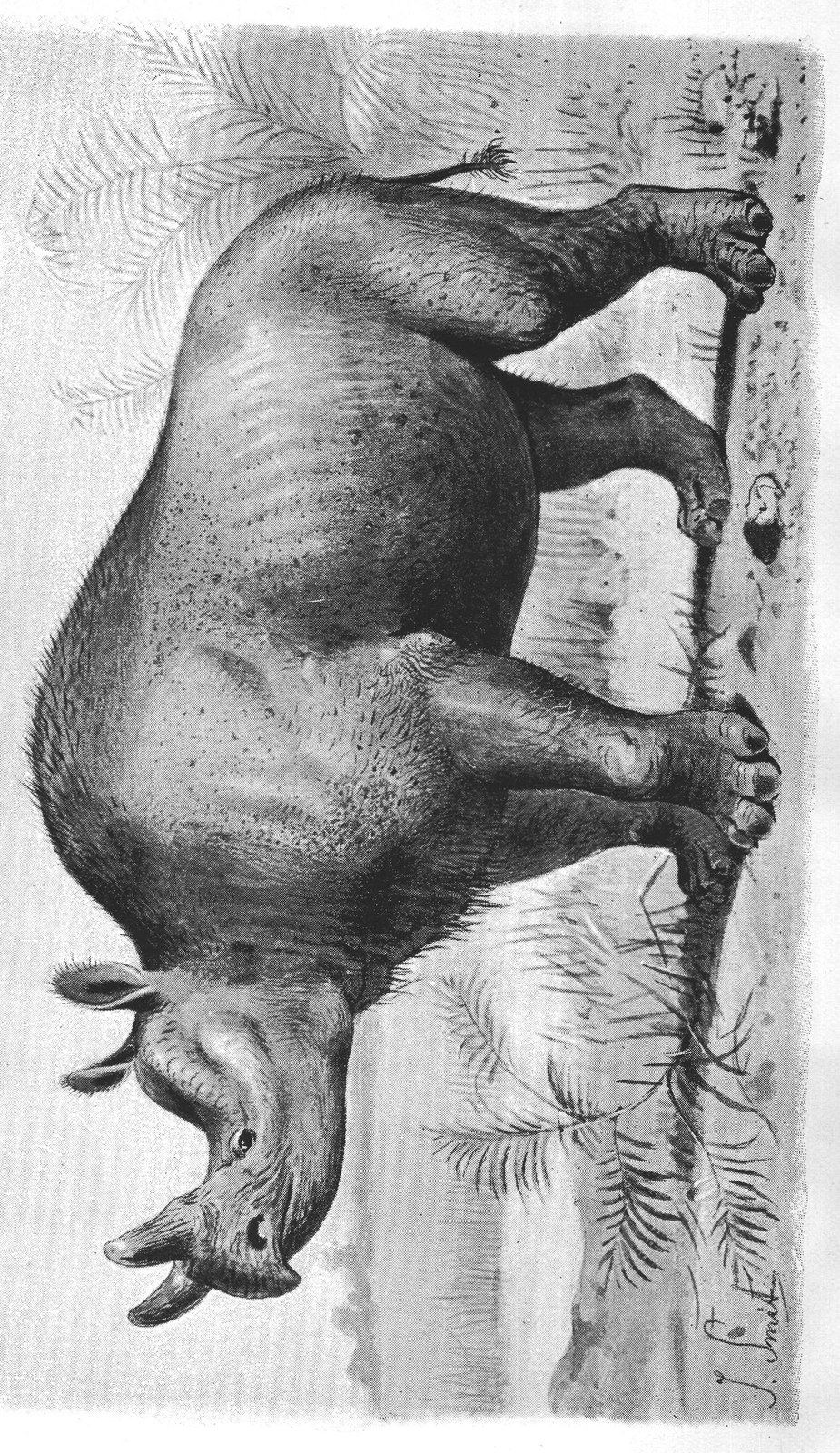
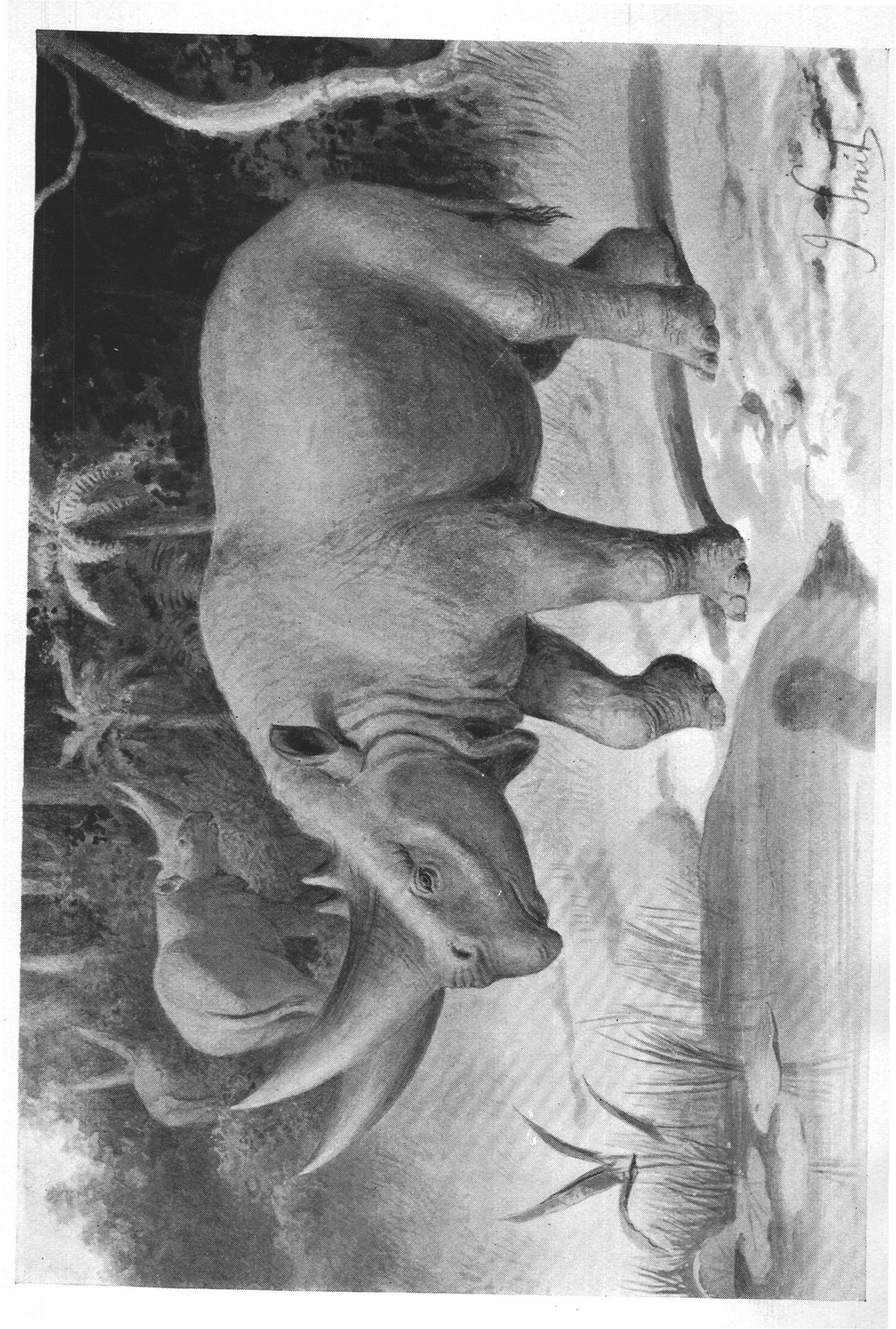
In the country east of the Rocky Mountains, including the states of Dakota, Nebraska, Wyoming, and part of Colorado, Professor Marsh has discovered the remains of yet another strange group of large quadrupeds. The best known of these is Brontops, of which the skeleton is seen in Fig. 97. These animals lived after the Dinocerata, namely, in the Miocene period, and FIG. 97.-Skeleton of Brontops robustus. (After Marsh.) were the largest American mammals of that period. They constitute a distinct family more nearly allied to the rhinoceros than to any other living form. The skeleton on which Fig. 97 is founded was the most complete of any yet discovered by Professor Marsh. Portions of it were exhumed at different times, but it was first found in 1874. Our artist has made the restoration seen in Plate XLII. from this skeleton, as figured by Professor Marsh.
This strange group of creatures flourished in great numbers on A HUGE EXTINCT MAMMAL, BRONTOPS ROBUSTUS, FROM NORTH AMERICA. MIOCENE PERIOD. PLATE XLII.
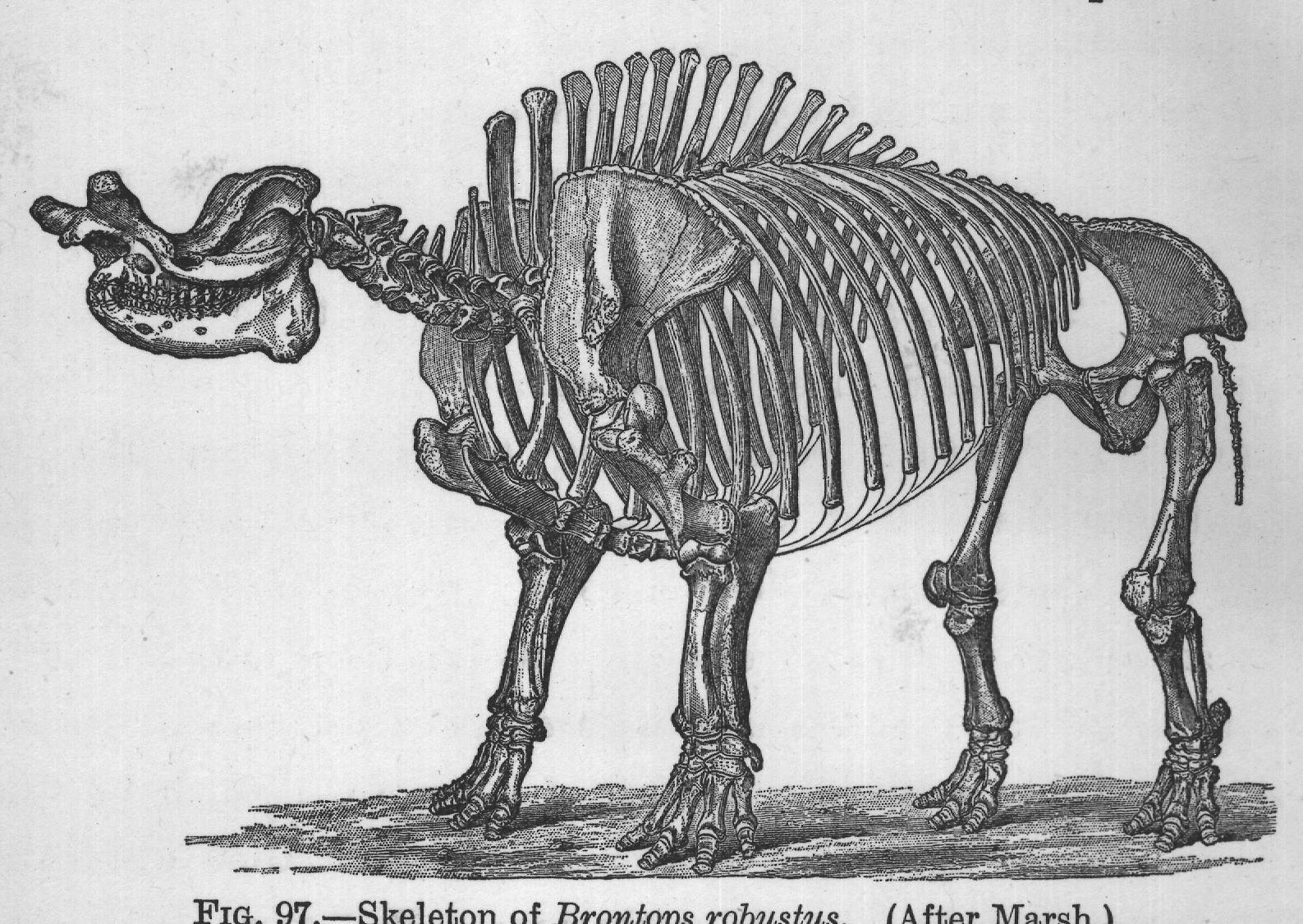
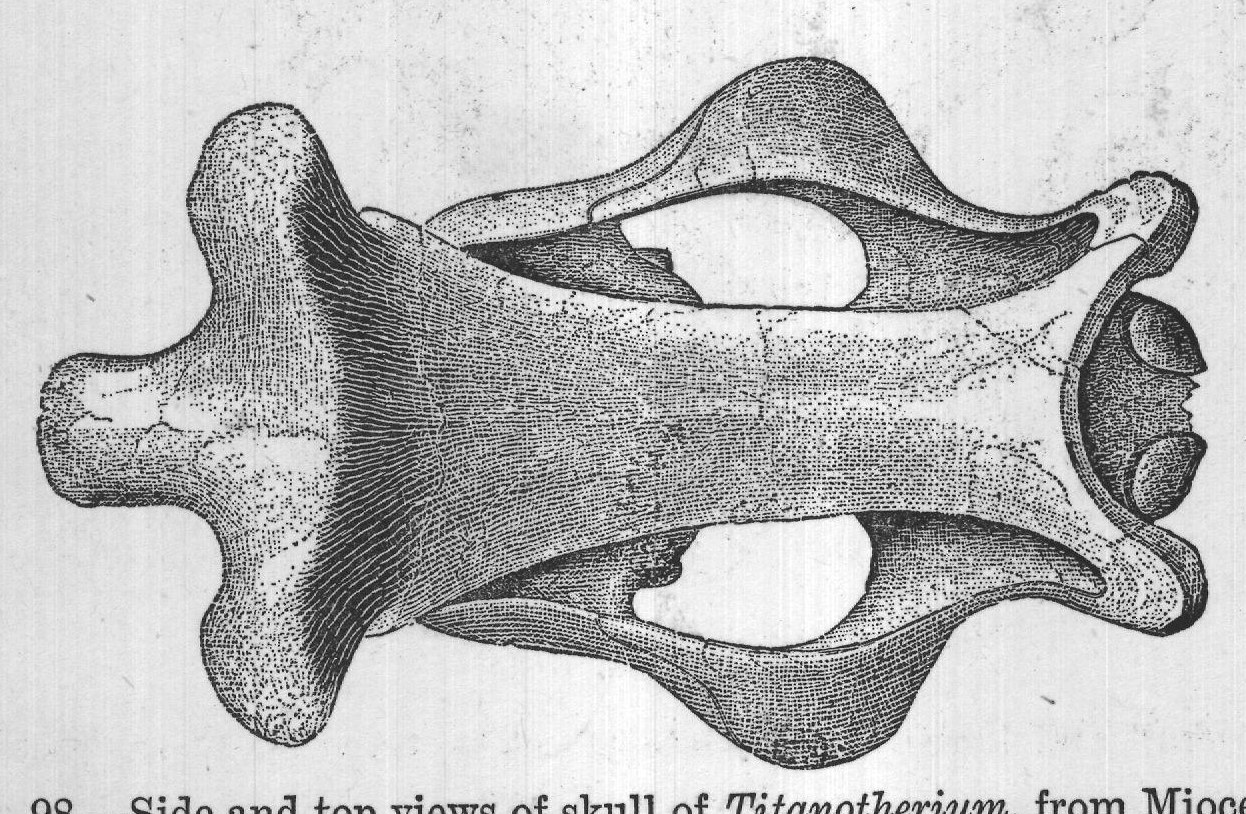
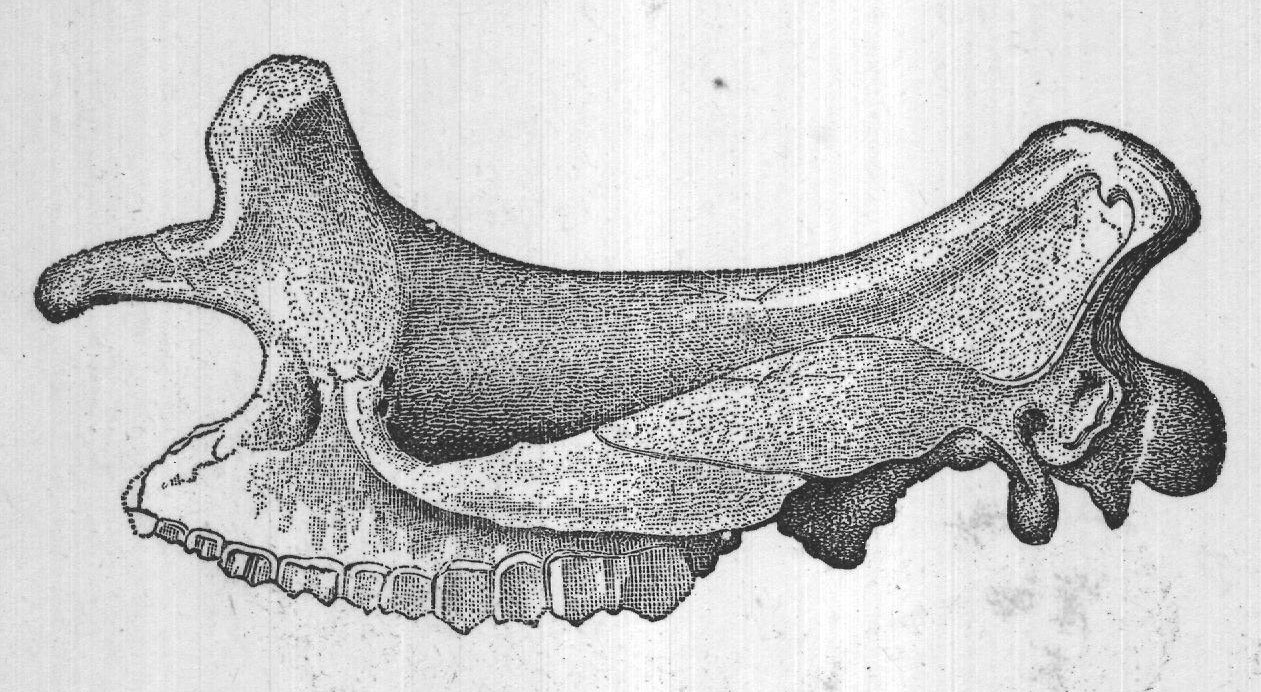
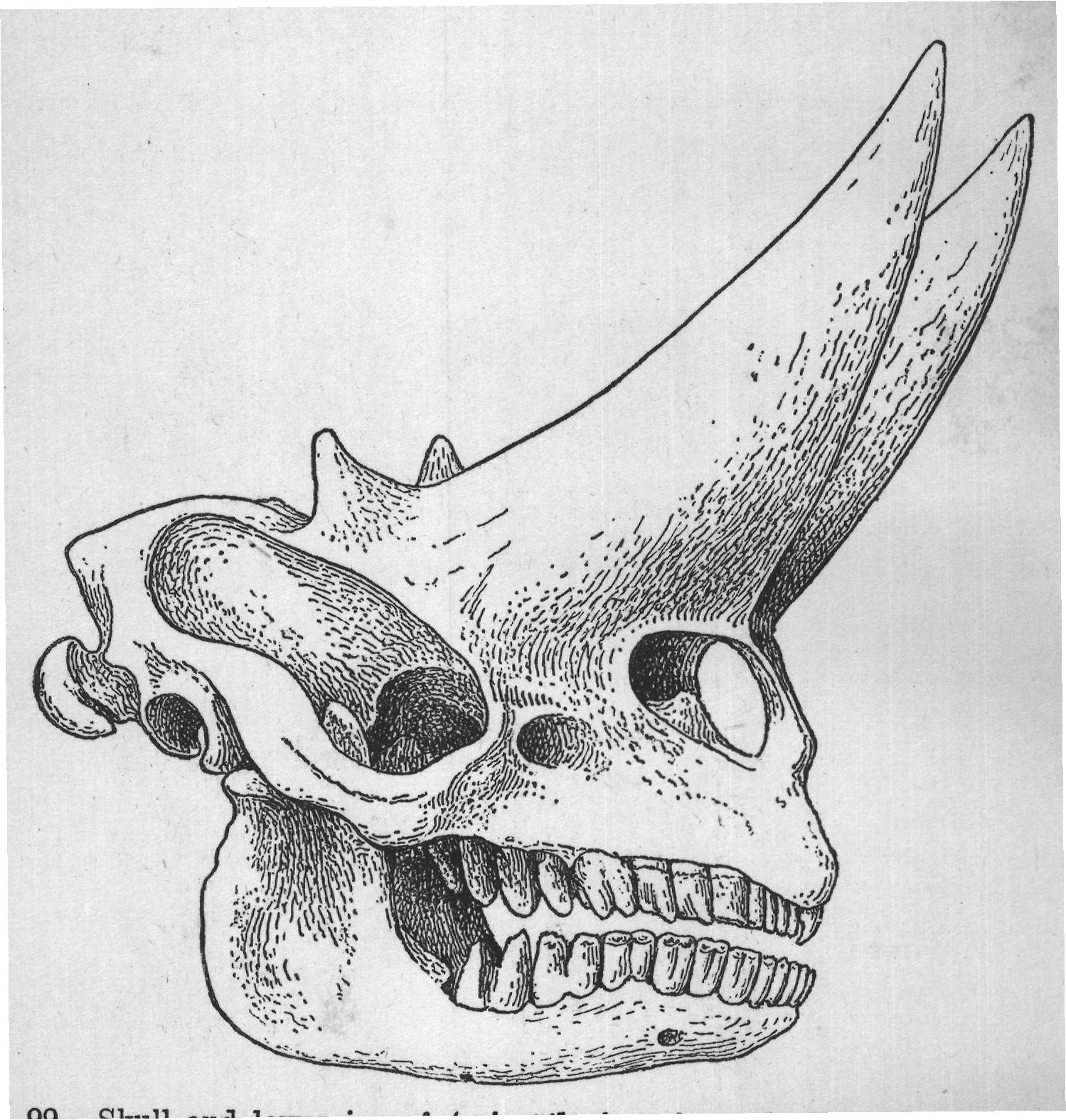
SOME EARLY MAMMALS the borders of an old lake of Miocene age. The Brontops was a heavy, massive animal, larger than any of the Dinocerata, with a length of twelve feet, not including the tail, and a height of eight feet. The limbs are shorter than those of the elephant, which it nearly equalled in size. As in the tapir, there were four toes to the front limbs, and three to the hind limbs. Its skull was of FIG. 98.-Side and top views of skull of Titanotherium, from Miocene strata, North America. a peculiar shape, shallow, and very large. That of Brontops ingens is thirty-six inches long, and twenty inches between the tips of the two horns, or protuberances. The creature was probably provided with an elongated, flexible nose, like that of the tapir, but not longer, because the length of the neck shows that it could reach the ground without the aid of a trunk such as the elephant's. This creature has also been described under the name of Titanotherium. (See Plate XLIII.) One of the strangest of quadrupeds ever discovered by geologists was the huge and fierce beast known as Arsinoëtherium of which S FIG. 99.-Skull and lower jaw of Arsinoëtherium, from the Upper Eocene of the Fayûm, Egypt. the skull is shown in Fig. 99, and a restoration in Plate XLIII. The remains were found by Mr. Beadnell of the Egyptian Geological Survey in the Upper Eocene Sands of the Fayûm 1 district. The only parts missing appear to be the ribs and the toes. The skull was nearly three feet long, and although some 1 See Catalogue of the Tertiary Vertebrata of the Fayûm, Egypt. By C. W. Andrews, D.Sc. Published by Trustees of British Museum. PLATE XLIII.
NOT A RHINOCEROS, ARSINOËTHERIUM ZITTELI. EOCENE AGE. EGYPT, Length about 9 feet.
Imit SOME EARLY MAMMALS bones are still missing, enough is known to justify a tentative restoration such as is shown in our Plate XLIII. See the specimens in the Fossil Mammal Gallery, Natural History Museum. Dr. C. W. Andrews proposes a new order, viz. the Barypoda (or heavyfooted beasts), to distinguish this creature from such of its allies as the Dinoceras and the Elephants. The affinities of Arsinoëtherium are at present unsettled, but it may possibly be related to the order of ungulates known as Hyracoidea, and at the present day represented by the Syrian Hyrax or coney. It is an isolated and a primitive group, probably related to the Phenacodus, as well as to the order Amblypoda. Queen Arsinoë, a Greek Queen of Egypt, had her palace near where the bones were found; hence the name. The horn-cores in the skull are formed by a hollow shell of bone. The height of the creature was 5 feet 9 inches at the withers, and the length about 9 feet 9 inches from the snout to the rump.