Home › Some Early Mammals and the Story of the Horse › Some Early Mammals and the Story of the Horse: Basin
Some Early Mammals and the Story of the Horse: Basin
BASIN WHITE RIVER BASIN MIOCENE. 'GREEN RIVER, BASIN EOGENE UINTAH BASIN EOCENE FIG. 93. Map of North America in Tertiary times, showing roughly the outline of the coast, and sites of the principal fresh-water lakes. vegetation, a large number of strange and primitive quadrupeds, together with many other forms of life. The most wonderful group of animals that haunted the shores of this lake, or perhaps river valley, was the Dinocerata so fully described by Professor Marsh, in his exhaustive monograph. The name implies that 1 When strata have been bent downwards into a kind of trough going far below the surface, they are said to lie in a "basin." Examples: the London basin, the Paris basin. 2 The Dinocerata, a monograph by O. C. Marsh, United States Geological Survey, vol. x. they were terrible horned monsters, but whether Nature provided them with true horns, like those of horned cattle to-day, is at least open to doubt.
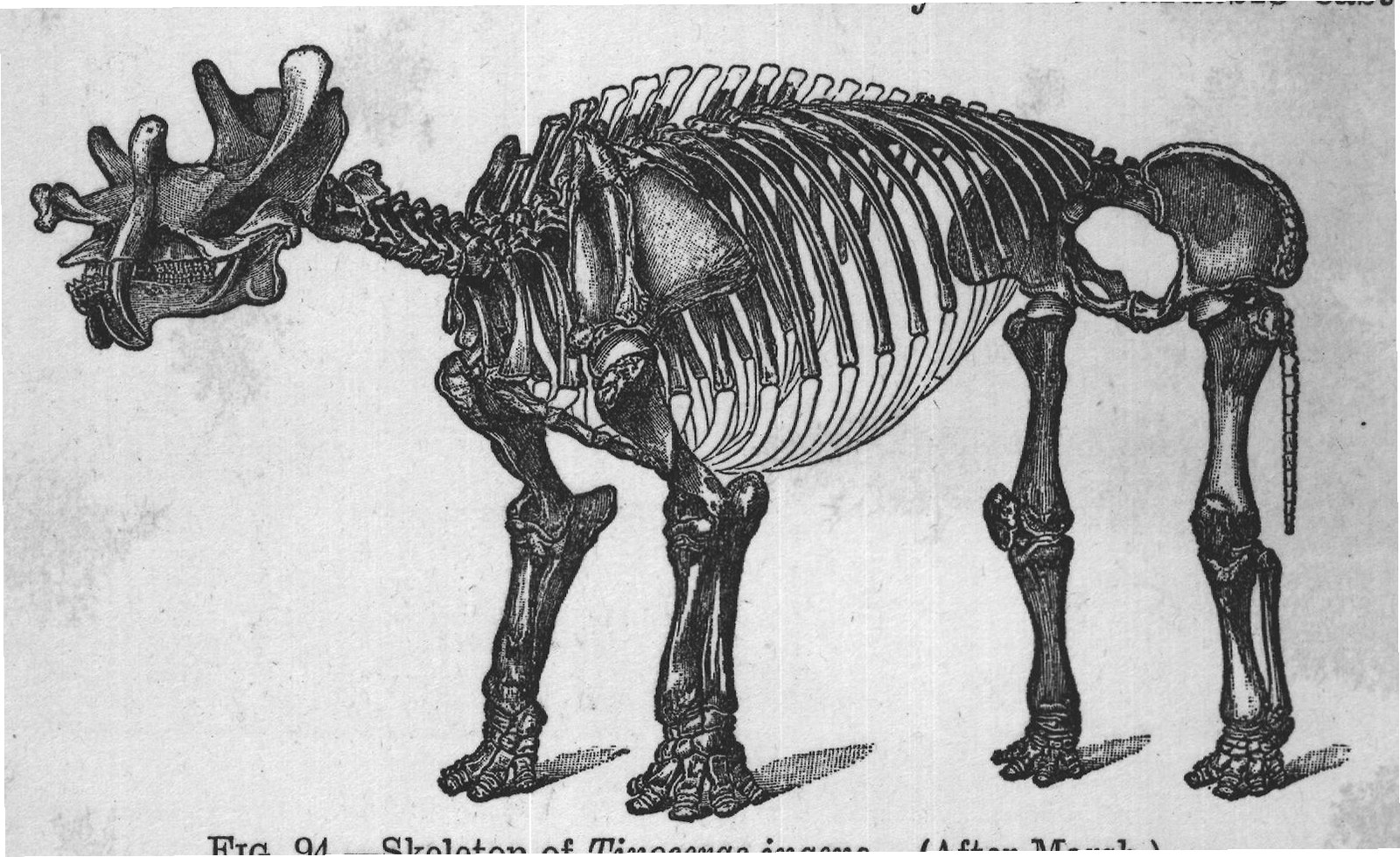
Fig. 94 shows the skeleton of one of these, namely, Tinoceras ingens. Its length was about twelve feet without the tail. Its weight, when alive, was calculated to have been six thousand pounds, or about two tons and three quarters.
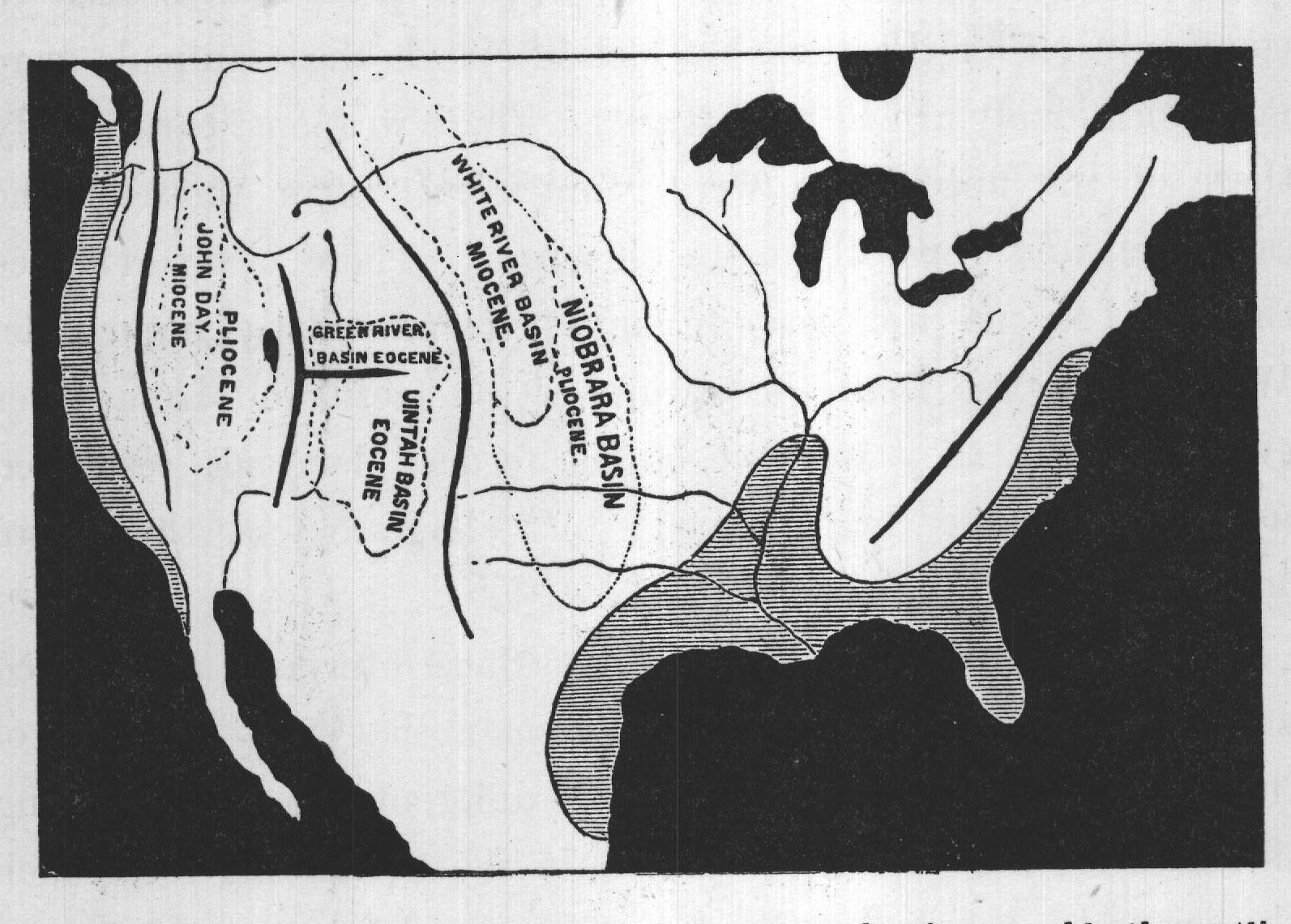
Plate XLI. is a restoration of the Tinoceras, made by our artist, after much consideration and careful study of the valuable cast FIG. 94. Skeleton of Tinoceras ingens. (After Marsh.) exhibited in the Natural History Museum at South Kensington, which was generously presented by Professor Marsh.
Looking at the skeleton, one is struck with a certain resemblance to the rhinoceros on one hand, and to the elephant on the other. The legs are very elephantine, and the feet must have been covered with thick pads, but the body reminds one more of the rhinoceros. The eye was small and deep set, as in the rhinoceros. In the upper jaw the two canine teeth are developed into dagger-shaped tusks, the use of which can only be conjectured. In the females these are but slightly developed. PLATE XLI.