Home › Some Early Mammals and the Story of the Horse › Some Early Mammals and the Story of the Horse: Cuvier
Some Early Mammals and the Story of the Horse: Cuvier
The discovery, in the early part of the present century, of the rich treasures embedded in the Tertiary strata of the Paris basin, and the consummate skill with which they were interpreted and restored by the immortal Cuvier, gave a very great impulse to the SOME EARLY MAMMALS study of Geology. His restorations became patterns for others, like Owen, Huxley, Marsh, Cope, Gaudry, and many more, who have worked on the lines he laid down. The mammalian remains brought to Cuvier by numerous collectors were very imperfect and fragmentary-detached bones and teeth, with occasionally some portion of a skeleton. The success with which he put them into order, and built up therefrom the long-lost types of Eocene days, was due largely to his wonderful knowledge of living animals, but partly also to his Law of Correlation (see p. 7). One of Cuvier's triumphs was the restoration of the Palæo- FIG. 86. Skeleton of a tapir-like animal, Palæotherium magnum, from Eocene strata, near Paris. (After Gaudry.) therium,¹ a tapir-like animal, from fragmentary remains found in the strata of the Paris basin, chiefly at Montmartre; his conclusions being afterwards verified by the discovery of a nearly complete skeleton (see Fig. 86). The molar teeth of this animal somewhat resembled those of the rhinoceros. The skull shows that it had a short proboscis. The toes, of which there were three on each foot, ended in small hoofs, the middle toes being 1 Greek-palaios, ancient; therion, wild beast. the largest.
Its eye was small, and the head rather large.
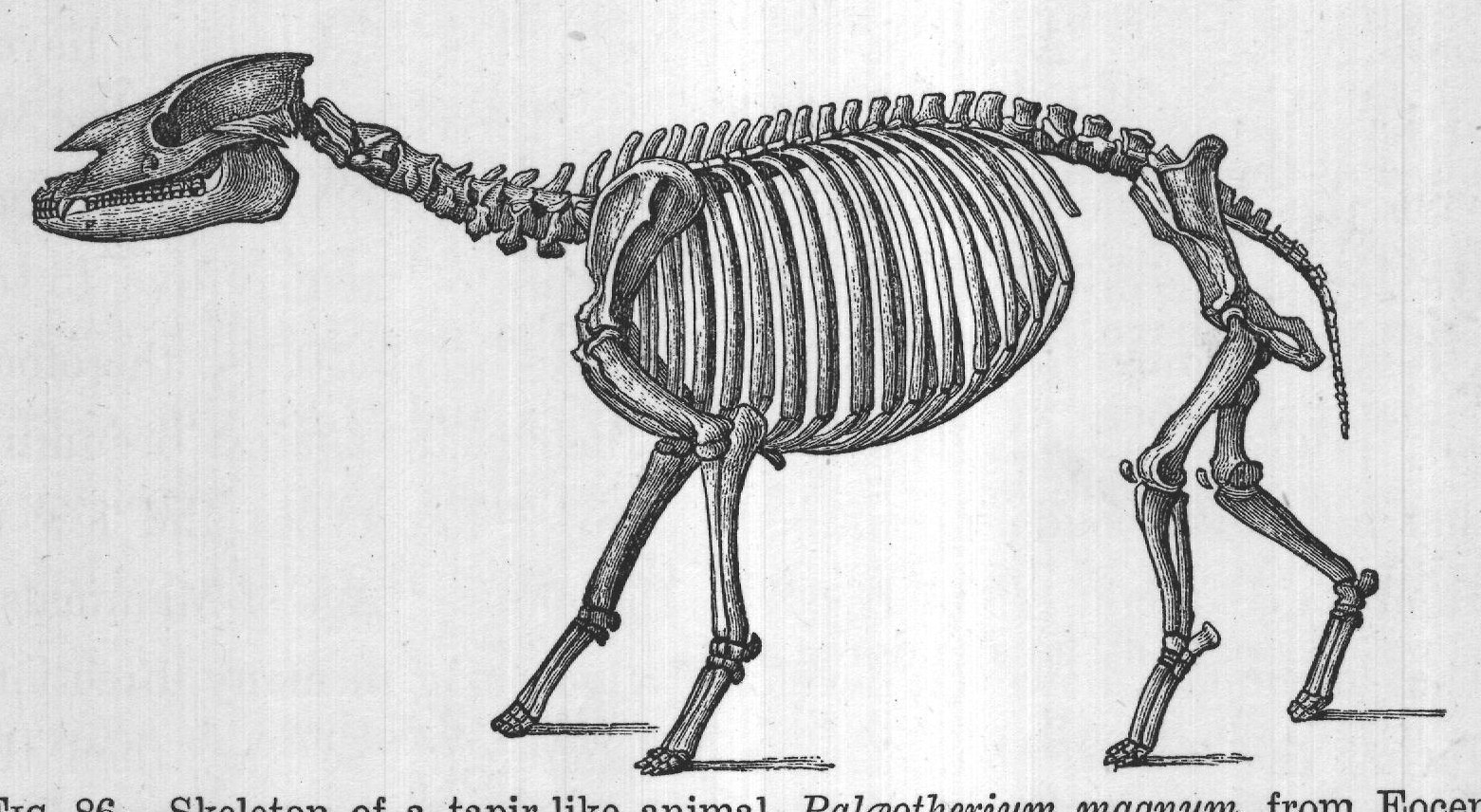
Several species have been determined, varying from the size of a sheep (P. curtum) to that of a horse (P. magnum), and it had much in common with both the horse and the rhinoceros. P. medium was rather smaller than an American Tapir: P. minus was a small and elegant species, of which the fresh-water Eocene beds of the Isle of Wight have yielded remains.
A complete specimen, discovered in 1874, with the outline of the body indicated in the rock, was of a slenderer build, and with a longer neck than in Cuvier's restoration, on which our artist's drawing in Plate XXXIX. is based; but the earlier discoveries do not agree with this, and the reader can easily see for himself that the skeleton shown in Fig. 86 could not have had a longer neck without at the same time having longer legs, and probably thinner bones. We have therefore adhered to the now familiar outline of the Palæothere as restored by Cuvier and since copied into almost every book on Geology. Doubtless there were many species existing at the time, and this later discovery probably represents one of the slenderer sort.
Such then, in all probability, was the Palæothere, a creature which lived in herds in the valleys of the plateau surrounding the ancient lake-basins of Orleans and Argenton; in the department of Gironde; in the Isle of Wight: and in various parts of Europe.