Home › Footprints on the Sands of Time › Footprints on the Sands of Time: Cheshire
Footprints on the Sands of Time: Cheshire
Some years previous to 1856, a series of strange impressions was found in a quarry in the lowest part of the Millstone Grit formation at Rhodes Wood, near Tintwhistle, Cheshire. The proprietor, Mr. Rhodes, was much struck with them, from the fact that they bore a resemblance to the marks of a human foot. The workmen also were struck with the resemblance, and, when they first showed him the impressions, remarked, "Master, some one has been here before us!" For several weeks the quarry was visited by many hundreds of people from Glossop and the surrounding neighbourhood. The common opinion was that the tracks were the footprints of some of Noah's family! This strange idea seems to have been founded on another equally strange, viz. that the Ark had rested on some neighbouring hills. But to return to the tracks; the distance between the impressions was two feet ten inches, and several of the impressions were thirteen inches long. Mr. Waterhouse Hawkins saw them, and thought that they resembled the supposed chelonian track figured by Jardine. Mr. Binney's conclusion (who read a paper on these tracks before the Geological Society) was that they were made on wet sand by a heavy slow-moving animal, like a tortoise, with irregular gait.
Soon after the discovery of footprints at Corncockle Muir, another discovery was made in strata of the same geological age at Hessberg, near Hildburghausen, in Saxony. These footprints, however, were evidently made by somewhat large creatures, in which the fore paws were much smaller than the hind ones (see Fig. 2). Subsequently, similar tracks were observed on slabs of Triassic Sandstone in the quarries at Storton, in Cheshire. Others, again, have been found in Cheshire. The Museums at Warwick, Warrington, and Liverpool, are rich in impressed slabs from the New Red Sandstone. Numerous fine specimens may be seen in the Museum of the Geological Society, the Museum of Practical Geology, in Jermyn Street, and in the Natural History Museum, Cromwell Road, which is a part of the British Museum (Gallery No. XI.). Some of the slabs from Storton are covered with small round pits, or depressions, produced by FIG. 2. Footprints of Cheirotherium, in the Bunter Sandstone, Hessberg, near Hildburghausen. rain-drops that fell while the surface was soft and impressible. The footprints from Storton are seen on the face of each successive stratum of marl, the corresponding surface of the overlying stone presenting, in relief, casts of the imprints and other markings. The hollow impressions of the feet are always on the upper surfaces of the slabs, and the convex casts on the under side of each layer or stratum, the latter fitting closely into the former. The double lines in between are casts of sun-cracks formed as the mud dried in the sun.
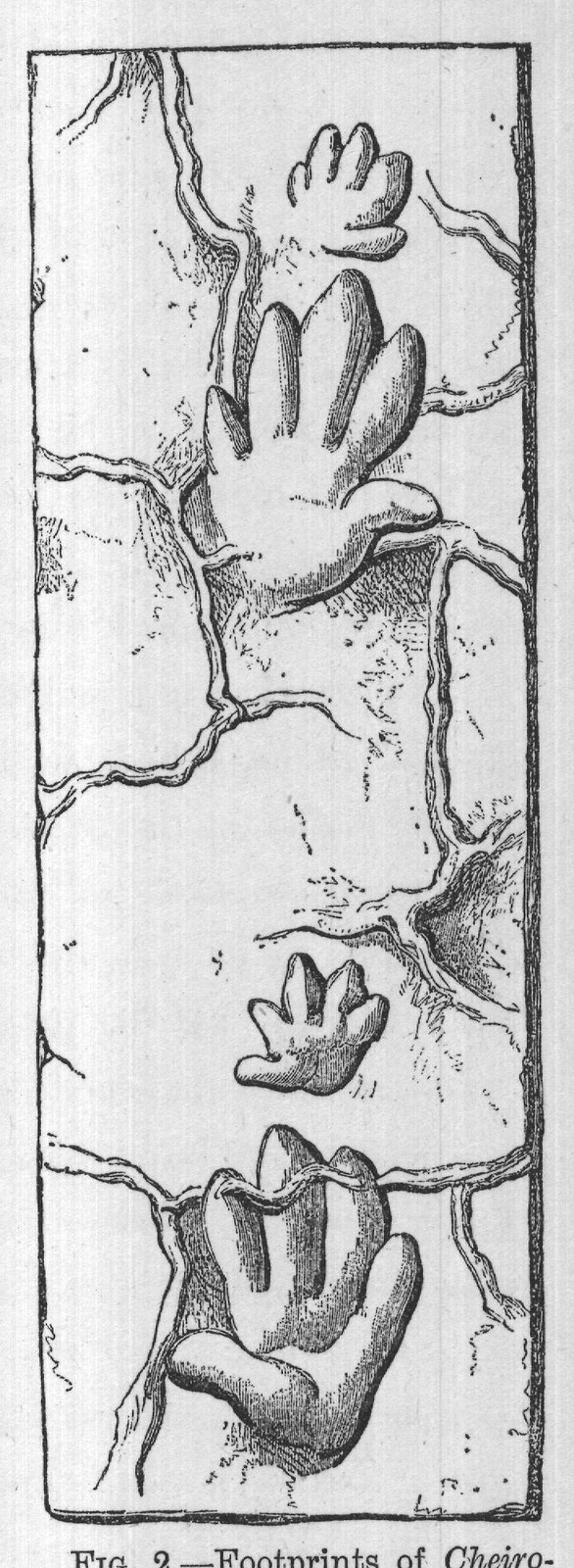
These "footprints on the sands of time" follow one another in pairs-one small, the other large, each pair being in the same line, and some fourteen inches in advance of the other. Each footmark has five toes, and the first, or little toe, is bent outward like a thumb, and is alternately on the right and left side of both the large and small footprints, which, except in size, resemble each other. The German geologist, Dr. Kaup, who first described them in 1834, proposed the name of Cheirotherium¹ for the great unknown animal that left the footprints, in consequence of the resemblance, both of the fore and hind feet, to the impression of a human hand. No certain remains of the creatures whose tracks we are now considering have yet been discovered in the same strata. But in these rocks and others of the same geological age in England and Germany there have been obtained skulls, teeth, and bones of amphibians, known as Labyrinthodonts, of which we shall have more to say in Chapter VI. Some of the salamander-like amphibians of the Triassic period, we now know from later discoveries, attained to a considerable size.
As Sir R. Owen points out, the impressions of the Cheirotherium resemble the footprints of a modern salamander in having the 1 Greek-cheir, hand; therion, beast. short outer toe of the hind foot projecting at right angles to the line of the middle toe, but yet are not identical with those of any known batrachian or reptile. Still it has been conjectured by the same great authority, as well as by others, that these footprints were the work of the creatures now known as Labyrinthodonts, which have left their remains in rocks of the Carboniferous, Triassic, and Permian ages. Later researches have shown that Owen was wrong. We need not be surprised at this, for Palæontology has, like all the other sciences, made great advances the last fifty years. The researches of Marsh, Cope, Huxley, Fritsch, Seeley, and others, have brought to light many new forms of old reptiles, some of which will be described in later chapters. The supposed Cheirotherium probably was one of the Dinosaurian reptiles, and in that case these footprints were made by Dinosaurs. 1 Our friend, Professor W. J. Sollas, has described some interesting footprints from South Wales, which probably were made by a Dinosaur of the Triassic age. A friend of his was, in 1878, passing through the village of Newton Nottage, in Glamorganshire, when his attention was arrested by some three-toed footprints on a slab of rock, deeply impressed and rendered particularly visible by the slanting rays of the setting sun. Casts of them were afterwards made by the curator of the Cardiff Museum (Mr. J. Storrie).
To show how valuable geological finds are often neglected through ignorance of their real worth, it may be mentioned here that this slab even in 1894 was lying in a corner of the village green, in front of the church; formerly it lay in front of the steps of the inn, where it consequently suffered more or less wear. The impressions remind one of some of those described by Professor 1 Quarterly Journal of Geological Society, xxxv. (1879), p. 510. Hitchcock (see p. 45), and resemble more especially those belonging to his genus Brontozoum. Other specimens were afterwards found in the same locality. Professor Sollas had casts made of impressions of the feet or a living emu in the Clifton Zoological Gardens, for the sake of comparison, and found a good deal of agreement between the two. Nevertheless, from what we now know of Dinosaurs, it would be unwise to say that the impressions were made by birds.