Home › Some Early Mammals and the Story of the Horse › Some Early Mammals and the Story of the Horse: Dinoceras
Some Early Mammals and the Story of the Horse: Dinoceras
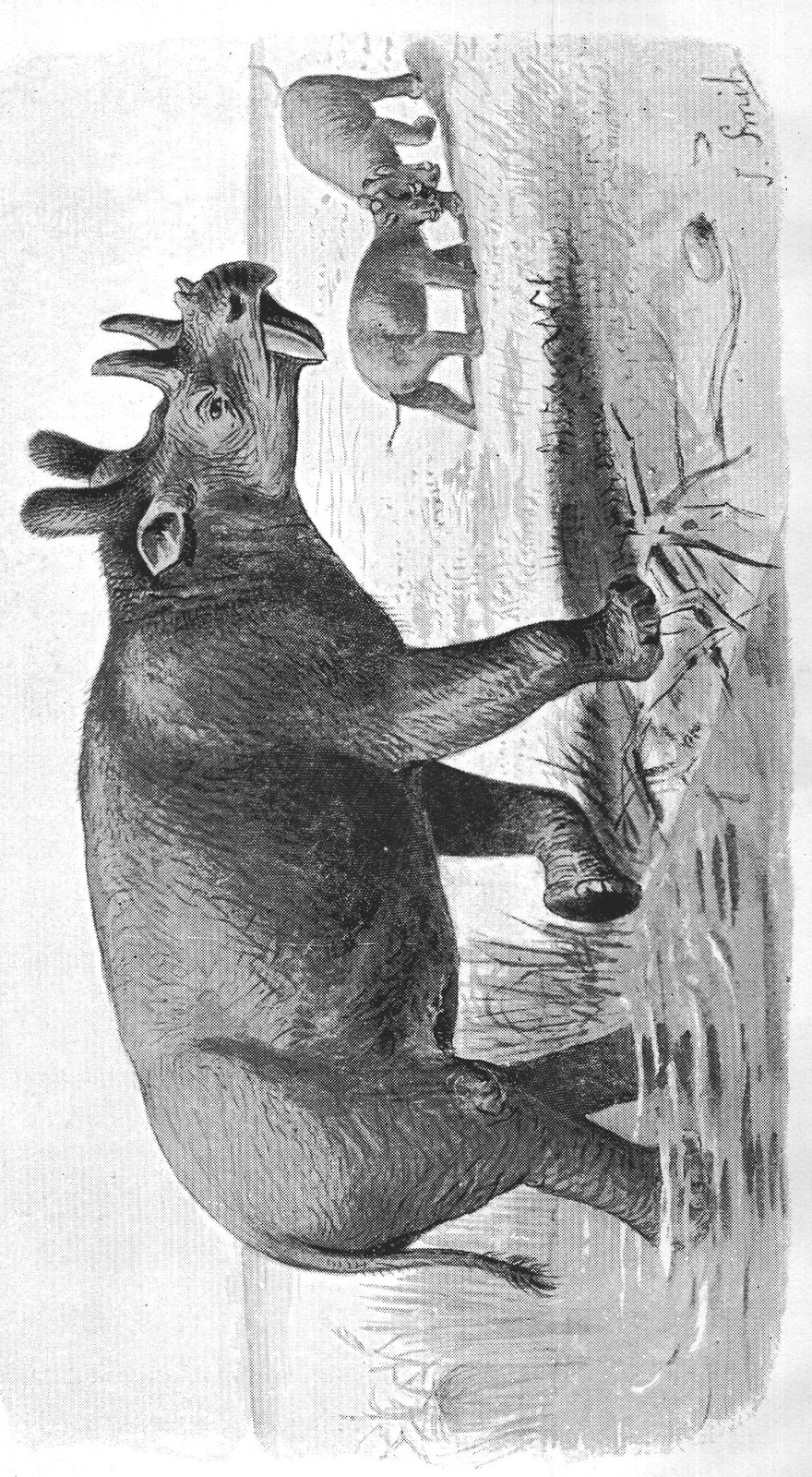
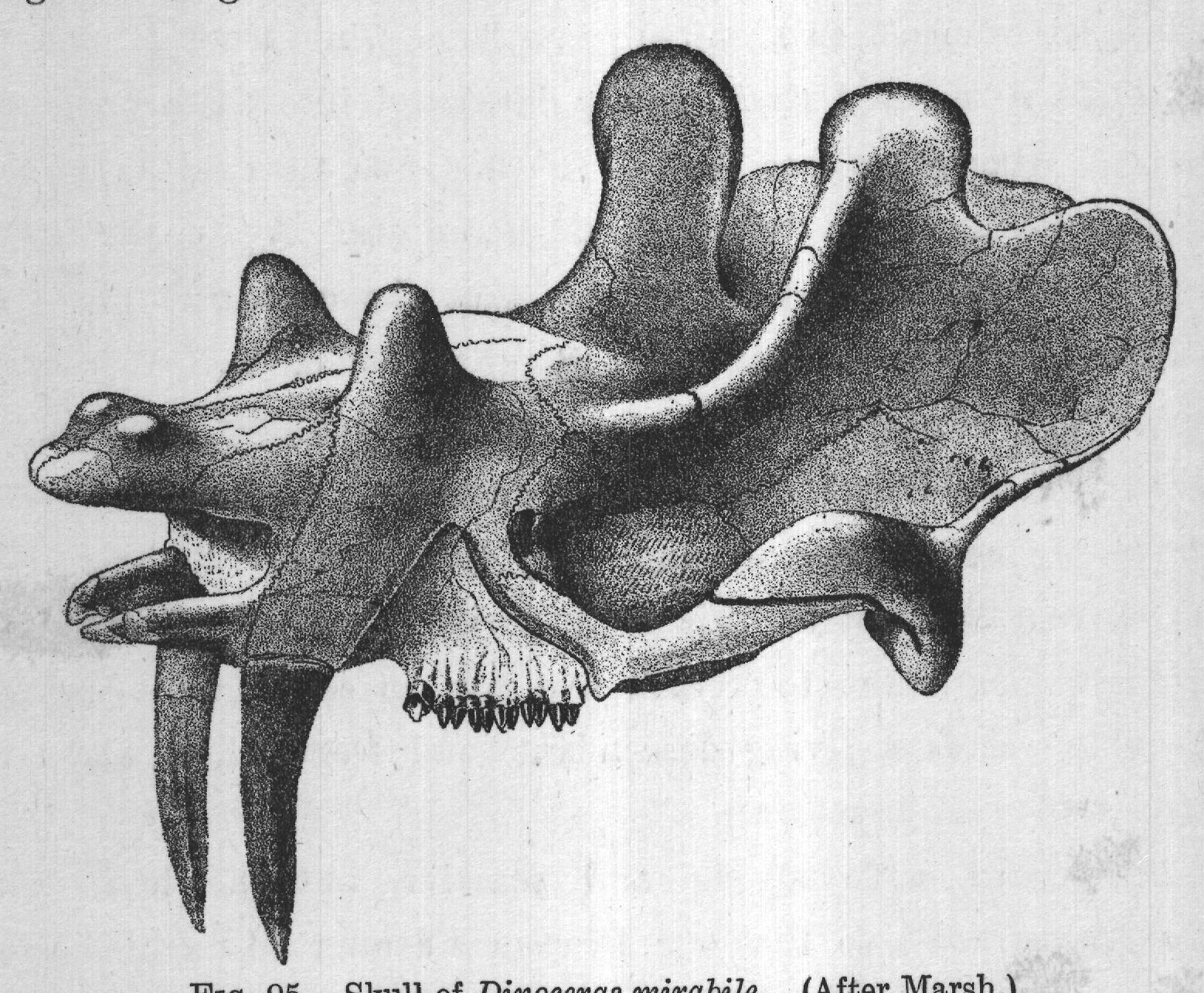
A LARGE EXTINCT MAMMAL, TINOCERAS INGENS. EOCENE PERIOD. From North America. Length about 12 feet (without the tail). J. Smil SOME EARLY MAMMALS دو It is quite clear, then, that we cannot place the Dinoceras in any order of living mammals. It is what palæontologists call a "generalised type; " that is to say, it presents certain characters seen in several groups of living quadrupeds, and not any of those elaborated or highly developed parts which we see in such animals to-day. Thus the proboscis of the elephant is the result of great elongation of the cheeks and nose of its ancestor (see FIG. 95.- Skull of Dinoceras mirabile. (After Marsh.) p. 269); in other words, the elephant is highly "specialised" in that direction, whereas our Dinoceras had no proboscis, or only a very slight one.
Again, the six remarkable bony protuberances of the skull served to some extent as horns, and probably were covered with thick bosses of skin, and did not support true horns like those of our modern oxen and other ruminants. Speaking of these protuberances, Professor Marsh says, "None of the covering of these elevations, or horn-cores, has, of course, been preserved; yet a fortunate discovery may perhaps reveal their nature by the form of a natural cast, as the eyeball of the Oreodon is sometimes thus clearly indicated in the fine Miocene matrix which envelops these animals." It looks rather as if we have here an early stage in the evolution of horns, and it may be that in the course of subsequent ages such prominences as those developed into true "horn cores," such as sheep or goats have, while the thick bosses of skin that covered them slowly developed into the true horns that are attached to these cores. If this is so, then we have here another instance of a "generalised" structure. Again, the limbs with their five toes tell us at once that the creature's place in Nature is outside of those two great groups of modern ungulates, or hoofed quadrupeds, the odd-toed and the even-toed, represented on the one hand by the horse, rhinoceros, and tapir, on the other by the pig, camel, deer, ox, and many other forms. Probably the two groups had not at this early period branched off from the primitive ungulate stock with five toes in each foot, of which the elephant is a living descendant, and from which also the Dinoceras must have come.
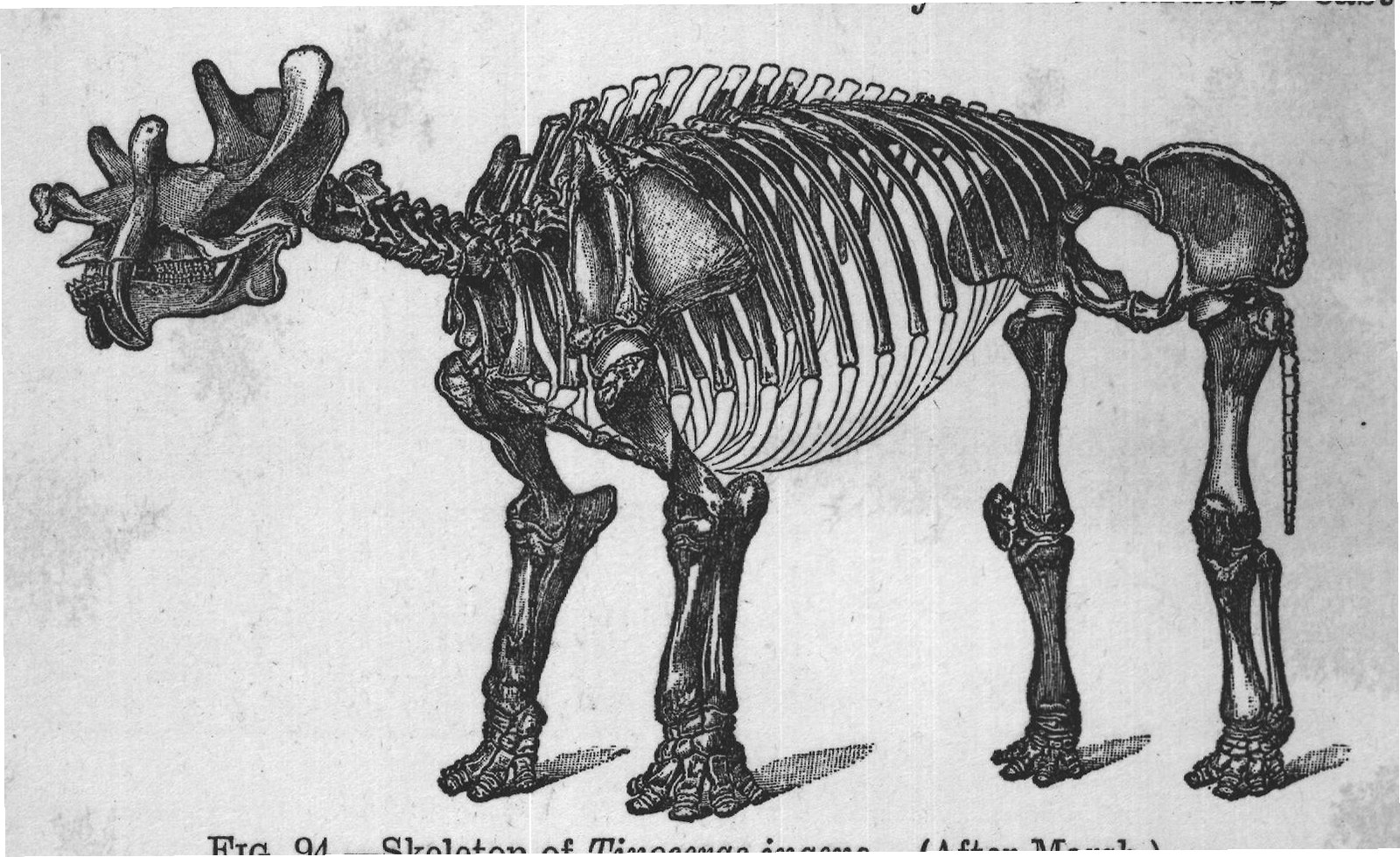
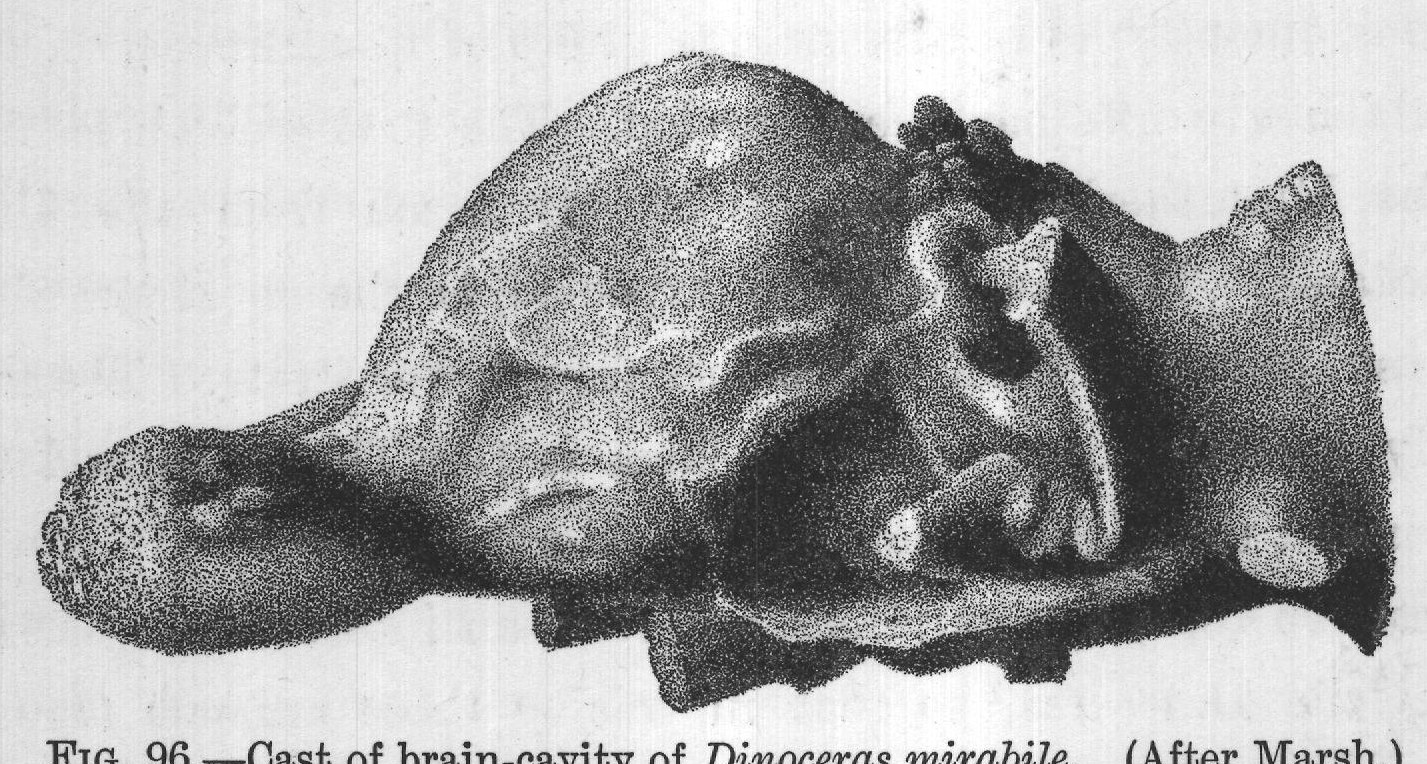
The limbs were strong and massive, but the brain was remarkably small, so that our Dinoceras cannot be credited with any high degree of intelligence: and here again we see an absence of "specialisation" compared with the sagacious elephant. Professor Marsh has taken casts of its brain-cavity (see Fig. 96). These casts show that the brain was smaller (in proportion to the size of the animal) than in any other mammal, whether living or extinct and even less than in some reptiles! In fact, it was a decidedly reptilian kind of brain. Perhaps it may seem hardly credible, but so small was the brain of Dinoceras mirabile, that it could have been pulled through the apertures (neural canal) SOME EARLY MAMMALS of all the neck vertebræ! In certain marsupials of the present day we find an approach to this kind of brain. It seems to be an established fact, according to Professor Marsh, that all the Eocene or earlier Tertiary mammals had small brains. His researches among fossil mammals have led him to the important conclusion that, as time went on, the brains of mammals grew larger; and thus he has been able to establish his law of braingrowth during the Tertiary period, a law which appears to be plainly recorded in the fossil skulls of succeeding races of ancient mammals. The importance of a discovery such as this cannot FIG. 96. Cast of brain-cavity of Dinoceras mirabile. (After Marsh.) fail to strike the imagination of even the most unlearned in geology as being singularly suggestive and instructive. It is not difficult to picture these dull, heavy, slow-moving creatures haunting the forests and palm jungles around the margin of the great Eocene lake, into the waters of which their carcases from time to time found their way-perhaps swept down by floods. No footprints have been discovered as yet.
The Dinocerata were very abundant for a long time during the middle of the Eocene period. The position of their remains suggests that they lived together in herds, as cattle do now, and they probably found an abundance of food in the shape of S succulent vegetation round the great lake. Geological evidence points to their sudden extinction before the close of the Eocene period; but it is difficult to understand this.
In the museum at Yale College are collected the spoils of numerous expeditions to the West, and the many tons of bones lying there are believed to represent the remains of no less than two hundred individuals of the Dinocerata. So perfectly have these bones been preserved by Nature that, even if the creatures had been living now, the material for studying their skeletons could hardly be more complete. Professor Marsh recognises three distinct types in this strange group of quadrupeds, on each of which a genus has been founded. The first and oldest form is the Uintatherium, which takes its name from the Uinta Mountains. This, as might be expected, is the most primitive or least specialised form, and comes from lower strata. The most highly developed or specialised form is the Tinoceras, and this is found at the highest geological level or "horizon." Between these two extremes, and from an intermediate horizon, comes the Dinoceras,¹ so that in tracing these animals through the strata in which they occur the geologist finds that he is following for a while the course of their evolution. Doubtless there were many slight differences presented by the members of this group, but at present it has not been found possible to determine the number of species, although about thirty forms more or less distinct have been recognised. Professor Marsh says that the specimen of the skull of Dinoceras mirabile, on which the whole order Dinocerata was founded, is, fortunately, in a very perfect state of preservation, and that it belonged to a fully adult animal. Moreover, it was embedded in so soft a 1 The Dincoeras of Marsh is the same form as Eobasileus of Cope. Uintatherium was discovered by Leidy. SOME EARLY MAMMALS matrix that the brain-cavity and the openings leading from it could be worked out without difficulty.
It is about forty-one years since the wonderful forms of life sealed up within these Eocene lake-deposits first became known to science. Long before then, however, the wandering Indian had been accustomed to seeing strange-looking skulls and skeletons that peeped out upon him from the sides of cañons and hills, as the rocks that enclosed them crumbled away under the influence of atmospheric agents of change the ceaseless working of wind, rain, heat, and cold. To his untrained mind no other explanation suggested itself than the idea that these were the bones of his ancestors, which it would be highly impious to disturb. Requiescant in pace! So he left them in peace. Perhaps he believed in a former race of human giants; if so, these would be their bones. Long before Professor Marsh's expeditions, the earliest squatters, trappers, and others used to bring back news of marvellous monsters grinning from the ledges of rock beneath which they camped. At last these tales attracted the notice of some enthusiastic naturalists in the eastern States. Professor Leidy obtained a number of bones, from which he was able to bring to light an extinct creature at that time unknown to science, namely, the Uintatherium. Professor Cope also described some extinct animals disinterred by himself from the same region.
But our knowledge of the Dinocerata is chiefly due to Professor Marsh, who has despatched one expedition after another, and who, after many years of laborious research both in the western deserts and in his wonderful collection at Yale College, has published a splendid monograph on the subject. No trouble and no expense have been spared in order to obtain material for this great work, and all geologists must feel grateful to Professor Marsh for so liberally devoting his time and his private resources in order to advance the science of Palæontology.