Home › Some Early Mammals and the Story of the Horse › Some Early Mammals and the Story of the Horse: Coryphodon
Some Early Mammals and the Story of the Horse: Coryphodon
SOME EARLY MAMMALS ridged and pointed grinding surfaces indicate that they were intended to be applied to the coarser kinds of vegetable substances. According to Owen, certain fossils from the lignite deposits of. Soisson, Laon, and Meudon, in France, belong to Coryphodon, Speaking of a tooth from Soisson, Cuvier said that the entire skeleton was found indicating an animal almost as large as a bull, but that the workmen employed in the sand-pit (sablière) unfortunately preserved only that one tooth. The first specimen of Coryphodon discovered in America was found in 1871, near Evanston, Wyoming, by Mr. William Cleburne, while engaged as surveyor for the Union Pacific Railroad, who secured chiefly its teeth and vertebræ. More or less perfect specimens were afterwards obtained by Cope during his explorations in New Mexico, under the survey of Captain Wheeler. Regarded merely as a fossil, it is characteristic of the Lower Eocene of Europe and America; in North America it is confined to the Wasatch and Wind River epochs, and is absent from the Upper Eocene of both countries.
Coryphodon is particularly interesting on account of the primitive features of its skeleton; the brain was very small and of a low type. Professor Cope places it, with its allied forms, in a separate order, to which he gives the name Amblypoda, on account of their elephantine limbs and probable ambling gait.1 C. hamatus was about six feet long; while some species were no larger than a tapir, others were as big as an ox (see Plate XL.). Professor Cope thinks that in general appearance the Coryphodons resembled the bear more than any other living animal, with the important exception that in their feet they were like elephants. 1 Mr. Charles Earle, after a careful revision of this family, has suggested that Cope's species should be greatly reduced in number, many of them in his opinion being only due to differences of age and sex. Bathmodon, Metalophodon, Ectodon, Manteodon may all be included in the genus Coryphodon. The artist and author, however, in making the accompanying restoration, have been guided by the evident relationship between Coryphodon and the Tinoceras. "The movements of the Coryphodons," says Professor Cope, “doubtless resembled those of the elephant in its shuffling and ambling gait, and may have been even more awkward from the inflexibility of the ankle. But in compensation for the probable lack of speed, these animals were most formidably armed with tusks. These weapons, particularly those of the upper jaw, were more robust than those of the carnivora, and generally more elongate." There is no evidence that they had a proboscis-in fact, it is practically impossible. We may suppose from the nature of the teeth, and from other evidence, that they were vegetable feeders, but not restricted to any particular class of food; to a large extent they were omnivorous, like the hogs of to-day.
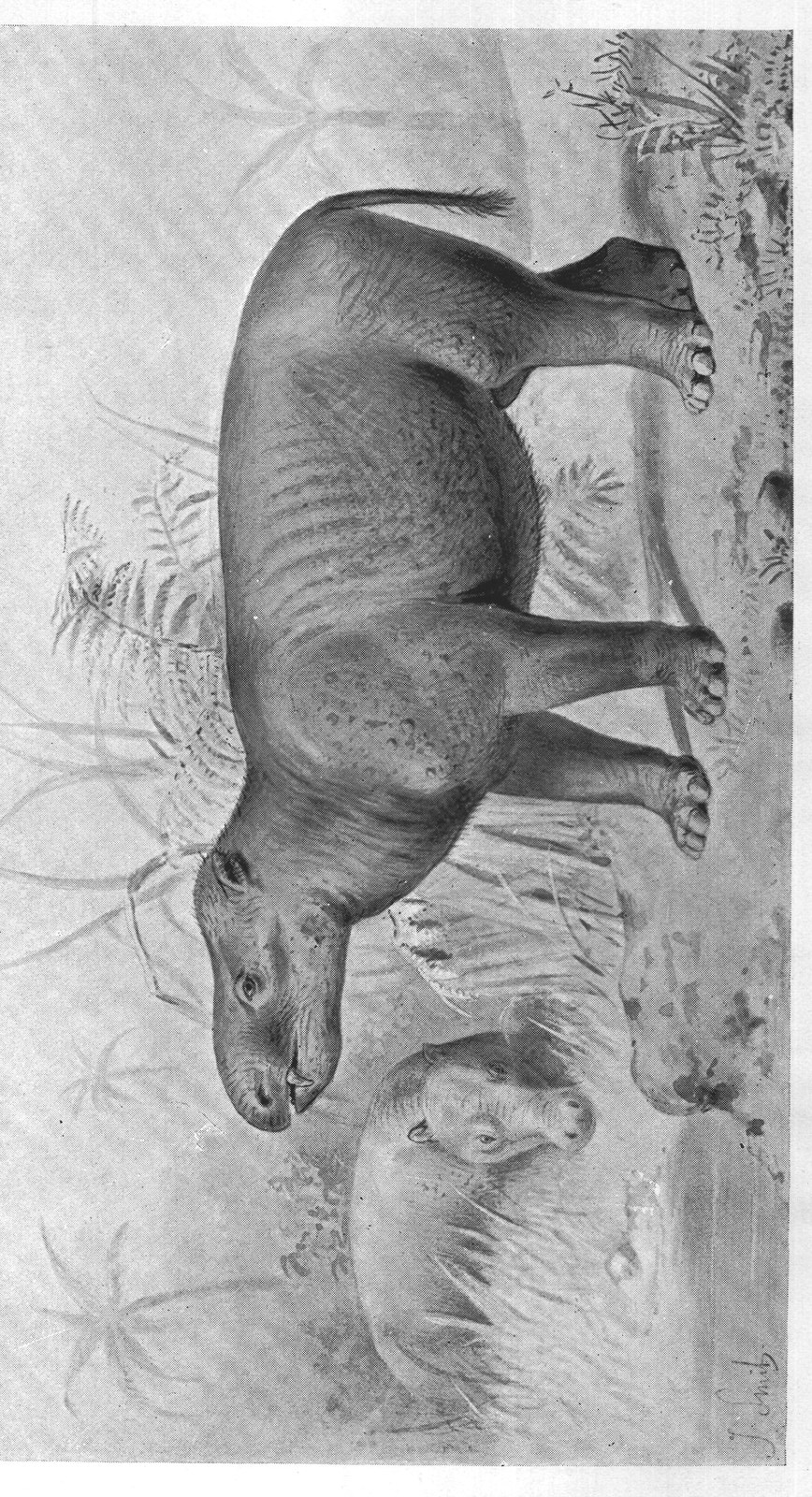
It is a little difficult to follow the curious interpretation arrived at by Professor Osborn and Dr. Wortman that "the positions of the fore and hind feet were absolutely different," the former being like those of the elephant (where only the tips of the toes touch the ground); the latter, in their opinion, like those of a bear and spreading out to rest on the ground (plantigrade).¹ This is not borne out by Professor Marsh's figure. Much valuable material for the study of the anatomy of this primitive mammal was collected by these two gentlemen, in spite of the many difficulties with which they had to contend, during their expedition, in the summer of 1891, into the Big Horn and Wind River regions, where the Wasatch strata are found.
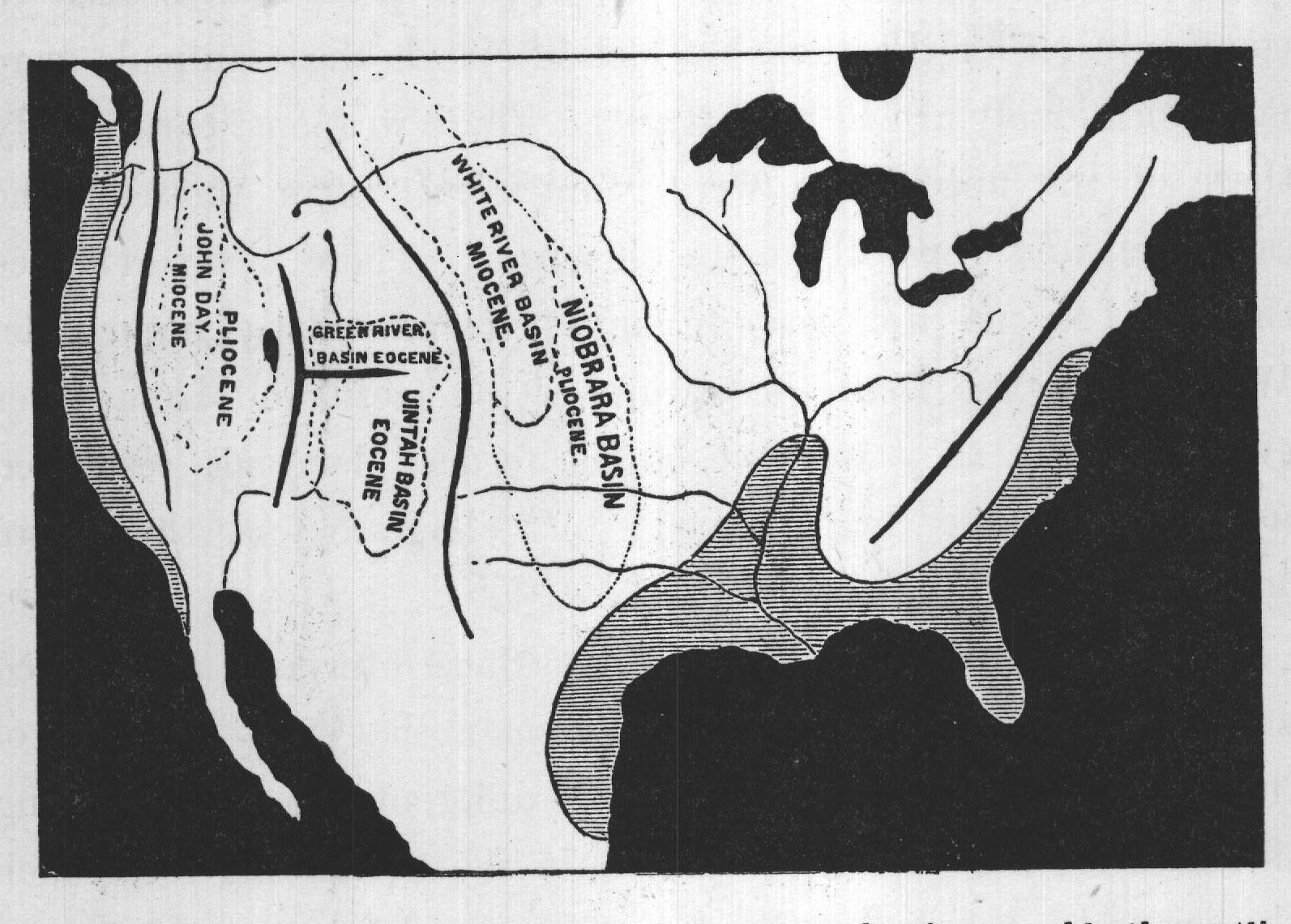
The sketch-map shown in Fig. 93 will give the reader a general idea of the positions of the different geological 1 Bulletin of the American Museum of Natural History, vol. iv. (1892), p. 121. ر SOME EARLY MAMMALS "basins"¹ in Western North America, where the strata have been found to yield so many valuable relics of ancient Tertiary life.
American geologists tell us that a long time ago (during the Eocene period) there was a great tropical lake in the Wyoming territory, on the borders of which roamed, amidst luxuriant PLIOCENE MIOCENE JOHN DAY. --PLIOCENE.