Home › Some Early Mammals and the Story of the Horse › Some Early Mammals and the Story of the Horse: History
Some Early Mammals and the Story of the Horse: History
South America had some peculiar horses of its own; for further information the reader should consult the Guide to the Horse Family, by Mr. R. Lydekker, F.R.S., to be obtained at the Natural History Museum (price one shilling).
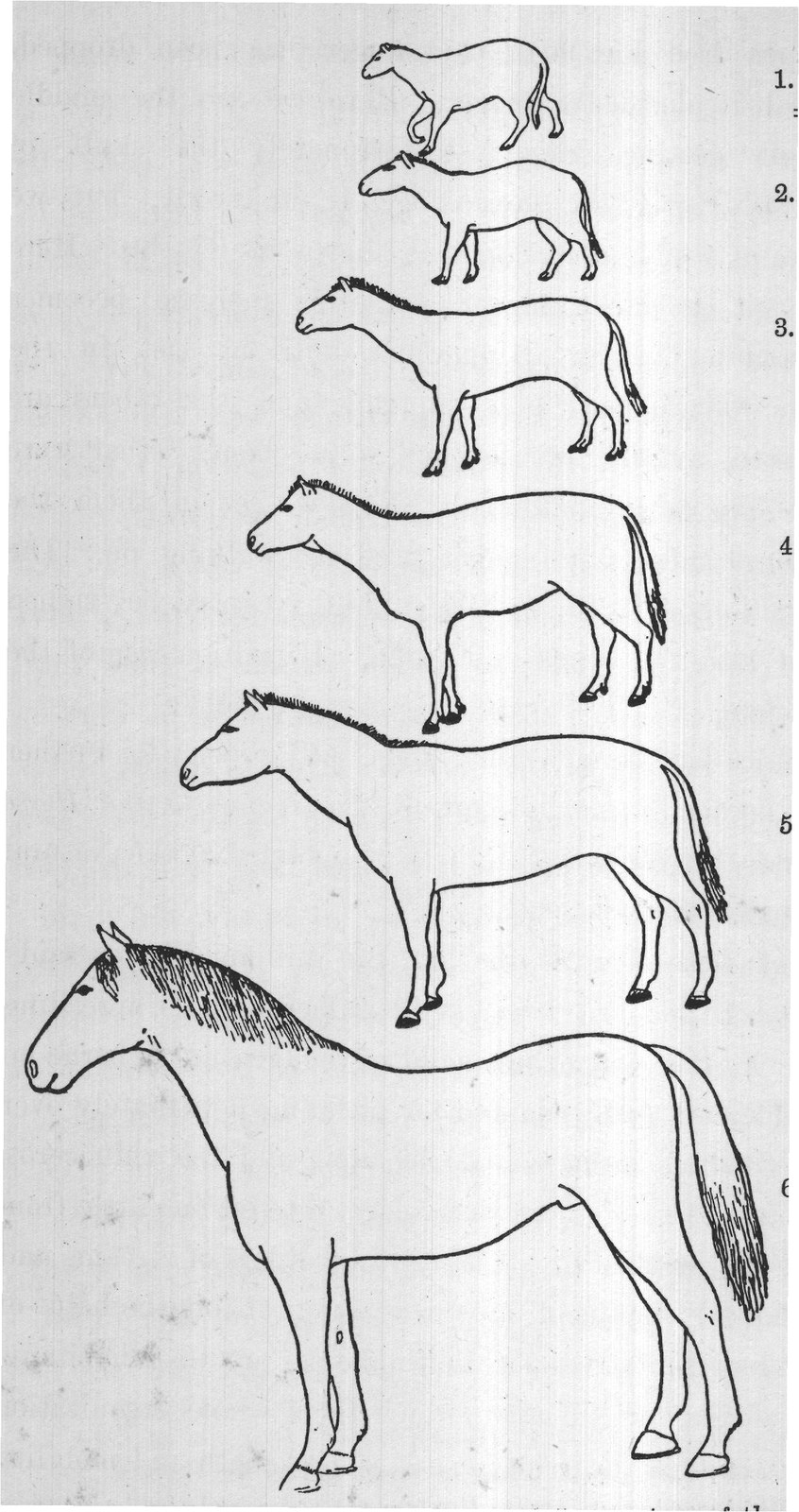
Speaking of these changes, the late Sir William Flower said,¹ "Short, stout legs and broad feet, with numerous toes, spreading apart from each other when the weight of the creature is borne on them, are sufficiently well adapted for plodding deliberately over marshy and yielding surfaces, and the tapir and the rhinoceros, which in the structure of their limbs have altered but little from the primitive Eocene forms, still haunt the borders of streams and lakes and the shady depths of forests, as was probably the habit of their ancient representatives; while the horses are all inhabitants of the open plains, for life upon which their whole organisation is in the most eminent degree adapted. The length and mobility of the neck, position of the eye and ear, and great development of 1 The Horse: A Study in Natural History. (London, 1891.) SOME EARLY MAMMALS 1. Hyracotherium = Protorohippus. 2. Orohippus. 3. Mesohippus allied to the Anchitherium. 4. Merychippus (Protohippus). 5. Pliohippus. 6. Equus caballus.