Home › Armoured Dinosaurs and the Iguanodon › CHAPTER IX: Nopcsa
Armoured Dinosaurs and the Iguanodon: Nopcsa
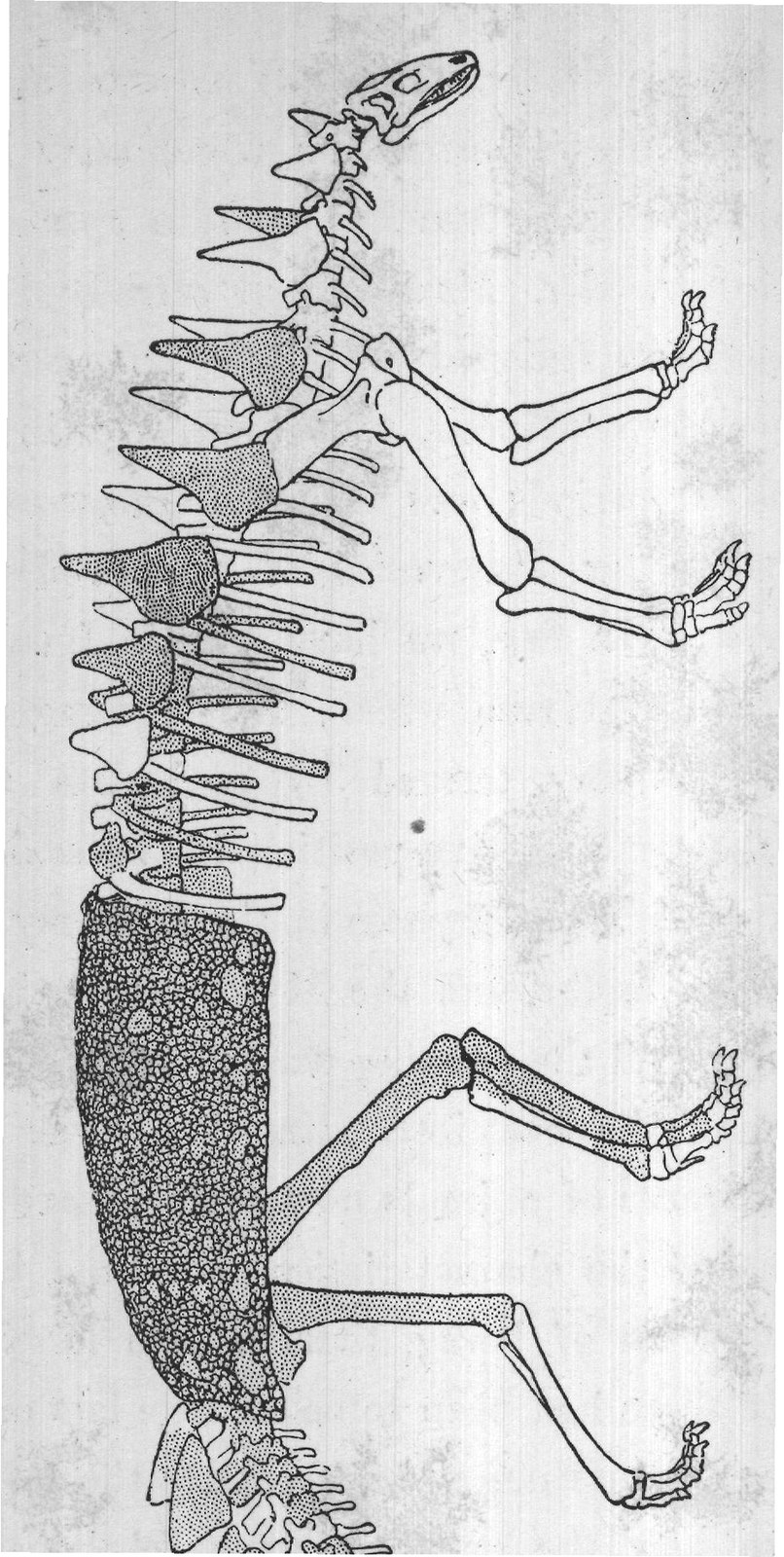
The researches of Baron Nopcsa show that this Dinosaur was provided with a thin but well-developed armour, consisting of large, thin, and flat bony plates, feebly punctured. The base of the skull is very bird-like, as in some of the group Theropoda. The eyes had no sclerotic plates, as Mr. Hulke thought. But there were in existence during the long Jurassic period other and even stranger forms of Dinosaurs with armour. One of these, only imperfectly known at present, was the manyspined Polacanthus. This remarkable monster had the whole FIG. 59. Skeleton of a small Dinosaur, Hypsilophodon Foxi, from Wealden strata, Isle of Wight. Restored by Professor J. W. Hulke, F.R.S. From the Philosophical Transactions of the Royal Society, vol. 173. region of the loins and haunches protected by a continuous sheet of bony plate armour, rising into knobs and spines, after the fashion of the shield or carapace of certain extinct armadillos known as Glyptodonts (see Chap. XV.). Fig. 60 shows a partial reconstruction of the skeleton. The shaded parts of the drawing indicate the parts actually preserved, the rest is reconstructed with the help of the bones of an allied Dinosaur: e.g. Stegosaurus. From this we see that Polacanthus was a reptile of low stature. It was a slow-moving vegetable feeder, according to Baron Nopcsa, 1 From Greek-polus, many, and acantha, spine.
J. Smits PLATE XXV.
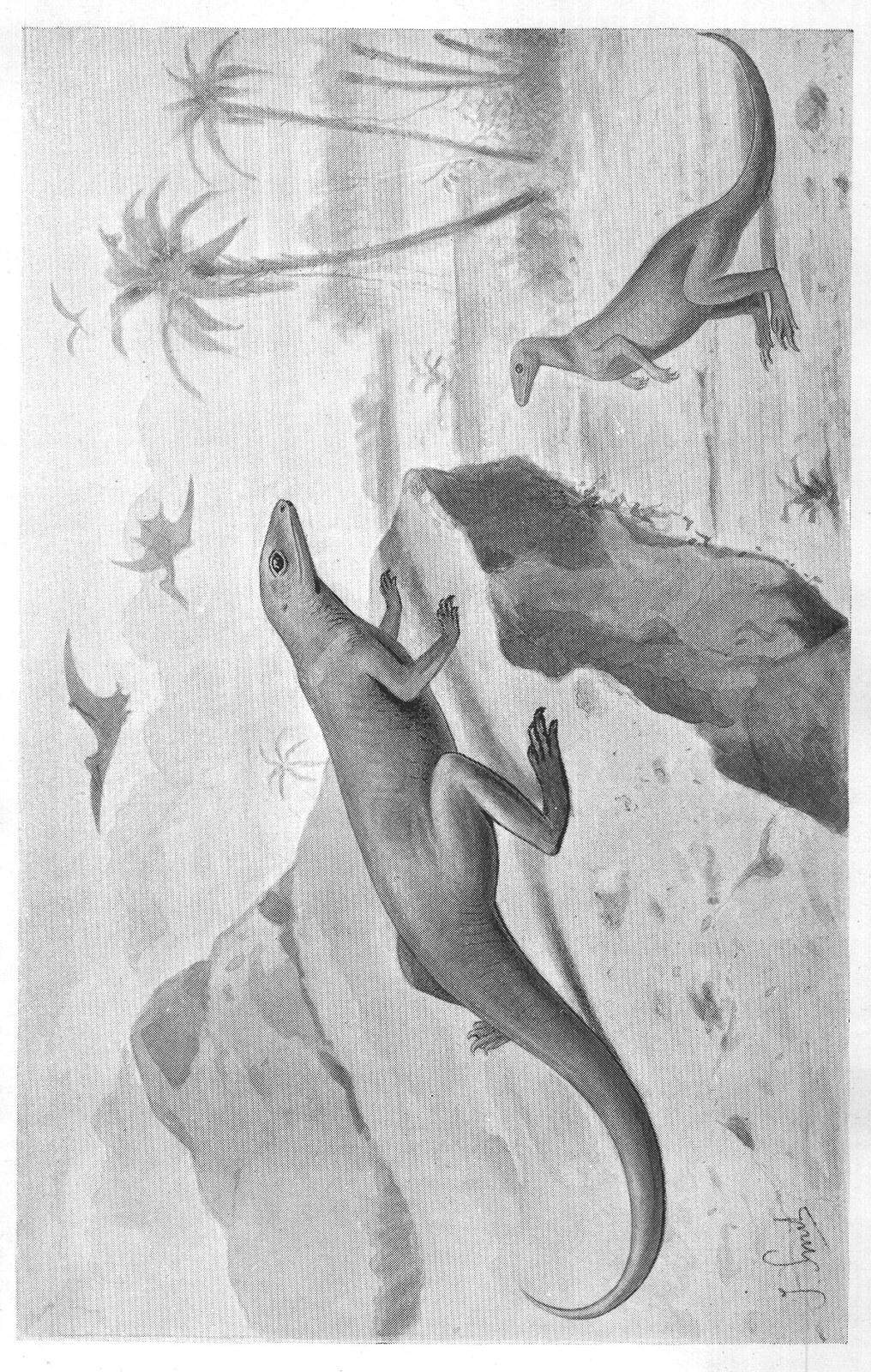
A SMALL DINOSAUR, HYPSILOPHODON. PTERODACTYLS IN THE AIR. CRETACEOUS PERIOD. GADG MOUYORMAN DINOSAURS FIG. 60. Reconstruction of skeleton of an armoured Dinosaur, Polacanthus foxi. (By Baron Nopcsa.) Wealden strata, Isle of Wight. Height about 3 feet. By permission of Baron Nopesa and the Geological Magazine. who, with the assistance of Dr. Smith Woodward and the late Mr. Barlow, made the above restoration which may be seen at South Kensington. Baron Nopcsa has made a special study of Dinosaurs in Hungary. Dr. Mantell had already pointed out certain analogies between Iguanodon and the huge extinct sloths of the South American continent, that flourished in the much more recent Pleistocene period; and this idea is now considerably strengthened by the later discoveries of armoured Dinosaurs. These are his words: "In fine, we have in the Iguanodon the type of the terrestrial herbivora which, in the remote epoch of the earth's physical history termed by geologists the age of Reptiles, occupied the same relative position in the scale of being, and fulfilled the same general purposes in the economy of nature, as the Mastodons, Mammoths, and the Mylodons (extinct sloths) of the Tertiary period, and the existing pachyderms." It is, perhaps, one of the most interesting discoveries of modern geology, that certain races of animals now extinct have in various ways assumed some of the characteristics presented by animals much higher in the scale of being, that flourish in the present day. It seems as if there had been some strange law of anticipation at work, if we may venture so to formulate the idea. It has already been shown how the great saurians Ichthyosaurus and Plesiosaurus presumed to put on some of the characters of whales, and to play their rôle in nature, though they were only reptiles; how the carnivorous Dinosaurs acquired teeth like those now possessed by lions and tigers, which also are mammals; and now we find herbivorous Dinosaurs imitating the Glyptodon, an armadillo that lived in South America almost down to the human period. We shall not lose sight of this very interesting and curious discovery, for other cases will present themselves to our view in future chapters. The reader might ask, "If reptiles DINOSAURS were able in these and other ways to imitate the mammals of to-day, or of yesterday, why should they not have been able to go a few steps further, and actually become mammals?" The Evolutionist, if confronted with such a question, would say, that there is no evidence of Dinosaurs turning into mammals, but that both may have branched off at an early geological period (say the Permian) from a primitive group of reptiles, or even of amphibians.
It must be borne in mind that, during the "age of reptiles" (Mesozoic period), the mammalian type was but feebly represented by certain small and humble forms, probably marsupials. As far as we know, there were no big quadrupeds such as flourish to-day; therefore reptiles played their part, and in so doing acquired some of their habits and structural peculiarities. It is difficult for us, living in an age of quadrupeds, to realise this, and to picture to ourselves reptilian types posing as "lords of creation," or, to use a homely phrase, "strutting in peacock's feathers." We now pass on to describe two of the strangest and most wonderful of all the Dinosaurs, recently discovered in the far West. The first of these is the Stegosaurus,¹ or plated lizard, not wholly unknown before, because part of its skeleton was found some years ago in a brickfield in the Kimmeridge Clay at Swindon. It has been proved that some of the bones to which the name Omosaurus 2 has been applied really belonged to the former genus.
With such complete specimens now known by Professor Marsh's descriptions, it will not be necessary to mention the meagre remains discovered in this country, or the conclusions arrived at by Owen and Seeley, interesting as they are. 1 Greek-stegos, roof of covering; sauros, lizard, 2 Greek-omos, humerus, and sauros, lizard.