Home › Footprints on the Sands of Time › Footprints on the Sands of Time: Protichnites
Footprints on the Sands of Time: Protichnites
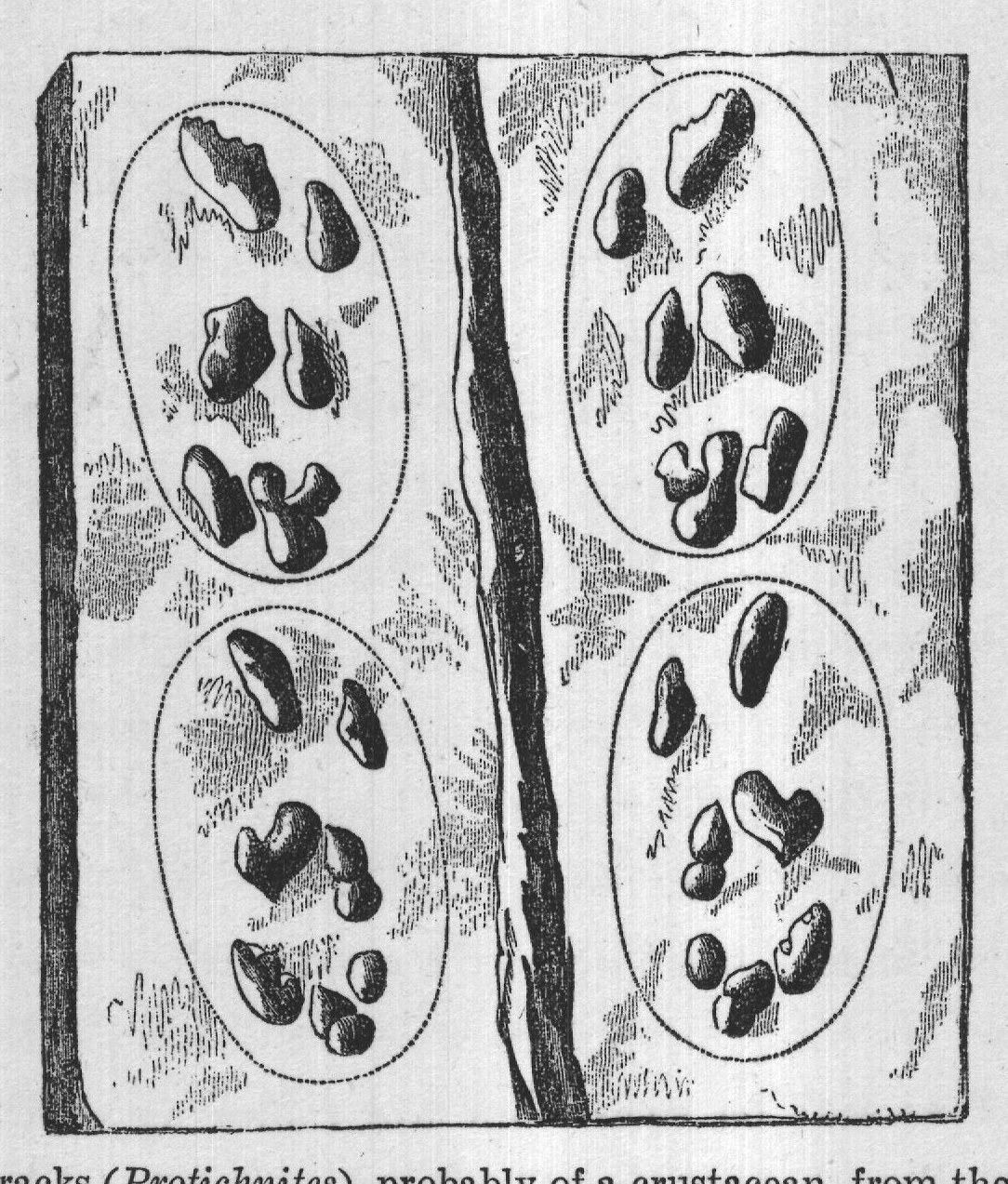
These very ancient tracks are known to geologists under the name Protichnites, and the creature that produced them must have made no less than fourteen impressions, seven on the right and seven on the left, each time its legs were set to work. There seems to be no doubt of this, because the groups of tracks, as marked out in our illustration, occur again and again in successive series so similarly and so regularly as to admit of no doubt that they were made by repeated applications of the legs, and these must have been capable of being moved so far in advance as to keep clear of the previous group of impressions. Sir Richard Owen concludes his account of the tracks by saying that the creature which made them was probably a crustacean genus, and that it may have had three pairs of limbs employed in locomotion, each of which was split up into two or more parts so as to make in walking either two or three tracks. The shape of the pits so clearly seen on these slabs of the old Potsdam Sandstone (although they have been rubbed and polished by the action of glacier-ice) suggests that they were made by the hard and partly pointed, partly blunt, terminations of the limb of a crustacean, such as a crab or lobster. But this creature moved directly forwards, not like a crab, but like a lobster or a king-crab. The furrow that runs between the tracks was probably made by a tail. The question then arises-what sort of a crustacean was it that made these tracks? Great caution is required in dealing with a problem of this kind, as will be seen from the following words of Sir R. Owen: "In all probability no living form of animal bears such a resemblance to that which the Potsdam footprints indicate as to afford an exact illustration of the shape and number of the instruments, and the mode of locomotion of the Protichnites." The imagination is baffled in the attempt to realise the extent of time past since the period when the creature was in existence which moved upon the sandy shores of the ancient Cambrian period, to which the "Potsdam Sandstone" belongs.