Home › Armoured Dinosaurs and the Iguanodon › CHAPTER IX: Stegosaurus
Armoured Dinosaurs and the Iguanodon: Stegosaurus
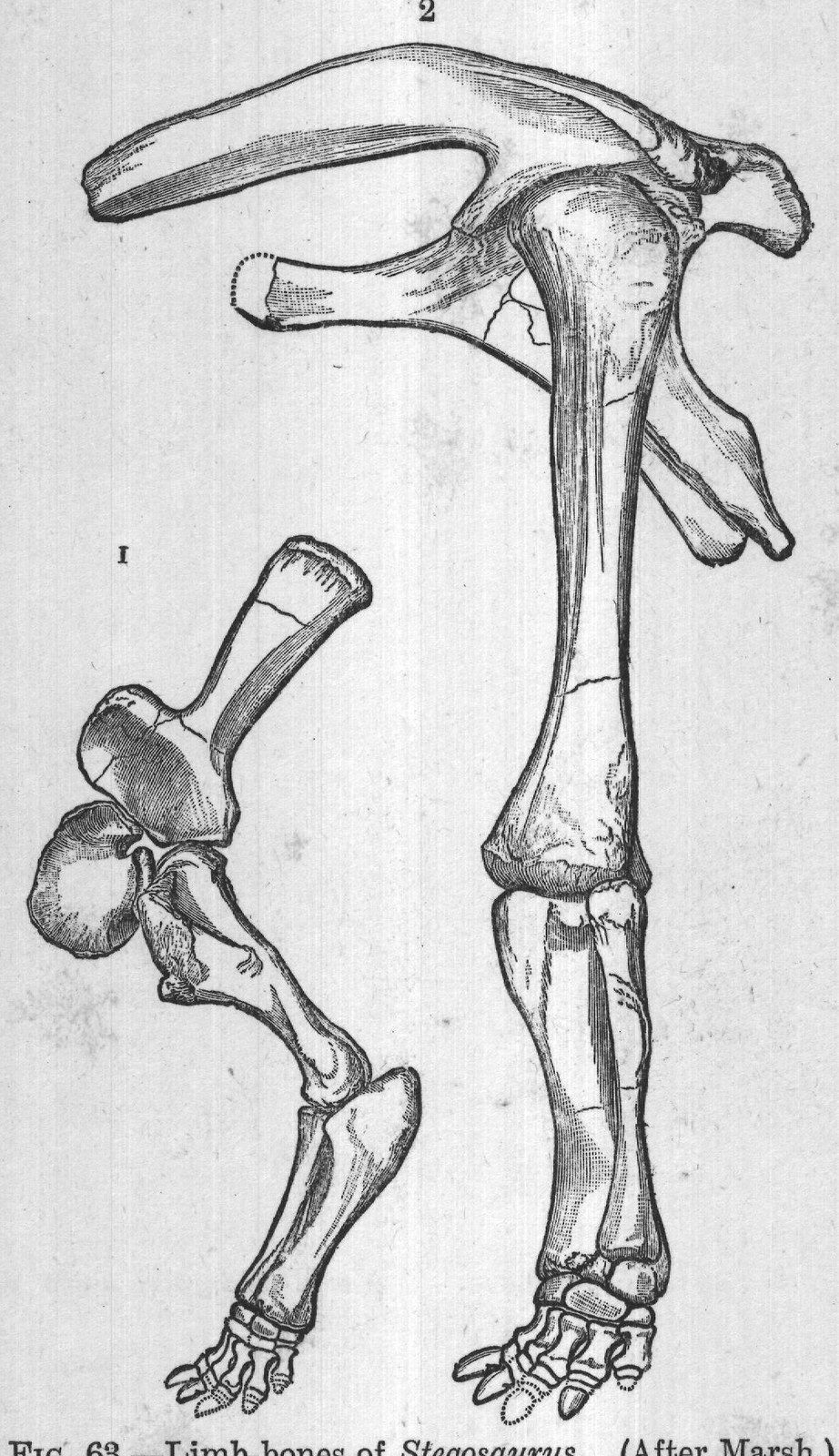
In the year 1877 Professor Marsh described, in the American Journal of Science, a considerable portion of a skeleton of a Stegosaur, remarking that this genus proved to be one of the most remarkable animals yet discovered. It was found on the eastern flank of the Rocky Mountains, in strata of Jurassic age; the bones indicated an animal about twenty-five feet long, and for this discovery Science is indebted to Professor A. Lakes and Engineer H. C. Beckwith of the United States Navy, who found the remains in Colorado, near the locality of the gigantic Atlantosaurus. The solid limb-bones seem to point to an aquatic life, but there can be little doubt that the monster did not pass all its time in the water. (Fig. 61 shows the skeleton.) In 1879 Professor Marsh announced the discovery of additional remains from several localities. The most striking feature-from which the Stegosaur takes its name was the presence of huge bony plates belonging to its skin, as well as large and small spines. Some of the plates were from two to three feet in diameter, and they were of various shapes. Of the spines, some were of great size and power, one pair being each over two feet long! The skull was remarkably small, and more like that of a lizard than we find in most Dinosaurs; the jaws were short and massive. Little was known at first of the brain, but fortunately a later discovery showed the brain-case well preserved. Later still, more than twenty other specimens of the Dinosaur were obtained, so that nearly every portion of the skeleton is now known. The skulls indicate that the creature possessed large eyes and a considerable power of smell. The jaws contain but a single row of teeth in actual use; but as these wore out, they were replaced by others lodged in a cavity below. Teeth, however, were not its strong point; they indicate a diet of soft succulent vegetation. The vertebræ have the ends of their MAAN armour of plates and spines with which the Stegosaur was N DINOSAURS centra more or less bi-concave. Many curious features in the skeleton can only be explained with reference to the heavy FIG. 61. Skeleton of Stegosaurus ungulatus; length about 25 feet. (After Marsh.) provided. Thus the vertebræ have their "neural spines" expanded at the summit to aid in supporting part of the armour. (See Fig. 62.) The fore limbs were short and massive, but provided with five fingers; the hind limbs were very much larger and more powerful. These and the powerful tail show that the monster could support itself on them as on a tripod, in an upright position, and this position must have been easily assumed in consequence of the massive hind quarters. As in Iguanodon, there were three toes to the hind feet, and these were probably 1 2 FIG. 62. Tail vertebræ of Stegosaurus. (After Marsh.) 1. Side view. 2. Front view. covered by strong hoofs. The fore limbs could move freely in various directions like a human arm, and were probably used in self-defence. (See Fig. 63.) But for this purpose the tail with its four pairs of huge spines would be very effective, and one could easily imagine that a single deadly blow from such a tail would be sufficient to drive away, if not kill, one of the carnivorous enemies of the species. All the plates and spines were, during life, protected by a thick horny covering, which PLATE XXVI.
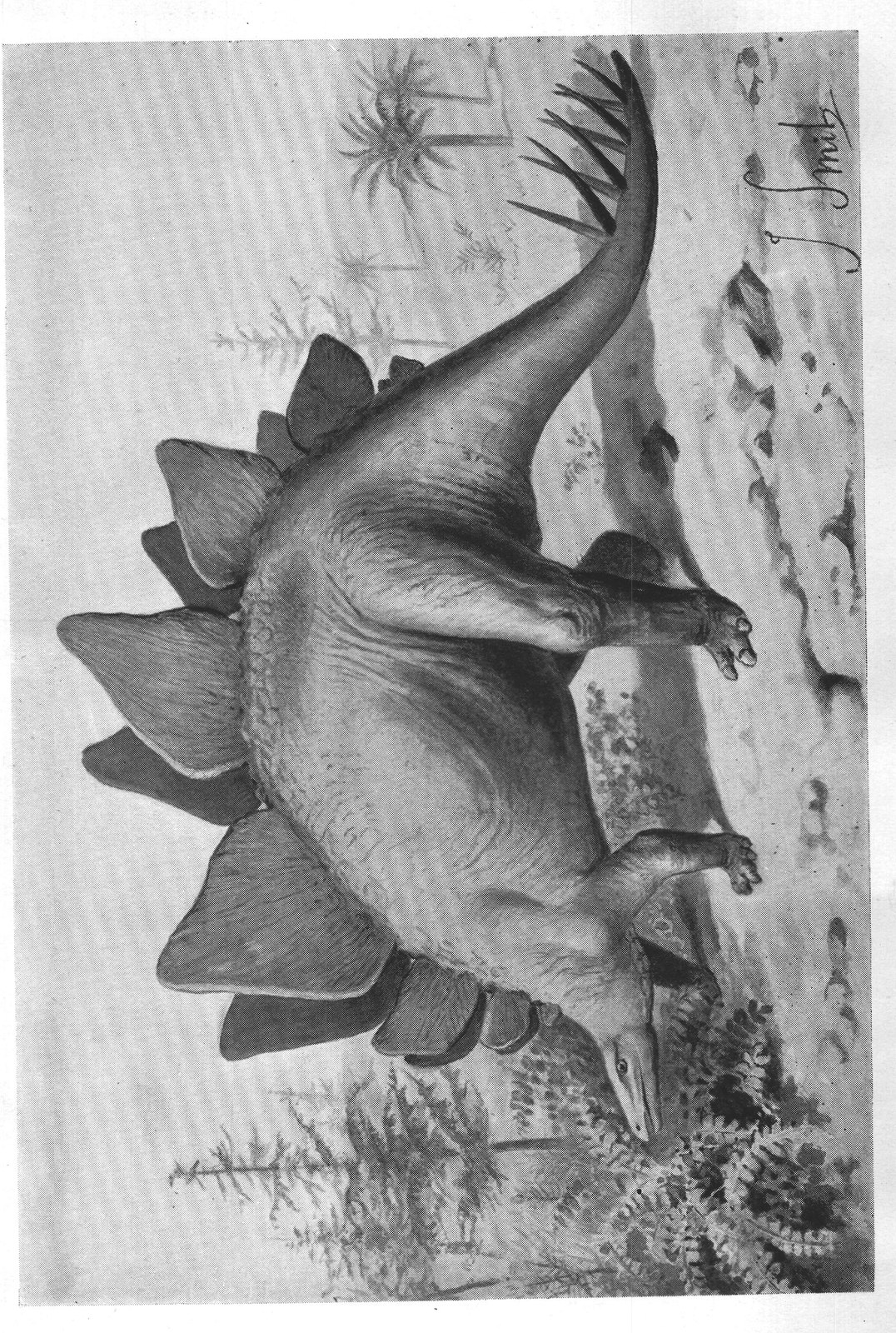
STEGOSAURUS UNGULATUS. FROM STRATA OF JURASSIC AGE. NORTH AMERICA. Length about 25 feet.
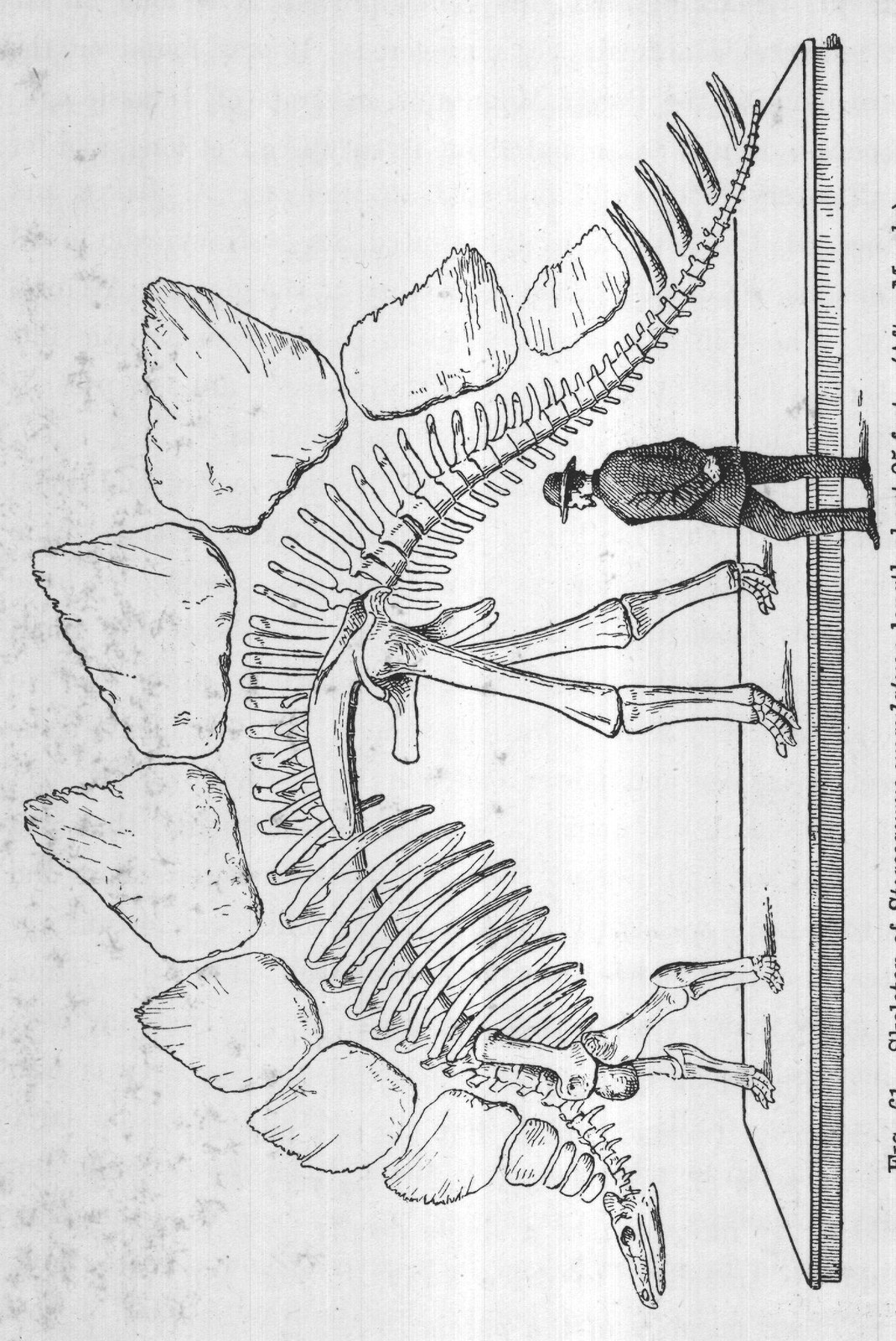
Illustration lent by H. R. Knipe (from Nebula to Man). DINOSAURS must have increased their size and weight. Such a covering seems to be clearly indicated by certain grooves and impressions that mark their surfaces. (See Fig. 64.) The largest plates are 2 I FIG. 63. Limb-bones of Stegosaurus. (After Marsh.) 1. Fore leg. 2. Hind leg. unsymmetrical, and were probably arranged along the back, in rows, as in our restoration, Plate XXVI. It will be noticed, by those who are familiar with our first edition, that this Plate gives a somewhat different representation of the Stegosaur, in which the length of the hind limbs is more apparent, and also they are more free from the body.
Finally, the Stegosaur displays a rather remarkable feature; for a very large chamber was found in the sacrum 1 formed by 1 2 FIG. 64.-1, 2. Plates of Stegosaurus. The middle figures show their thickness. (After Marsh.) an enlargement of the spinal cord.