Home › Armoured Dinosaurs and the Iguanodon › CHAPTER IX: Bernissart
Armoured Dinosaurs and the Iguanodon: Bernissart
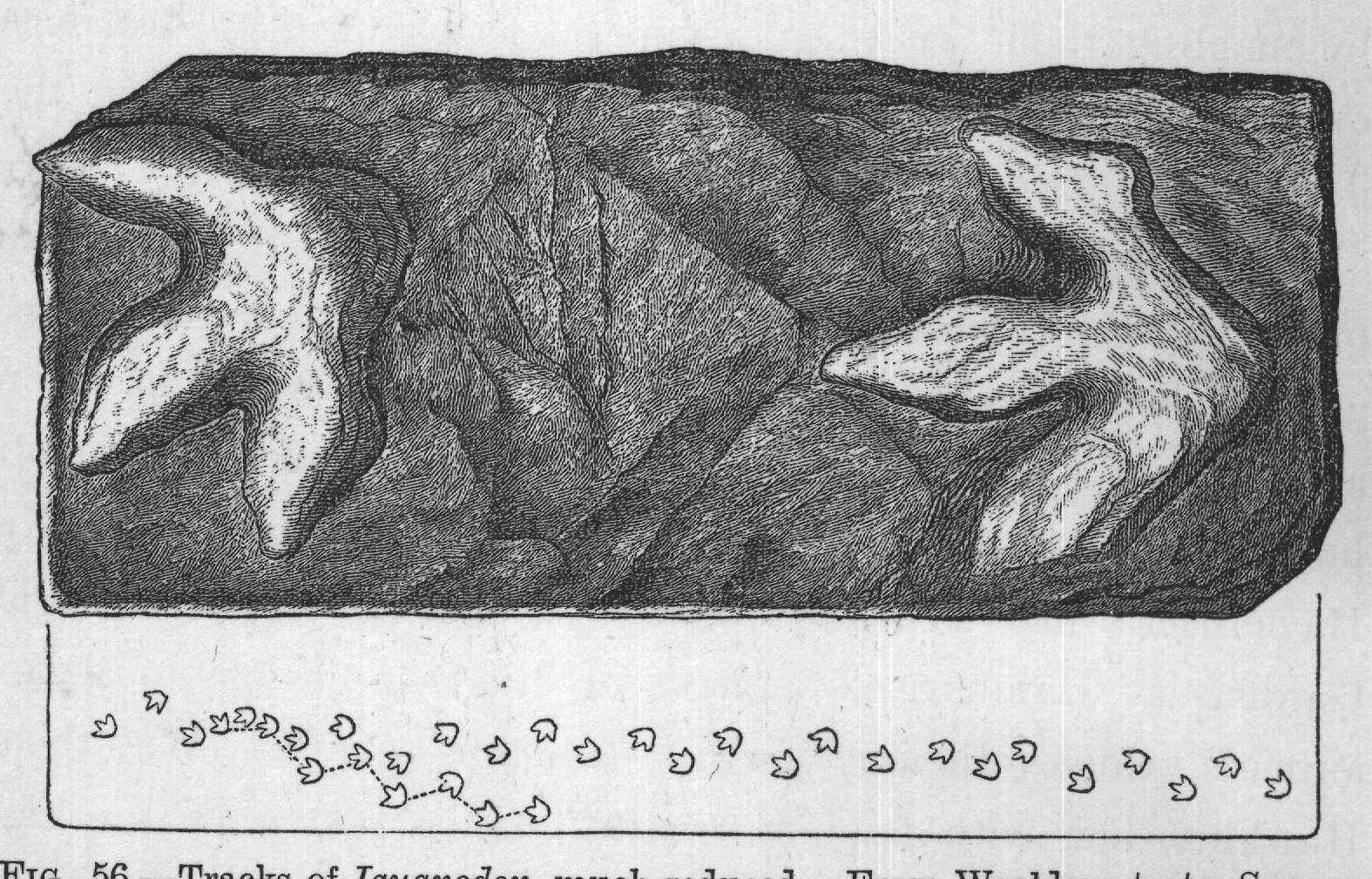
The Bernissart specimens even afford some evidence as to the nature of the integument, or skin, and this supports the idea previously held that the creature possessed a smooth skin, or, at least, only slightly roughened. The muzzle was quite toothless, and perhaps may have been sheathed in horn, like the beak ఎ ఇబ FIG. 56. Tracks of Iguanodon, much reduced. From Wealden strata, Sussex. of turtles-an arrangement highly useful for biting off the leaves of trees.
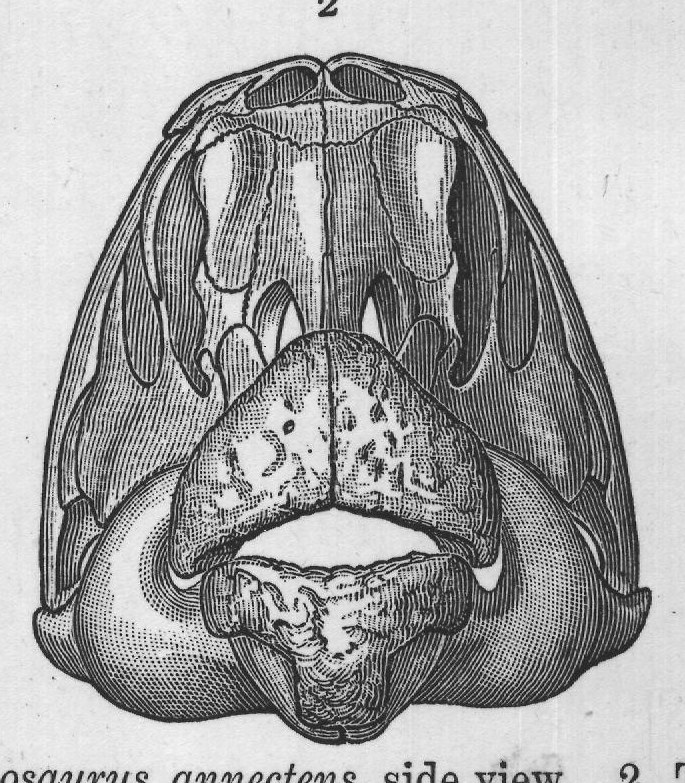
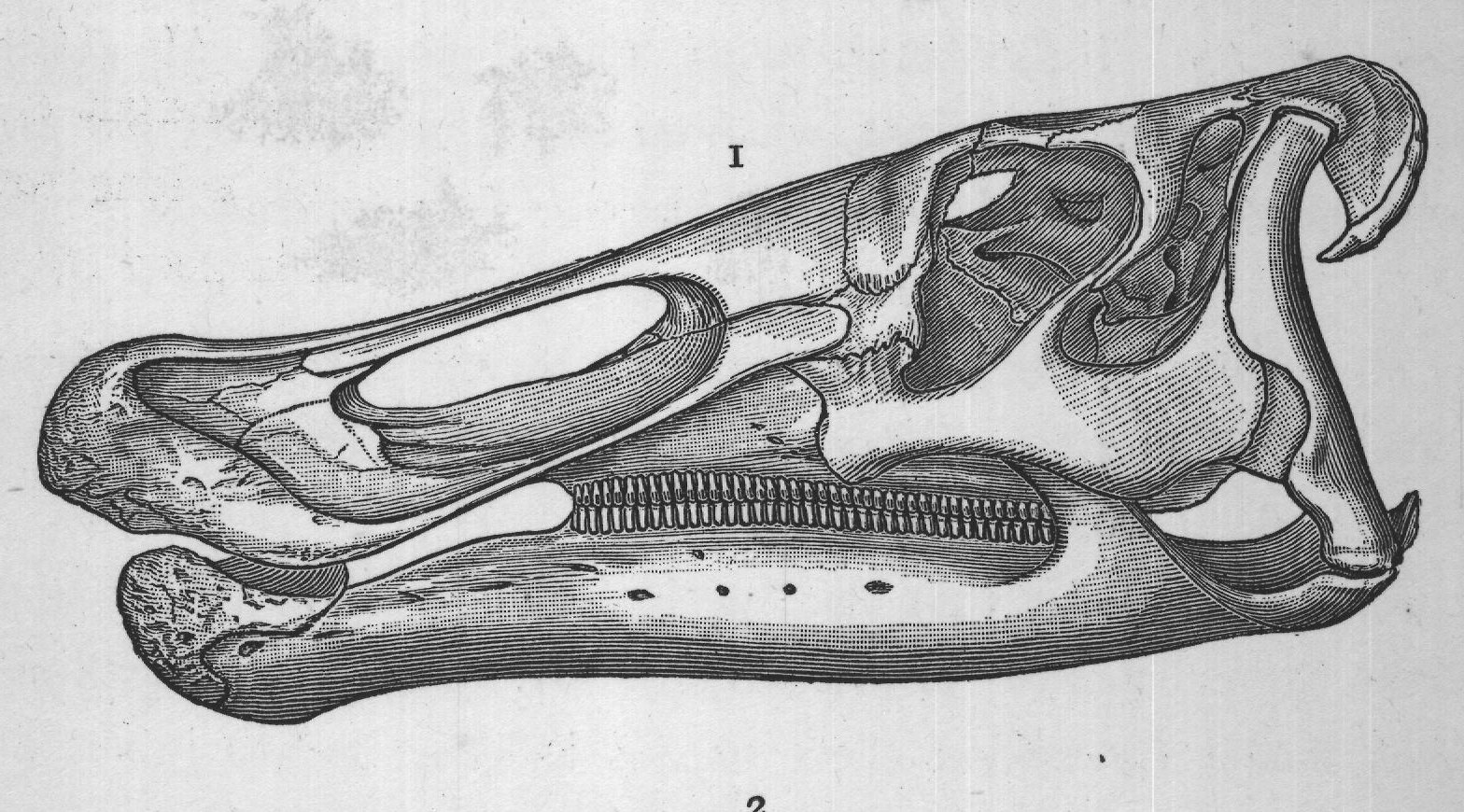
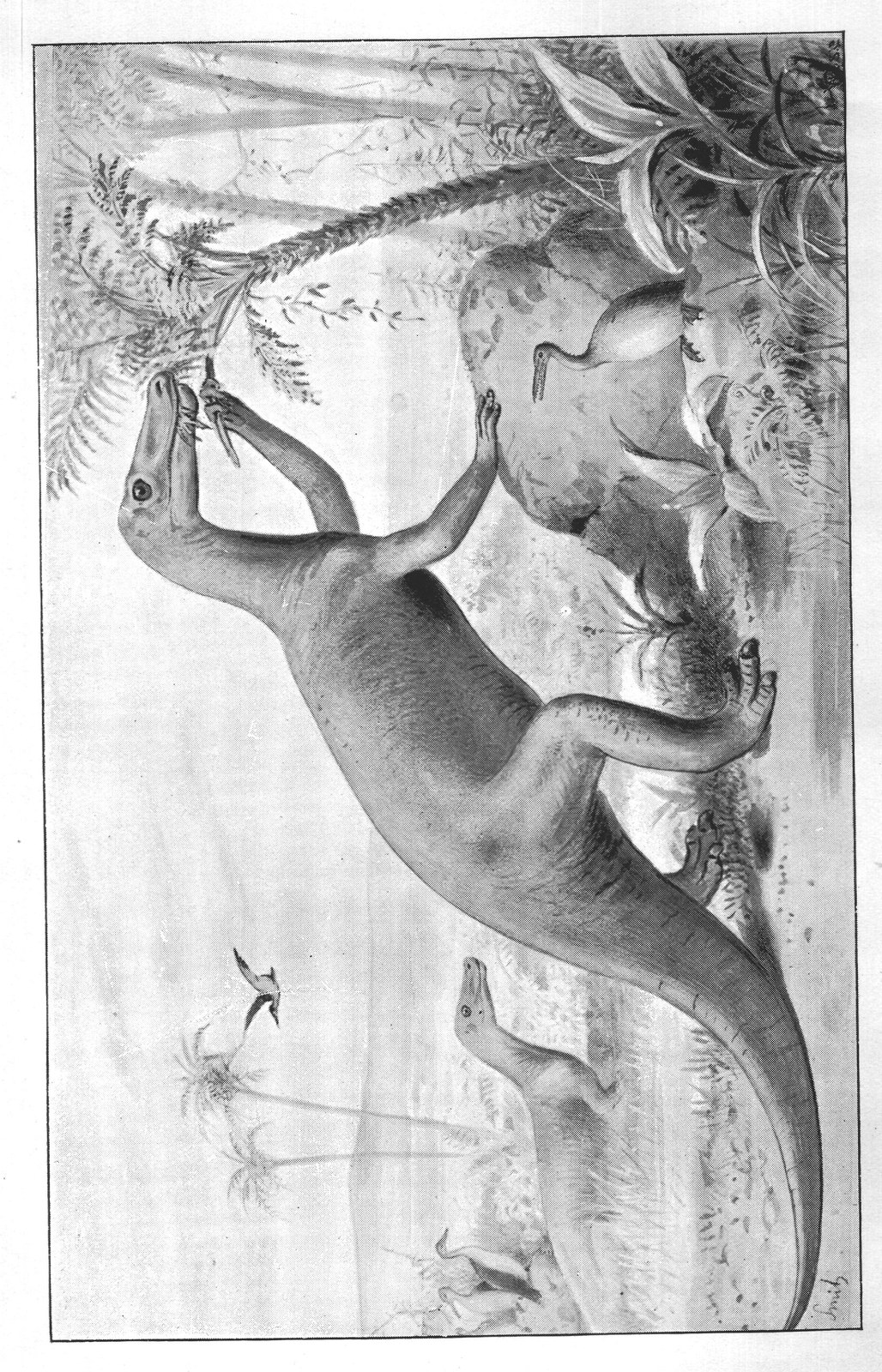
Probably it passed much of its time in the water, using its immense powerful tail as an organ of propulsion. When swimming slowly it may have used both sets of limbs, but when going fast it probably fixed its fore limbs closely beside its body, and drove itself through the water by means of the long hind limbs alone. M. Dollo, of Brussels, is preparing a final monograph on the Bernissart Iguanodons, a work to which palæontologists DINOSAURS eagerly look forward. The Brussels Museum now contains ten mounted specimens, and twelve more lying in position on the rock. There cannot be much doubt that these unarmoured Dinosaurs were molested and preyed upon by their carnivorous contemporaries, such as the fierce Megalosaurus, previously described (p. 134). And with regard to this, M. Dollo makes the suggestion that, when on land, their great height and erect posture enabled them to descry such enemies a long way off. Their great height must also have stood them in good stead, by enabling them easily to reach the leaves of trees, tree-ferns, cycads, and other forms of vegetable life, which constituted their daily food. (See Plate XXIII.) Should the reader visit the "geological island" in the grounds of the Crystal Palace, he will see that Mr. Waterhouse Hawkins's great model Iguanodon there set up is by no means in accordance with the description given above; but we must remember how imperfect was the material at his command. Mr. Karl Hagenbeck has recently added to his famous Zoological Gardens at Hamburg a number of life-size models of extinct animals, thus following in the footsteps of Mr. Waterhouse Hawkins, but with happier results. It is a step in the right direction, for the Science of Palæontology has made such great strides in the last forty or fifty years that a great deal of light has been thrown on the ancestry of living animals, and thus the student of life as it is to-day finds himself led back into past ages in order to get some glimpses into the evolution of the various orders and families now inhabiting the world. Just as the Ceratosaurus of the New World is represented by, or rather corresponds to, the Megalosaurus of the Old World, so the other newly discovered Dinosaur, which we are about to describe, shows a good deal of correspondence with the now well-known Iguanodon. It is called by Professor Marsh, Claosaurus; and it represents a whole family of herbivorous Dinosaurs. In length it was nearly thirty feet, and must have stood nearly fifteen feet high. The remains of this remarkable creature were discovered by two of Professor Marsh's assistants in the Laramie I 2 FIG. 57.-1. Skull of Claosaurus annectens, side view. 2. The same, front view. (After Marsh.) beds of Wyoming, associated with those of the still more strange Triceratops, and also of some diminutive mammals lately discovered. The most important feature in the skeleton of the Claosaurus is the skull. This is long and narrow, and, as seen in Fig. 57, Smith PLATE XXIV.
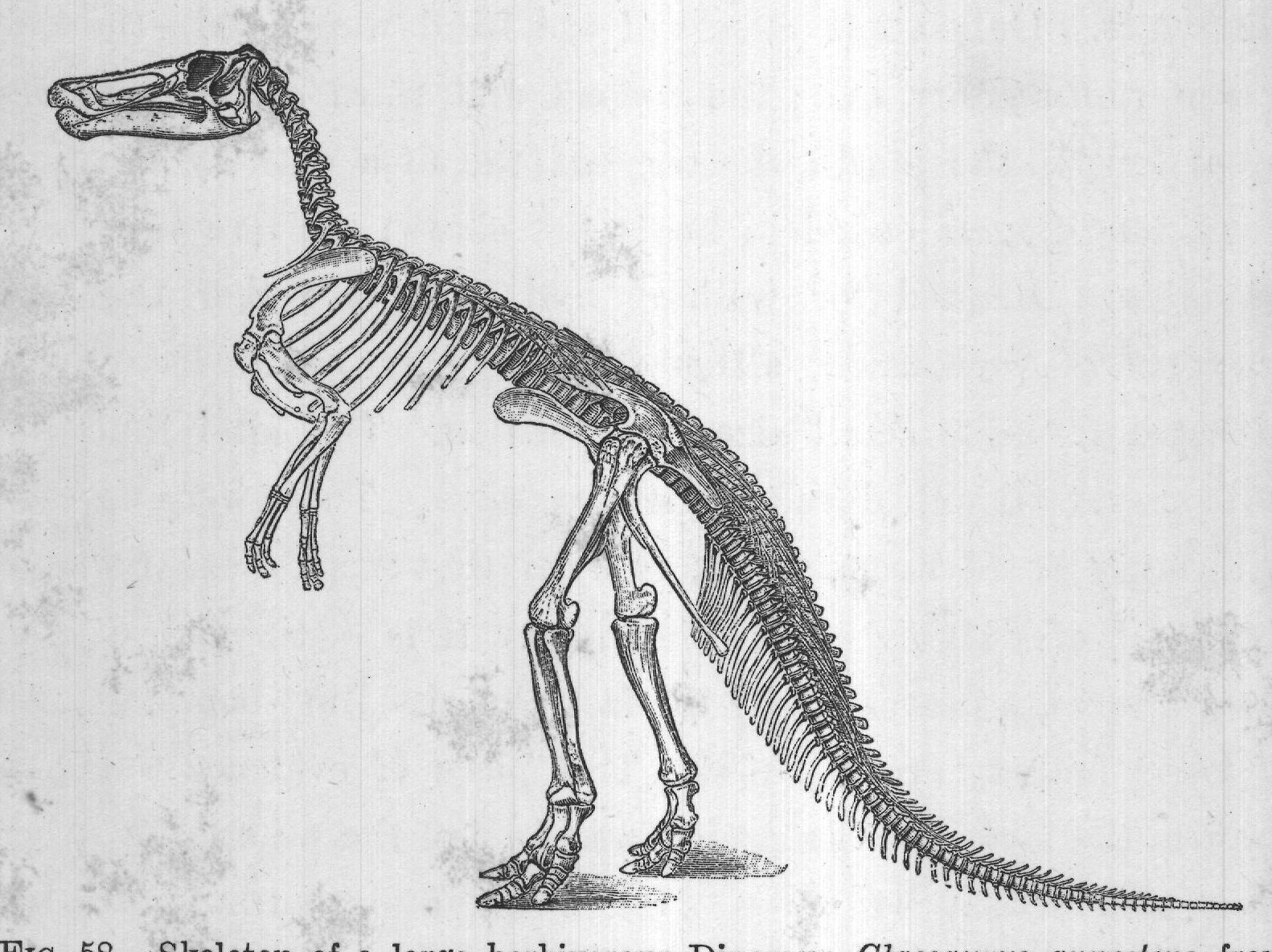
A LARGE HERBIVOROUS DINOSAUR, CLAOSAURUS, FROM NORTH AMERICA. CRETACEOUS PERIOD. The bird represented on the right is a young Hesperornis. DINOSAURS has a large muzzle, the surface of which is considerably roughened, showing that it was covered, during life, with hard and thickened skin. The brain of the creature was very small in proportion to its skull. The orbits for the eyes are large, suggesting large eyes; and its sense of smell was probably pretty keen. The teeth resemble those of Hadrosaurus, an allied form. Succulent vegetation probably was the main diet of this animal. The whole backbone, or vertebral column, was found complete, with the 100000 FIG. 58. Skeleton of a large herbivorous Dinosaur, Claosaurus annectens, from Cretaceous strata, North America. (After Marsh.) exception of a few little vertebræ from the end of the tail. Altogether there were about ninety vertebræ in the backbone of this powerful creature. The reader will perceive, from the drawing of the skeleton, in Fig. 58, that this Dinosaur must have possessed a long and powerful tail, such as would have constituted a most useful organ of propulsion through the water. As in its ally, Iguanodon, the vertebræ of the tail are compressed in a vertical direction. Plate XXIV., which is a restoration, should be compared with the drawing of the skeleton in Fig. 58. Another important feature of the skeleton is the remarkable ossified tendons, by means of which the neural spines of the vertebræ were held together, and so strengthened. They increase in number in the region of the thighs, and also in the first part of the tail. The reader will have noticed the smallness of the fore limbs compared with the hind limbs. This is often the case with Dinosaurs. Only three fingers of the hand were used-the first was a rudimentary one; the second and third were of nearly equal length, the fourth shorter, and the fifth entirely wanting. These long fingers ended in hoofs, not claws; the fore limb as a whole was adapted for walking and support, rather than for purposes of prehension, although the latter might have been expected from its small size and position. The hind limb has three digits, all well developed and massive. These were covered with fairly broad hoofs, and it is clear that this Dinosaur was in the habit of walking on its hind legs. It is distinguished from Hadrosaurus, a near ally, by the fact that its limb-bones, instead of being hollow, are all solid. This piece of evidence tends to confirm the idea that Claosaurus was fond of the water; for it has been pointed out by Owen, Marsh, and other authorities, that land animals, having to support the weight of their bodies on land, have hollow bones; while those which live in the water, like whales, being buoyed up by the action of the water, and thus having so much weight taken off their hands and feet, have their limb-bones solid.
The late Professor von Zittel considered that possibly Claosaurus was not to be distinguished from Hadrosaurus.
There is an unusually fine example of a mounted skeleton in the United States National Museum (Washington), to which the DINOSAURS name Trachodon has been given, but it is really the same genus. Professor F. A. Lucas says that in some cases the impression of the skin was preserved in the surrounding rock, and that it appears from these that the creature was covered with small horny plates. Another at Yale University is twenty-nine feet long. The Natural History Museum possesses a specimen showing the skin. Gallery IV., Wall-case 8.