Home › Ancient Salamanders › Ancient Salamanders: Archegosaurus
Ancient Salamanders: Archegosaurus
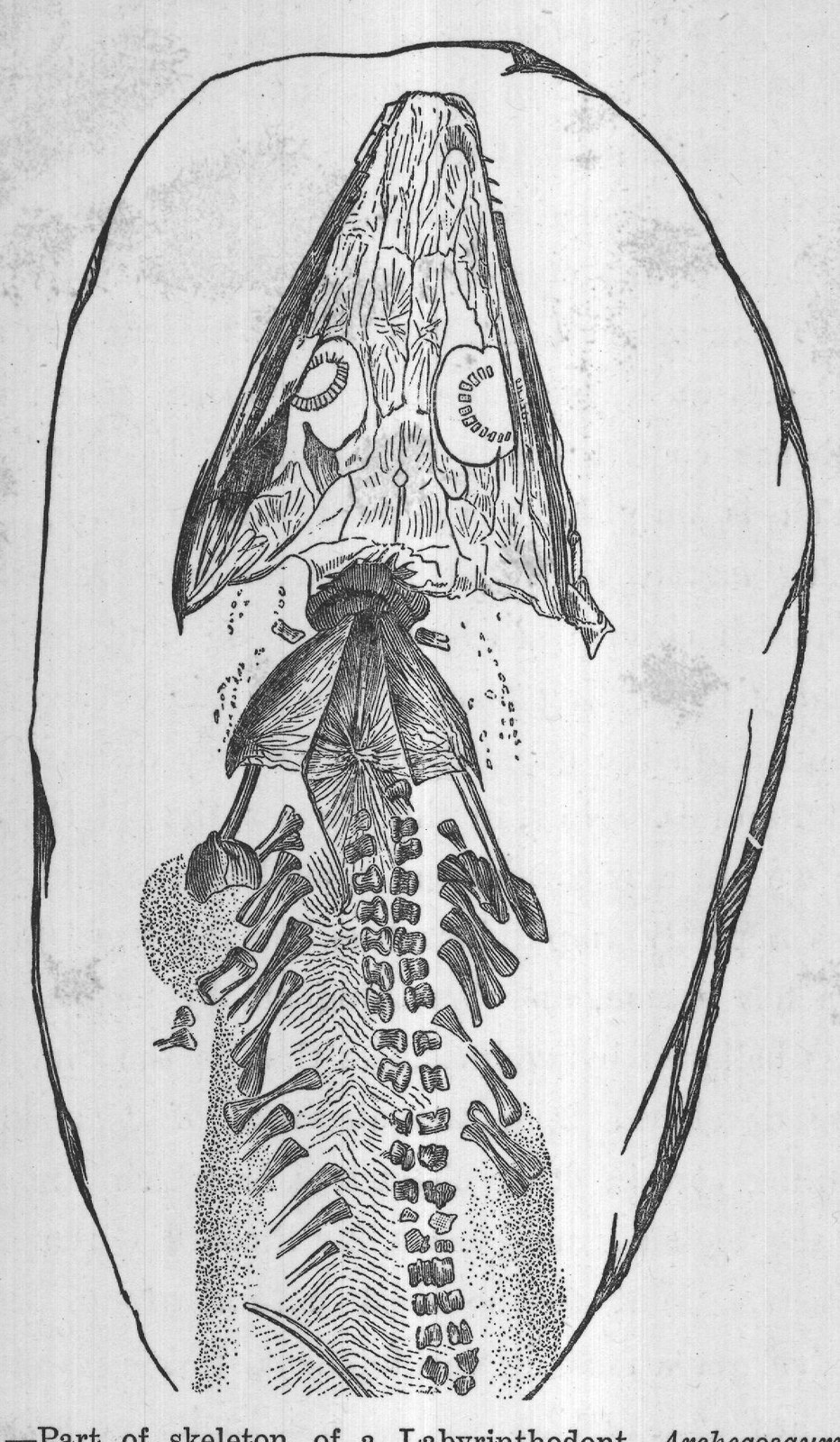
Archegosaurus. by Dr. Fritsch, have been very well preserved in those deposits of the Permian age, so that he was able to recognise in 70000 FIG. 17. Part of skeleton of a Labyrinthodont, Archegosaurus Decheni, from the Permian, Saarbrücken. (After H. von Meyer.) The snout is incomplete. The three ventral plates are seen near the head. some cases the signs of the gills, by means of which, in early life, they breathed in water, like fishes. And so it is manifest that they did go through a series of metamorphoses.
One of the most primitive, and at the same time one of the earliest known Labyrinthodonts, is the Archegosaurus, of which we must now give a short account.
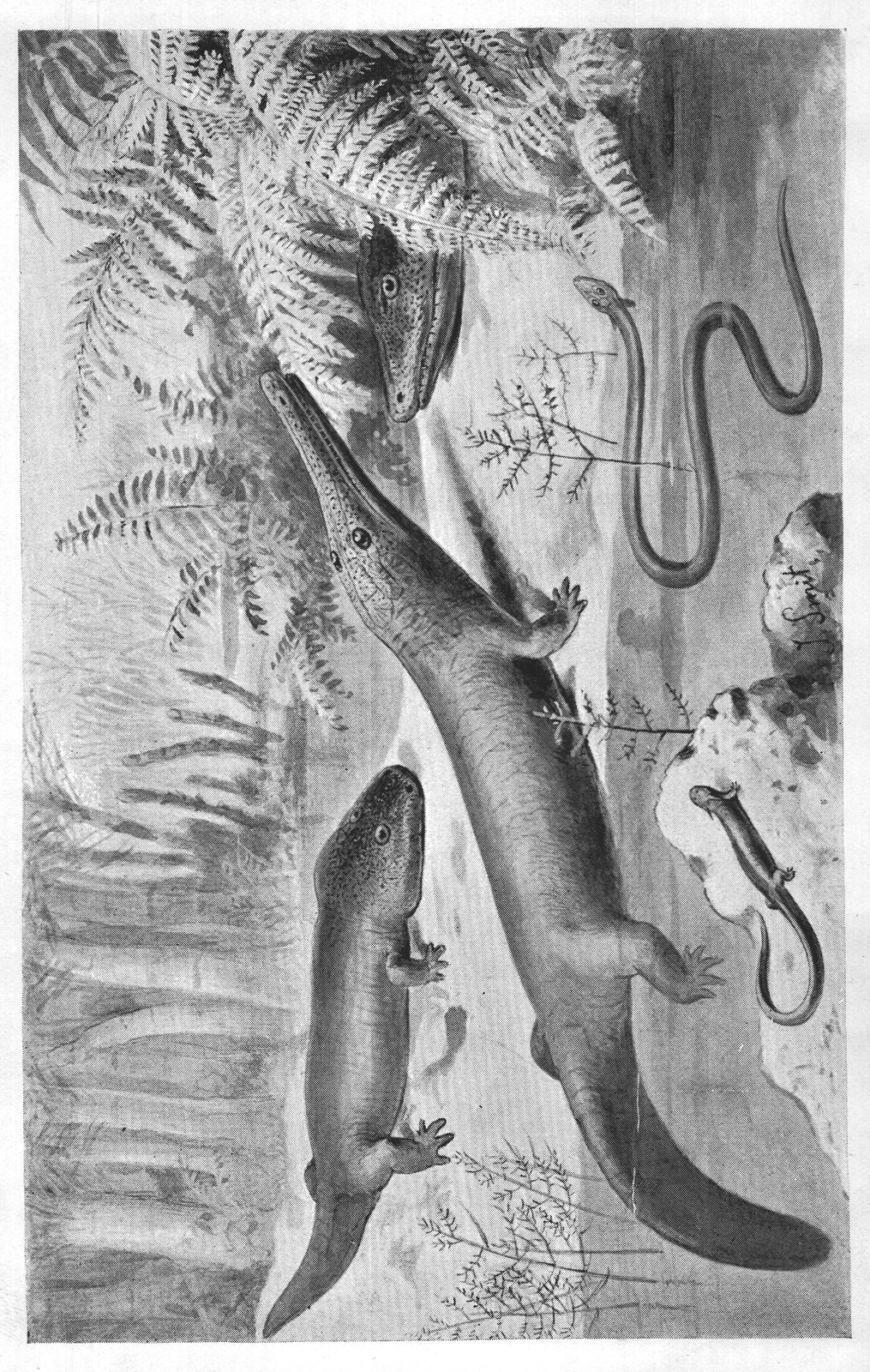
It resembled the modern Proteus and other amphibians that retain their lungs throughout life.
Some of the specimens acquired since Sir R. Owen published his conclusions on this creature are now in the Natural History Museum. There are certain fishes of the present day that have their backbones in an incomplete or unfinished state; that is to say, the bones consist partly of cartilage, like an unfinished house which is only built up to a certain level, the upper stories being merely indicated by scaffolding. An example of this kind of fish is furnished by the existing mud-eel, or Lepidosiren, a highly interesting form of life to the geologist, because it tends to fill up the gap between the two distinct classes of Fishes and Reptiles. Now, in this respect, the old Carboniferous amphibian we are now considering resembles the mud-fish. The latter leads a partly amphibious life, burying itself in the mud during the hot season, and breathing air by means of its airsack. It is believed by evolutionists that, in the course of ages, lungs were developed from the air-sacks of "ganoid" fishes. After detailing certain other characters, in which Archegosaurus resembles the higher ganoid fishes, Sir Richard Owen says, "All these characters point to one great natural group, peculiar for the extensive gradations of development, linking and blending together fishes and reptiles within the limits of such group." The salamander-like ganoids, Lepidosteus of North America and Polypterus of the Nile, are the most fish-like; the true Labyrinthodonts are the most reptilian or saurian of the group; Archegosaurus conducts the march of development from the fish proper to the labyrinthodont type; Lepidosiren conducts it to the batrachian type with permanent gills. Both tend to show the artificial nature of the arrangement by which, under most systems of classification, fishes are separated by a wide gap from reptiles and amphibians.
The Labyrinthodonts ranged through three geological periods -the Carboniferous, the Permian, and the Triassic. At the time when the coal-forests of Europe and America were flourishing, they were tenanted by a large number of Labyrinthodonts. These, and others of the succeeding Permian period, which may conveniently be taken together, have been specially studied by such authorities as Professors Huxley and Cope, Dr. Fritsch, FIG. 18. Skull of Archegosaurus. (Permian.) Professor Miall, and others. The limits of space will only allow us to make a small selection from the numerous forms described by them.