Home › Protective Resemblances in Spiders › Protective Resemblances in Spiders: Gasteracanthidæ
Protective Resemblances in Spiders: Gasteracanthidæ
This proposition is well illustrated by the Gasteracanthidæ. Among larvæ the warning colors are almost invariably black and white, or black (or some very dark color), in contrast with yellow, orange and red. These are the colors that also constantly recur among the Gasteracanthidæ.
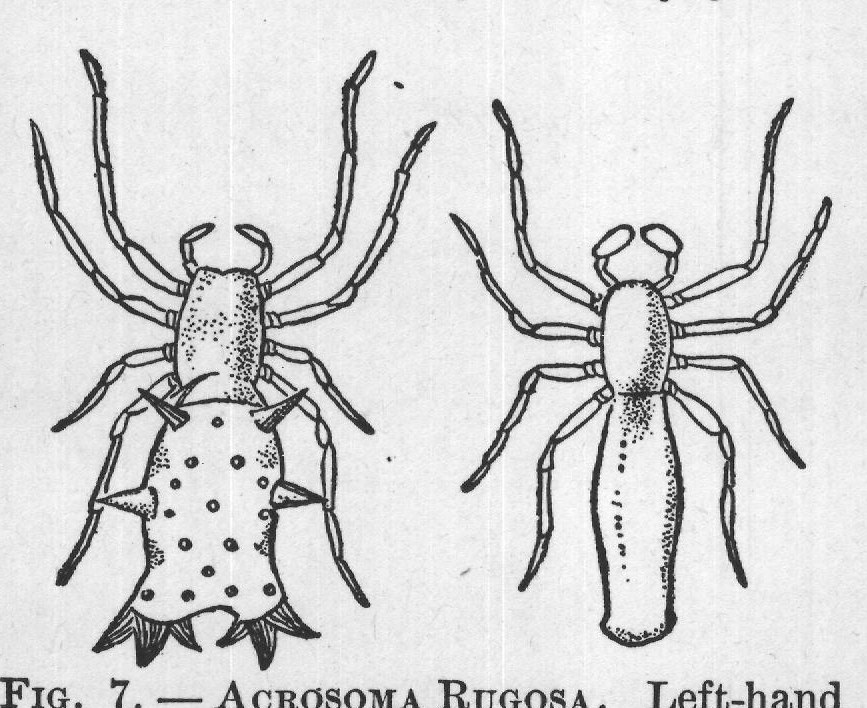
Cases that may be more justly considered exceptions to the rule that these hard, uneatable spiders are conspicuous are such species as Acrosoma rugosa (Fig. 7). One of this species was sent me by Mrs. Treat last summer. It lived for several weeks in my window, making no regular web, but hanging among a few irregular strands. It ate nothing, although provided with insects, but drank greedily of water. It might seem that its black and white coloring would make it conspicuous, but in connection with its irregular shape and its way of hanging motionless in the web it had the opposite effect.
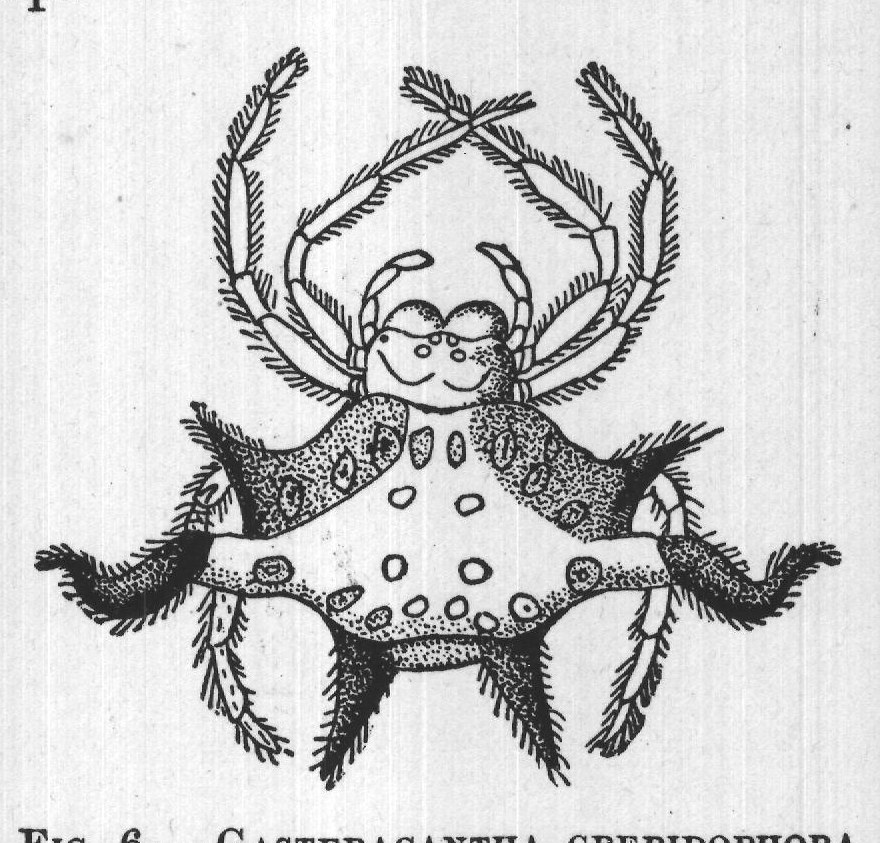
We have no reason to suppose that the class represented in rugosa is like that touched upon by Poulton, in which very protectively colored larvæ suddenly assume a terrifying aspect on the near approach of an enemy; still they do enjoy a kind of double protection. They are inconspicuous, and thus likely to escape attack, but in case they are attacked they have still the advantage of being quickly rejected. This experience cannot be as fatal to them as to the soft and figure female, right-hand figure male thin skinned larvæ. (from Emerton).
Their hard covering and projecting spines would protect them to such an extent as to give them a fair chance of surviving.