Home › Protective Resemblances in Spiders › Protective Resemblances in Spiders: Uloborus
Protective Resemblances in Spiders: Uloborus
This rule, while it has numerous exceptions, is borne out by the great majority of cases. A good illustration is found in the genus Uloborus, of which the members bear a deceptive resemblance to small pieces of bark, or to such bits of rubbish as commonly become entangled in old deserted webs. The only species in our neighborhood is Uloborus plumipes, which I have almost invariably found building in dead branches, where its disguise is more effective than it would be among fresh leaves. The spider is always found in the middle of the web, with its legs extended in a line with the body. There has been, in this species, a development along several lines, resulting in a disguise of considerable complexity. Its form and color make it like a scrap of bark, its body being truncated and diversified with small humps, while its first legs are very uneven, bearing heavy fringes of hair on the tibia and having the terminal joints slender. Its color is a soft wood-brown or gray, mottled with white. It has the habit of hanging motionless in the web for hours at a time, swaying in the wind like an inanimate object. The strands of its web are rough and inelastic, so that they are frequently broken; this gives it the appearance of one of those dilapidated and deserted webs in which bits of wind-blown rubbish are frequently entangled. ...
Out of seven examples of the species taken during one summer, five were found in dead tamarack branches, one on a dead bush, and the seventh, an interesting variety, under the eaves of a porch. My eye was caught by what seemed to be a string of eleven cocoons (it is not common to see more than four in a web).
On attempting to take them down I was surprised to see one of the supposed cocoons begin to shake the web violently. Ten were what they seemed to be, but the eleventh was the mother spider, whose color and (from Vinson). general appearance was exactly like that of the little cases that she had made for her eggs.
We come now to a large and interesting class in genus Epeira. I refer to those species, mostly nocturnal, which are protected during the day, not by hiding in crevices, nor in any way actually getting out of sight, but by the close resemblance which they bear to the bark of the trees to which they cling. This resemblance is brought about in two ways; through their color, which is like that of wood or lichens, and through their tuberculated and rugose forms, which resemble rough bark.
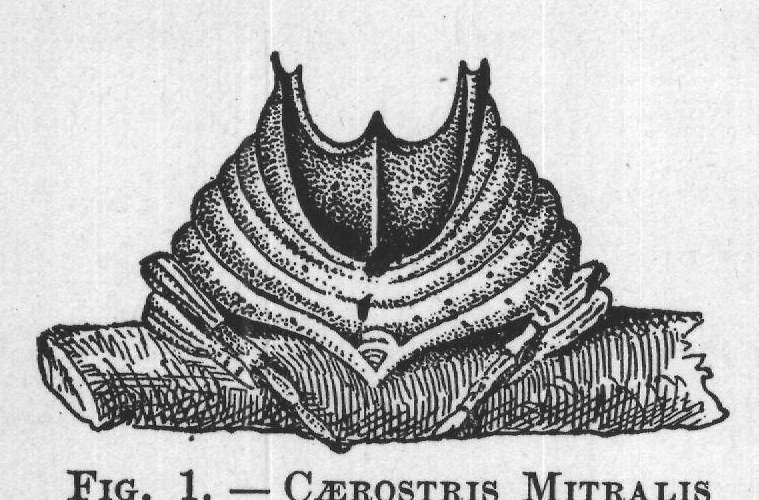
One of the most remarkable of these forms is C. mitralis, a FIG. 2. CÆROSTRIS MITRA- Madagascar species, which, LIS, in profile (from Vinlooked at in profile, probably reson). sembles a woody knot. The abdomen is divided into two divergent cones (Fig. 1). The entire upper surface of the body is covered with conical elevations, which render it rough and uneven; the sides of the abdomen are made up of several layers, which form stages, one above another, like the ridges of bark on a woody excrescence. The legs, formed of wide, flattened plates, make the base. The color of the spider is yellowishgray, varied with white and dark reddish-brown. It has the habit of perching on a branch and clasping it like a bird, so that the elaborate modification of form, which would be useless if the spider hung exposed in the web, is made as effective as possible.