Home › Protective Resemblances in Spiders › Protective Resemblances in Spiders
Protective Resemblances in Spiders
BY ELIZABETH G. PECKHAM.1 T HERE are, among spiders, two forms of protective modification: the first, including all cases of protective resemblance to vegetable and inorganic things-that is, all modifications of color or of color and form that tend to make them inconspicuous in their natural relations I shall call direct protection. The second form, which I shall call indirect protection, includes two classes, the spiders which are specially protected themselves and those which mimic other creatures which are specially protected.
Spiders are specially protected when they become inedible through the acquisition of hard plates and sharp spines. The modification of form is frequently accompanied by conspicuous colors, which warn their enemies that they belong to an unpalatable class.
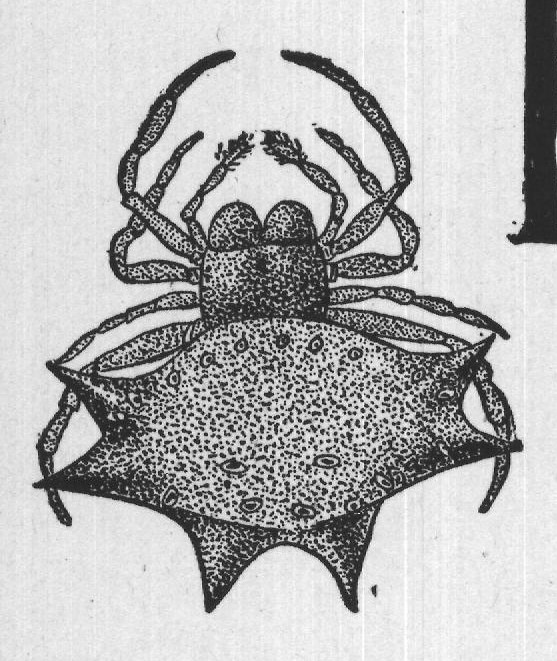
The second class of indirectly protected spiders - 1 Abbreviated from the occasional Papers of the Natural History Society of Wisconsin, Vol. I., 1889. By permission. those that mimic specially protected creatures - presents some difficulties, since it is not always easy to determine whether the purpose of mimicry is protection or the capture of prey. The resemblance may, as is frequently the case in direct protection, serve both purposes.
In looking for instances of protective form and color among spiders we encounter one difficulty at the outset. The meaning of a protective peculiarity can be determined only when the animal is seen in its natural home. The number of strangely modified forms depicted in descriptive works on spiders is enormous. Bodies are twisted, elongated, inflated, flattened, truncated, covered with tubercles or spines, enclosed within chitinous plates, colored like bark, like lichens, like flowers of every imaginable hue, like bird droppings, like sand or stones, and in every one of these modifications there is doubtless an adaptation of the spider to its surroundings which, when it is studied out of its natural relations, we can only guess at. It has been well said that in these protective resemblances those features of the portrait are most attended to by nature which produce the most effective deception when seen in nature; the faithfulness of the resemblance being much less striking when seen in the cabinet.
Direct Protection. Resemblances to Vegetable and Inorganic Things. - As a general rule the forms and colors of spiders are adapted to render them inconspicuous in their natural homes. Bright colored spiders, either keep hidden away or are found upon flowers whose tints harmonize with their own.