Home › Nothing but Leaves › Nothing but Leaves: Sometimes
Nothing but Leaves: Sometimes
Sometimes flowers forget and go back to the old ways of doing things; and if we are lucky enough to find such a flower, we can see just how it happened.
Sometimes roses behave in this peculiar way, and the flower goes back to leaves.
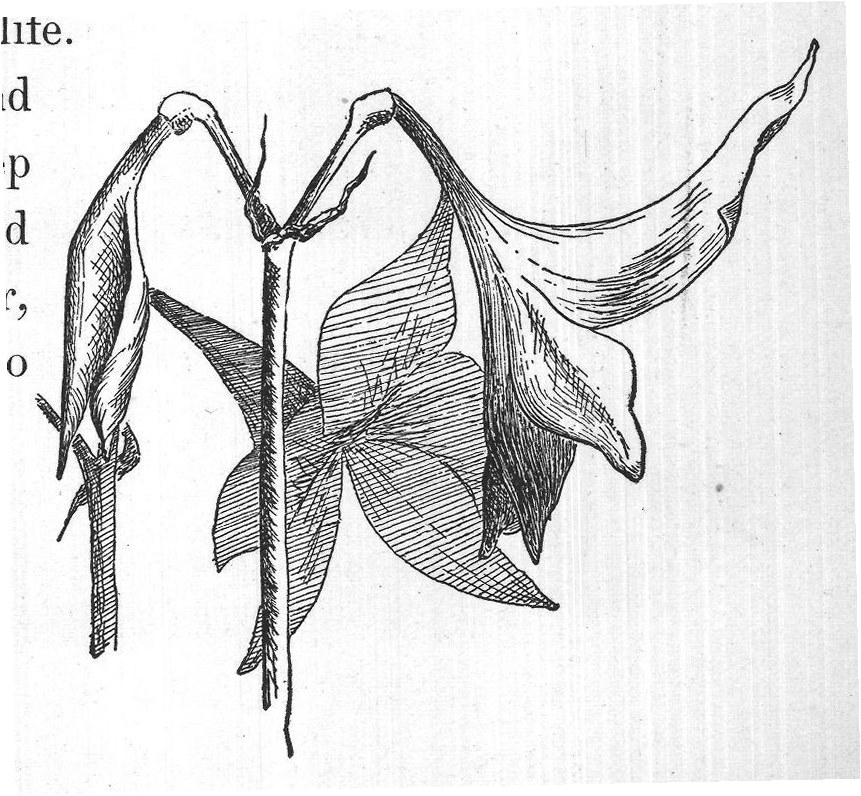
I used to know a bush whose roses did that. The pistils were leafy and also the stamens, and sometimes a branch grew right out of the middle of a rose as it does out of a leaf bud. Of course it was a very ugly-looking thing, neither flower nor leaf, but it was very instructive.
What do you suppose double flowers are?
Very often they are only flowers whose stamens have changed into petals.
A double rose has fewer stamens than a single rose, and sometimes all the stamens are changed, and the rose has not a grain of pollen to help itself with. What becomes of its seeds? It does not have any, as a rule. Where flowers become very double, the vitality goes to make petals instead of essential organs, as stamens and pistils are called, and such flowers often set no seeds.
Then how do they continue the life of the race?
Sometimes simply because somebody takes care of them. Almost always double flowers are cultivated ones. People take them and tend them, give them rich soil to grow in, water them, and, if necessary, keep them warm. Such plants seem to grow lazy and helpless, as rich people who pamper themselves a great deal always do. They have all they want without any effort of their own, and so they cease to be self-supporting; they cannot even raise their own children, but live and die seedless. Such plants, if left to themselves, would quickly die, as they would be crowded out by sturdier growths, or else they would change their habits at once and become good seed-setting, industrious plants once more, with a tendency to stop having double flowers.
There are one or two things about corollas that I am sure you would like to know. One is, how did the flowers manage to change stamens into corollas?
Another is, how did they manage to give them such bright colors?
About corolla-making, - if you are determined to know that, you will have to take yourself off to that far-away time when there were no flowers. Then, in course of time, while changing about and trying to get fitted to their surroundings, the plants, as you know, rolled some of their leaves into pistils and stamens. But still they had no petals.
The pistils and stamens were flowers, however, as much flowers as they would ever be, no matter how much corolla they might develop.
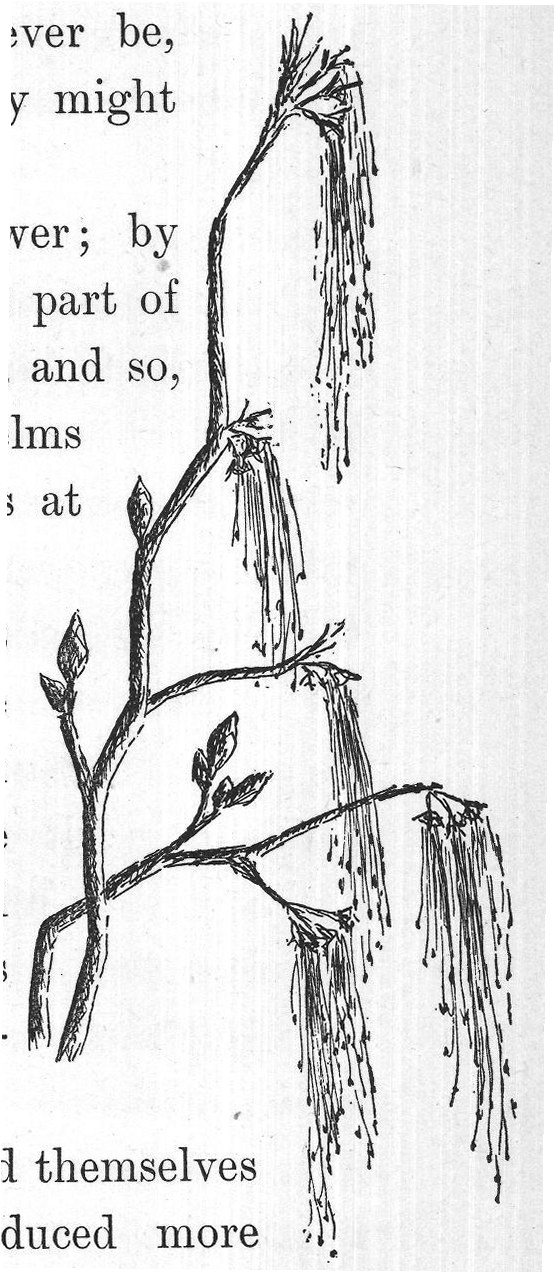
A corolla does not make a flower; by this time you know the important part of a flower is the pistil and stamens, and so, even to-day, some flowers, as the elms and some maples, have no petals at all. When such maples are in bloom, you will see gay fringes decorating the trees. This fringe is made of the long pedicels with the stamens at the end. The stamens swing in the breeze, and the pollen is blown to the stigmas which are often in flowers on different trees.
Now, as plants grew and adapted themselves to their surroundings, they produced more seeds than could by any chance find room in the earth to grow. So every little seed that fell had to fight its way with a host of other seeds and plants. A defective seed or a weak one would stand no chance at all. The others would crowd it out. We know how that is in a garden. The delicate flowers have to be helped or the strong weeds would kill them. We pull up the weeds and let the flowers have the whole garden to themselves. But in the woods and fields each plant has to take care of itself and struggle up as best it can.
This fight of the plants for a place to grow in is called the struggle for existence. Now, whatever would help a plant in the struggle for existence would, of course, be of great benefit to that plant. As we know, cross-fertilization is a very great help; it makes stronger and better seeds, and the plants whose seeds were regularly cross-fertilized would be the ones to survive.
Where pistils and stamens are forming, there is a great deal of nourishment brought to that part of the plant, and substances are being changed there.
Very often sweet juices are present. Long ago when insects, in flying about, smelled these sweets they doubtless would go and eat them, and they would also eat the pollen. As they went from flower to flower looking for food, they would carry pollen sticking to their legs or bodies, and so would sometimes fertilize the flowers.
The seeds from such flowers would be strong and would have the best chance to survive. The plants that grew from these seeds would also inherit the tendency to secrete sweet juices near the flower.
In probing for sweets, the insect would irritate the parts it touched, and this would cause an extra flow of sap there and very likely the manufacture of more sweet juice; so the nectary came to be developed.
You can understand how this might be by recalling how the skin of your hand changes when you first try to do some new and hard work, like rowing a boat. After you have rowed a little while your hand is blistered. The constant rubbing of the oar in one place has irritated it, just as you can imagine the tongues of the insects rubbing against the delicate flower tissue would irritate it. Wherever a place on the skin is irritated, the blood flows to that spot; and so in the plant, where it is irritated, there will likely be a collection of sap. After the blood has flowed to the place on your hand which was rubbed by the oar, the spot becomes red and inflamed and pains you, and finally the skin separates in the form of a blister and a new skin forms underneath; and if you keep on rowing, your hand does not keep on blistering, but actually makes a new kind of skin to protect the rubbed places, and what we call a "callous" or hard spot is formed. The skin is many times thicker here than elsewhere, and was formed on purpose to protect the place. So we can understand how irritation might change a plant organ and in time form a nectary.
But how about petals, you are asking. Well, imagine yourself in those old times when plants made their first flowers out of pistils and stamens only.
These primitive flowers were probably not very showy. Primitive flowers means first flowers, flowers that lived way back in the beginning of plant life.
They had no petals, but they secreted juices which the insects liked. Those early insects were queer fellows, too, not very much like our insects, except that they were fond of sweets and liked to eat the tender parts of the flowers, just as our insects do to-day. They ate nectar when they could find it and did not disdain pollen, which, it is to be feared, they sometimes ate, anther and all; and, what is worse, they in all probability frequently dined on pistil, which was very bad for the plant.
Now imagine one strong plant secreting a good deal of nectar. The insects would be likely to eat this and let the pollen and pistil alone, only in getting to the nectar, they would be apt to dust the pistil with pollen from another plant which they had been visiting and would also brush off some pollen against their bodies.
Thus the strong plant with the abundant nectar would be cross-fertilized and would keep its pistil unharmed. It would be very likely to develop good strong seeds that would grow and again bear strong flowers with plenty of nectar. Now, remember the essential organs - that is, stamens and pistil - seem to find it a little easier to change than other parts of the plant; so it would not be surprising if in time some of the stamens were to become different. You see, the insects in visiting the flowers would irritate them more or less walking over them and clinging to them, and they would be likely to undergo change for this reason; and if it happened that in some flower a row of stamens got too full of sap to know what to do with themselves and so spread out a little broader and more leaf-like and kept their yellow stamen color or bleached-out white, that flower would be seen far and near and the insects would go straight to it, for insects have the sharpest kind of eyes for seeing bright colors a long way off. You see what would happen; all the flowers whose stamens had done so would be abundantly crossfertilized, that is, all their seeds would get fresh pollen from another strong plant, and the plants growing from these seeds would inherit the tendency of their parents to form petal-like parts from some of the stamens. The flower could well afford to lose part of its stamens for this purpose. Of course as time went on, these stamens, which were half petals, might develop more and more in the direction of signals, - that is, might become more and more perfect petals, finally losing all trace of their old life as stamens.
Of course no one can say that is just the way it came about, but it is likely that in some such way it happened, for there are proofs of it which you may like to read when you grow older.
So, you see, flowers are nothing but leaves after all, - very much changed leaves, to be sure, but yet just leaves.
Sometimes when plants and animals have changed into a new form, they change back again. We know some plants which once had petals but which have again lost their petals and gone back to a form which has no petals. Such backward changes we call retrogression, and it is sometimes difficult to find out whether a flower with no petals is a primitive form which for some reason has not changed or whether it is one which has changed and gone back again. Usually, though, we can find traces of petals and sepals in flowers which have retrogressed.
You see, a flower depends upon its surroundings for its shape. If its surroundings (and of course this includes its insect visitors) are such as to favor its growth in the line of petals, it does so. But if for some reason it becomes easier for it to grow and be fertilized in some other way, perhaps by making abundance of light pollen which is blown by the wind, as in the maple trees, then it may gradually lose its petals, as it depends less and less on insects and more and more on the wind for cross-fertilization. Nothing in life stands still; it is always moving, going on or going back. And this, we know, is just the same in human life.
We cannot stand still; we must keep growing wiser and stronger and better, or else we must do the opposite.