Home › Nothing but Leaves › Nothing but Leaves: Leaf
Nothing but Leaves: Leaf
So Mr. Flabby Leaf was a very good life starter.
One thing we are quite sure of, and that is, these earlier plants did not have any seeds. When new plants came from the old ones, they merely sprouted out from the leaves or the roots, as a certain fern that grows in Fayal and other places does to-day.
It is fun to raise this fern in a window box and watch the young ferns sprout out of the edge of the leaves of the old fern. After they get two or three tiny green leaves and the cunningest little curled-up frond, just like a big fern, off they tumble down to the ground, where they strike root and grow as calmly as though they had come the regular plant way and sprouted from a seed.
They do come the regular way the very early plants did, instead of coming the way modern plants do, for in some such way the earlier plants, no doubt, reproduced themselves.
They had no flowers and no seeds. Leaf and stem did it all. You see, these first plants were simple people, not complicated at all, and so each part of the plant was able to do all its own work. But after awhile the plant world became more complex; the earth grew drier, for one thing. The first plants lived in the water, no doubt, and so everything was much easier for them; at least they could always get plenty of water, which is a matter of great importance with plants. No water, no plant. Then, too, the earth cooled more and more, and from being uniformly warm and moist, which was just the best conditions for plants to live without taking any trouble about it, the air was sometimes colder and contained less moisture.
So the plants that grew on the land had to invent ways of getting and keeping an extra amount of water, and even those that lived in the water had to look around and find a way of protecting themselves against changes of temperature.
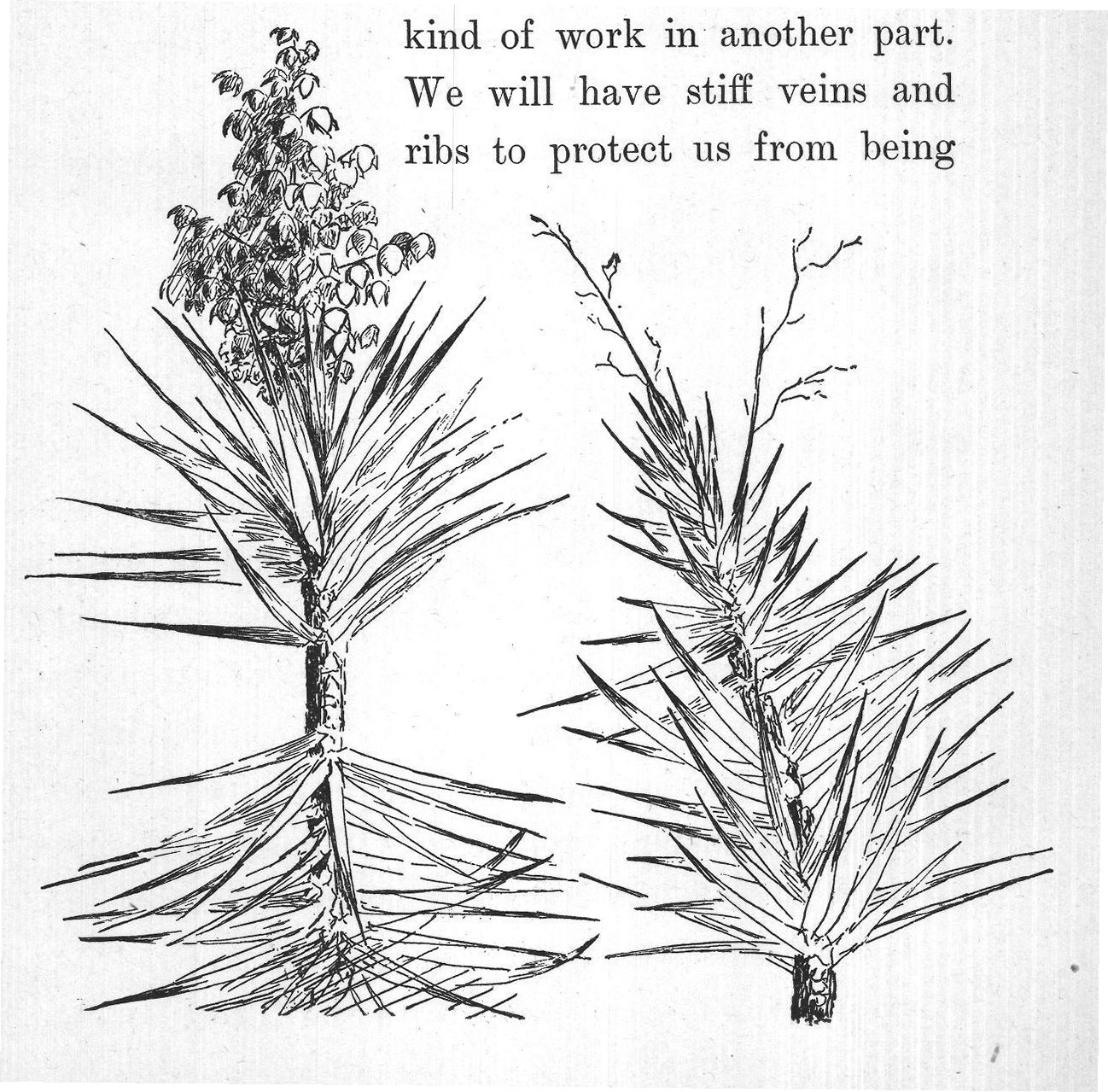
As the earth grew cooler and drier, and the changes from hot to cold at the different seasons became more marked, the plants that grew on the prairies and mountain sides, where it was very hot and damp at one season and very dry or very cold at another, had to find ways to protect themselves against these changes. So the leaves and stems began to be a little more particular about their work. The leaves may have said, "We will do one kind of work in one part of us and another kind of work in another part.
We will have stiff veins and ribs to protect us from being blown to pieces, and we will have our sap flow through veins, instead of soaking all through us everywhere. And we will have a thick skin to breathe through and to protect us from the sun when it is too hot."
So some lived on the hot plains with small, thick, hard leaves, and others lived in the damp shady woods with large, thin, tender leaves.
Thus, you see, there came about a division of labor. Not all at once, - oh, no! but so gradually, so very gradually that, had you been watching these plants grow from year to year, you could no more have seen any change than you can see a blade of grass grow to-day, although you know it does grow.
Perhaps the plants on the edge of a swamp were the first to change.
Perhaps the water receded and so gradually left them higher and drier. As they got less water, they would have to do one of two things, change to suit the new state of affairs or give up trying and die. Very likely a good many died; the water may have receded too rapidly, or they could not see just how to change. But others did see, and they stiffened their flabby leaves with ribs and veins and made for themselves a thicker skin, and so lived on. They survived because they were the fittest to survive. And now you know the meaning of that very celebrated saying, "the survival of the fittest"; whatever plant or animal can adapt itself the best to the place it lives in is the fittest, of course, for that place, and so it survives or lives on.
No doubt, in those early days, new plants grew out of the old ones just anywhere as the baby plants grow out of the leaf of the Fayal fern I told you about.
But as life grew more and more difficult, as the plants had to contend with too much heat at one time and too great cold at another, with now a season of moisture and now one of great dryness, their leaves, as you know, began to change and divide up the work. A part of the leaf breathed for the plant; another part ate for it; another part protected it. Nor was this all. Some leaves did one ' kind of work and some another, as time went on.
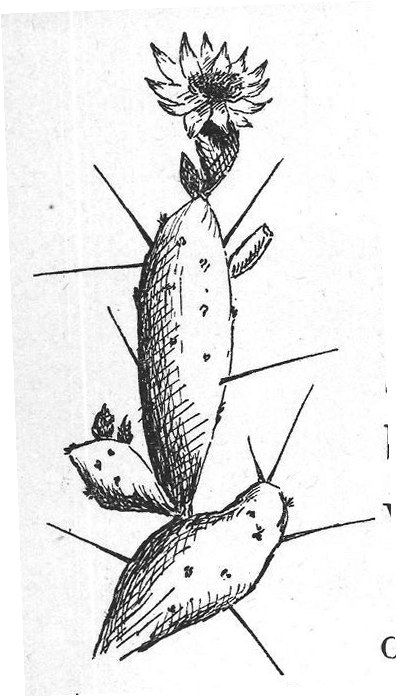
When animals came upon the earth they ate the plants, and so the plants had to partly protect themselves to keep from being entirely destroyed. Thus some plants changed part of their stems or leaves into sharp thorns, as we see to-day in the hawthorns and cactuses. Some, like the mullein, covered their leaves with a disagreeable wooly substance that stuck to animals' mouths and made them avoid the plants. These wooly coverings served two purposes, regulated evaporation and protected from the attacks of animals. Some, like the aconite, manuof animals. Some, like the aconite, manufactured a poisonous, disagreeable juice, while others, like the nettle, clothed the stems with stinging hairs.
There are many, many ways by which plants have changed their leaves and stems in order to protect themselves from being eaten, and all this came about very, very gradually.
While these things were happening, other things were happening too. Wher- - ever there is life there is change. Living things keep changing all the time.
The little fern that drops from the leaf of its parent is, in a general way, like the parent, but it is not not exactly like its parent; it is itself and has some of its own. You see, it changes a little from the parent form or, as we say, varies. Every living thing has this power to vary within limits.
No doubt , the power of variation was much greater in early times, and animals and plants were able to change much more then than now.
As time went on, things sort of settled down, as it were, and stopped changing SO rapidly. , and stopped changing so rapidly.
But way back in the early ages the plants changed a good deal. And all they had to work with, you will remember, was just stem and leaves, - not another thing. But that was enough. They could change stem and leaves into thorns, as we know, and they could do something else. They could change leaves into pistils.
When the leaves divided their work, some plants devoted certain of their leaves to the task of making new plants. Ferns show this up to this very day.
Look at a clump of ferns in the woods any time in the middle of the summer or later, and you will see that some of the fern leaves have little dark spots on their backs. Sometimes these dots are on their margins, sometimes on the ribs, and sometimes scattered everywhere over the back of the leaf.
These dots are little cups filled with a fine dust, which falls on the ground and finally gives rise to more ferns. It is sometimes called fern seed, but the bits of dust are not exactly seeds. In the end they answer the same purpose, however. Well, suppose one of these fern leaves with the dots growing on it should curl over backwards until its edges met, and suppose the little grains should become true seeds, then we would have a very good ovary with the ovules inside.
Fern leaves do not act in this way; they are too old-fashioned. But some of the leaves in flowering plants do. They just roll up into a pistil, with young plants, in the form of seeds, growing inside.
And to this day that is all a pistil is, - a leaf, or a whorl or circle of leaves, rolled together, with seeds growing along the inner part. Of course, in time, these pistil leaves changed very much, and to-day we find all sorts of pistils, and by just looking at them, we would never suspect they were leaves or ever had been. And they are not leaves any more, and they themselves never have been leaves; but long ago the pistils of their ancestors were leaves or parts of leaves, and they have inherited and improved upon these pistil leaves, as a boy improves upon a willow twig and makes it into a beautiful carved whistle that does not look at all like a willow twig, and yet that is just what it is at heart. So you see, one of the most important parts of the flower is, after all, "nothing but leaves."
After seeing how the pistil, with its seed-children, is modified leaves, you will not be surprised to learn that stamens, too, are merely modified leaves. Anyway, whether you are surprised or not, that is just what they are. Tender little leaves folded a part of themselves together into little rooms or cells, and on the inside of these cells the pollen grains grew.
Now the plant was all fitted out. It had flowers, not very beautiful ones, to be sure, as they had nothing but pistils and stamens. Still they were flowers, and flowers are flowers whether they are bright or not.
Pistils and stamens were enough at first. But times change. Each plant tried every possible means to make strong seeds, so it could live in the crowded world.
It did not wish to be crowded out, So when it discovered the you see. value of cross-fertilization, it began, so to speak, to invent ways to bring this about.
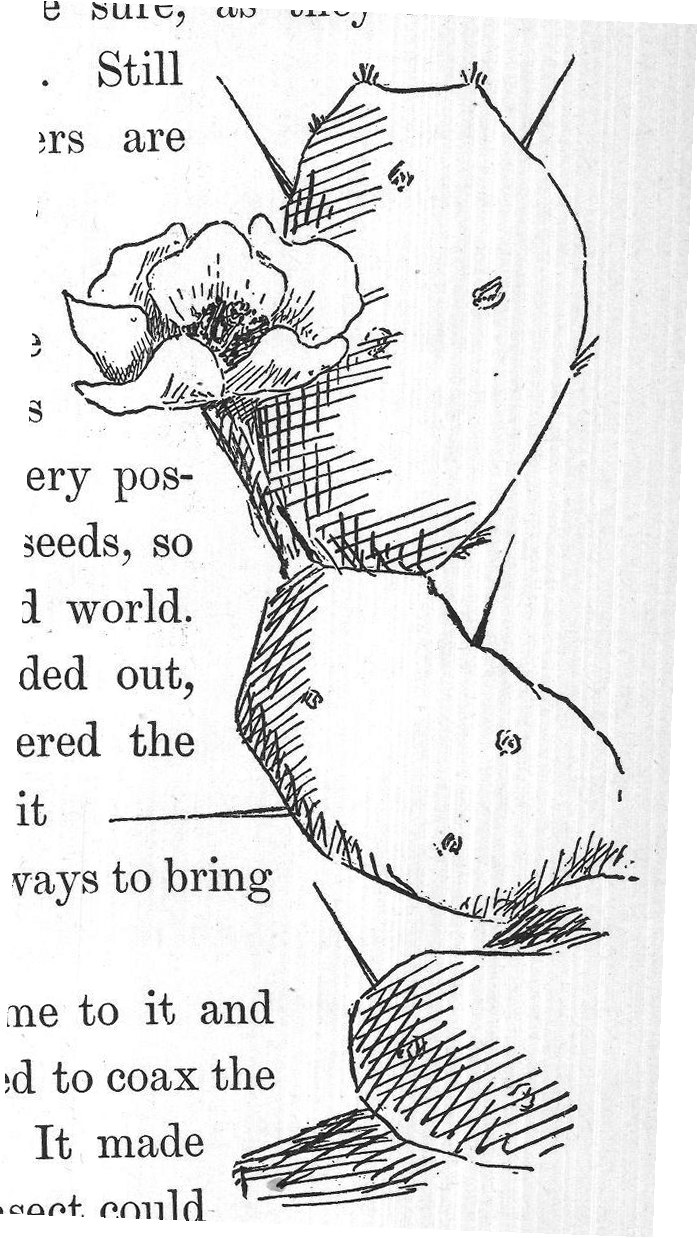
The insects with wings came to it and brought it pollen, so it learned to coax the the insects to come oftener. It made quantities of pollen, so the insect could eat what it would and still leave enough for the plant. It, no doubt, had several rows of stamens, as a wild rose or a cactus flower has to-day. But it soon found out a good use to put some of these stamens to. It wanted the bees to see and come, so it changed some of its stamens into petals.
The anthers ceased to grow, and they and the filaments spread out broad and bright. So, you see, petals, too, are nothing but leaves, - very much changed leaves, true, as they were first leaves, then stamens, and then petals, but that does not prevent their having come from leaves after all.
If you want to see how it is done, look at a water lily next time you get a chance.
Unless it is a very unaccommodating lily indeed, you will be sure to see stamens changing into petals. Some of the inside petals are small with an anther at the tip.
Of course flowers do not go through all these changes every time they bloom now. They used to way, way back, when things were in a general state of change, but after awhile they found out just how to do it, and so out of the tiny buds at once made pistils and stamens and petals and sepals.
For sepals, too, came from stamens. The plants made all these new forms out of the materials of For sepals, too, came from stamens. The plants their leaf buds and wrapped them all together into a flower bud; so when this opened, there were the parts all ready to go to work without any more a flower bud; SO when this opened, there were the shifting around.
The calyx was ready to protect, the corolla to call the bees and butterflies, the stamens to make pollen, the pistils to make ovules.