Home › Rings in Ecclesiastical Usages › Rings in Ecclesiastical Usages: Waterton
Rings in Ecclesiastical Usages: Waterton
An episcopal ring, with gold and a sapphire, said to have belonged to St. Loup, is in the treasury of the Cathedral of Sens, and is, probably, of the Carlovingian period. 'Mention occurs,' remarks Mr. E. Waterton, 'of epis copal rings being set with the balass-ruby, the emerald, the topaz, the turquoise, the chalcedony, and, as accessories, pearls and garnets. Sometimes these gems were of great value.' The Rev. C. W. King thinks it probable that when mediæval rings occur, set with a ruby instead of a sapphire, they belong to bishops who were at the same time cardinals. At the disgraceful seizure of Archbishop Cranmer's effects, in 1553, we find mentioned, among the articles of considerable value taken from his house at Battersea: 'six or seven rings of fine gold, with stones in them, whereof were three fine blue sapphires of the best ; an emerald, very fine; a good turquoise and a diamond.' At the degradation of a bishop in former times, the reasons were given in a solemn assembly, and judgment pronounced, the mitre was removed from his head, and the pontifical ring drawn off his finger, as having outraged the Church.
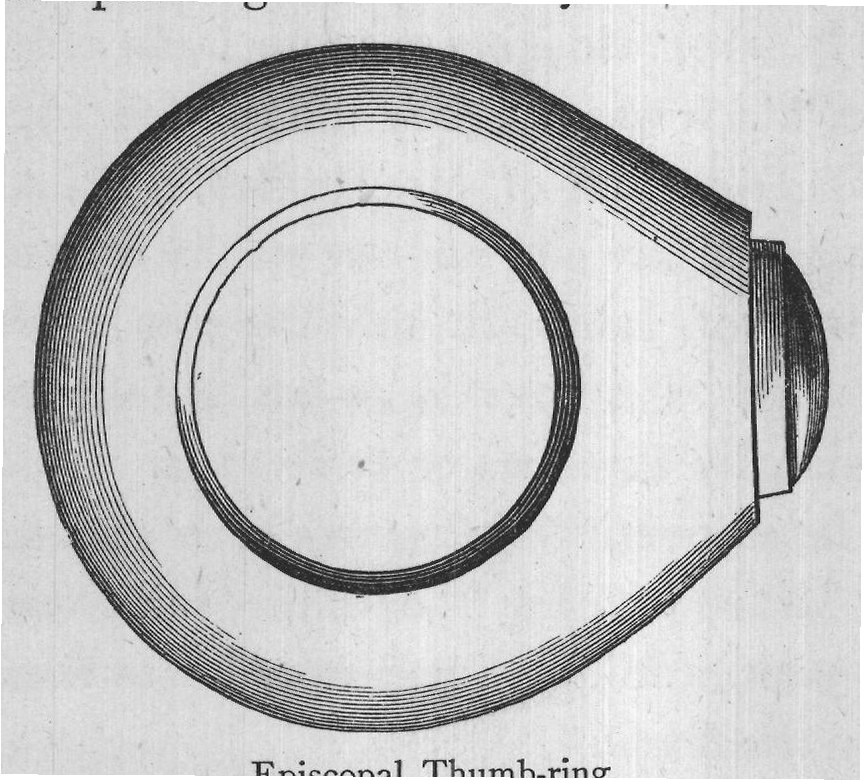
With regard to the finger on which the episcopal ring is worn, a correspondent of 'Notes and Queries' (vol. v., first series, p. 114), remarks that 'all who wear rings, ex officio, wear them on the third finger of the right hand. Cardinals, bishops, abbots, doctors, &c., do this for the reason that it is the first vacant finger. The thumb and the first two fingers have always been reserved as symbols of the Three Persons of the Holy Trinity. When a bishop gives his blessing he blesses with the thumb and two first fingers. Our brasses, with sepulchral slabs, bear witness to this fact.' A French writer observes that formerly the episcopal ring was worn on the fore-finger, but as, for the celebration of the holy mysteries, bishops were obliged to place it on the fourth finger, the custom prevailed of carrying it thus. Mr. E. Waterton gives his explanation thus, and there could be no better authority: 'It appears that bishops formerly wore their rings on the index of their right hand, being the middle one of the three fingers which they extend when they are giving their blessing, but when celebrating mass they passed the ring on to the annular. They wore it on the index as the fore-finger was indicative of silence, that they ought to communicate the divine mysteries only to the worthy. Gregory IV., in 827, ordered that the episcopal ring should not be worn on the left, but on the right hand, as it was more distinguished (nobile) and was the hand with which the blessing was imparted.'1 The episcopal ring is now always worn on the annular Episcopal Thumb-ring. finger of the right hand, and bishops never wear more than In the pictures of the early Italian masters, however, one. 1 The mode of giving the benediction differs in the two Churches. In the Greek it is given with the forefinger open, to form an I, the middle finger curved like a c, the ancient sigma of the Greeks, the thumb and annulary crossed form an x, and the little finger curved represents a c. All this gives IC XC, the Greek monogram of Jesus Christ. Thus, as the author of the 'Guide of Painting,' of Mount Athos, observes : - 'By the Divine providence of the Creator, the fingers of the hand of man, be they more or less long, are arranged so as to form the name of Christ.' The Latin benediction is more simple, being made with the annulary and the little finger closed, the three first fingers open, symbolical of the Trinity.
Formerly, bishops and priests blessed alike; latterly, bishops reserved to themselves the right of blessing with their fingers, the priest with the open hand; the bishops facing the congregation, the priests in profile, with the hand placed edgeways. The sign of the cross was formerly made with three fingers open, but now with the open hand, from the forehead to the breast, and from the left to the right shoulder by the Latins, but from the right to the left by the Greeks' (Didron, 'Iconographie Chrétienne'). and on sepulchral effigies, bishops are represented with many rings, some of which are not unfrequently on the second. joint of the fingers. A thumb-ring is often seen; one is represented (p. 219) belonging to a late Dean of St. Patrick's, the sketch of which was made by the late Mr. Fairholt, when it was in the possession of Mr. Huxtable, F.S.A., in 1847. It is of bronze, thickly gilt, and set with a crystal. In Raffaelle's portrait of Julius II. the Pope is represented as wearing six rings. Certain it is, as late as the year 1516, the Popes occasionally wore two or more rings.
As the large pontifical ring was of a size sufficient to enable the bishop to pass it over the silk glove which he wears when pontificating, a smaller, or guard ring, was used to keep it on the finger.
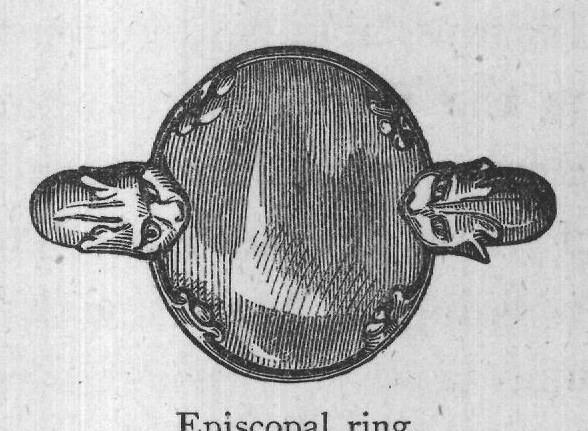
In the Waterton Collection is a very pale gold episcopal ring, with oblong hexagonal bezel, set with a pale cabochon sapphire, and the hoop divided into square compartments chased with rosettes, and finished on the shoulders with monsters' heads. French, of the early part of the fifteenth century.
In the Anglo-Saxon annals, an archbishop bequeaths a ring in his will, and a king sends a golden ring, enriched with a precious stone, as a present to a bishop. So great was the extravagance among the clergy for these ornaments that Elfric, in his 'canons,' found it necessary to exhort the ecclesiastics 'not to be proud with their rings.' In the mediæval romances we are told that at the marriage of Sir Degrevant, there came Erchebyschopbz with ryng Mo than fiftene.