Home › Rings in Ecclesiastical Usages › Rings in Ecclesiastical Usages (If you do not surrender it)
Rings in Ecclesiastical Usages (If you do not surrender it)
'and if you do not surrender it quietly it will be taken from you by force.' To escape further insult the Fisherman's Ring was given up, but as it was found to be intrinsically of no value it was soon afterwards restored to the Pontiff.
The ring of Pius the Ninth is of plain gold, weighing one and a half ounces, and it was made from the gold which composed the Ring of the Fisherman of Pope Gregory the Sixteenth. 1 The Fisherman's Ring is always in the custody of the Grand Papal Chamberlain. It is taken to the Conclave, or Council of the Cardinals, with the space left blank for the name; and as soon as a successful scrutiny of votes for a new Pope has taken place, the newly-elected Pontiff is declared, and conducted to the throne of St. Peter, where, before the cardinals have rendered homage to their chief, the Grand Chamberlain approaches, and, placing the Papal ring on the finger of the new Pope, asks him what name he will take. On the reply of the Pontiff, the ring is given to the first Master of the Ceremonies to have the name engraved on it that has been assumed. The announcement of the pontifical election is then made to the people from the balcony of the Papal palace.
Kissing the Pope's ring as an act of reverent homage is a custom which has descended to our own times. One of the important ceremonies at the opening of the great Ecumenical Council at Rome (December 8, 1869) was that 1 Horace Walpole, in one of his letters, alludes to the 'Fisherman's Ring' in his usual lively manner: 'Mr. Chute has received a present of a diamond mourning-ring from a cousin; he calls it l'annello del Piscatore. Mr. Chute, who is unmarried, meant that his cousin was fishing for his estate.' every single primate, patriarch, bishop, and mitred abbot, who were present on this solemn occasion at St. Peter's, and who were to take part in the Council, paused before Pius \the Ninth, and, in an attitude of profound reverence, kissed his ring. As high dignitaries they were exempted from kissing the Pope's toe, a condescension reserved for the laity and lower clergy.
In Bishop Bale's 'Image of Both Churches' occurs a curious passage on the subject of episcopal rings: 'Neyther regarde they to knele any more doune, and to kisse their pontifical ryngs, which are of the same metall' (i.e. fine gold).
It would seem that the Popes were formerly buried in their pontifical habits and ornaments. In the 'Journal' of Burcard, Master of the Ceremonies in the Pope's chapel from Sixtus the Fourth to Julius the Second, he mentions as having, by virtue of his office, thus clothed the body of Sixtus the Fourth, and amongst other things a sapphire ring of the value of three hundred ducats was placed on his finger, and so little trust was placed in the honesty of those who came to see the body that guards were placed to prevent the ring and other ornaments from being stolen.¹ In 1482 Cardinal d'Estouteville, Archbishop of Rouen, was buried with great magnificence at Rome, where he 1 To show how little, in former times, the sanctity of the Popes was regarded after death, Aimon, in his 'Tableau de la Cour de Rome,' relates that 'when the Pope is in the last extremity, his nephews and his servants carry from the palace all the furniture they can find. Immediately after his death, the officers of the Apostolic Chamber strip the body of everything valuable, but the relations of the Pope generally forestal them, and with such promptitude that nothing remains but bare walls and the body, placed on a wretched mattress, with an old wooden candlestick and a wax end in it.' G died. The body of the prelate was arrayed in the richest robes of cloth of gold, and his fingers were covered with rings of the greatest rarity and beauty. The brilliancy of the jewels (observes Dom Pommeraye in his 'Lives of the Archbishops of Rouen') excited the cupidity of the canons of St. Mary Major at Rome, where he was interred, insomuch that they threw themselves on the body, and struggled with each other to get at the rings. The monks of St. Augustine, who also attended on this occasion, pretended to be highly scandalized at this profanation 'peut-être,' however, 'pour avoir part au butin '-and attempted on their part to seize the rings. In this unclerical skirmish the body of the archbishop was entirely stripped of its gorgeous trappings, and left naked, a piteous spectacle.
Matthew Paris informs us that archbishops, bishops, and abbots, with other principals of the clergy, were buried in their pontificalibus; thus 'they prepared the body of Hubert, Archbishop of Canterbury, for the burial, closing him in his robes, with his face uncovered, and a mitre put on his head, with gloves upon his hands, a ring on his finger, and all the other ornaments belonging to his office.' In describing the finger-ring found in the grave of the Venerable Rede, the writer of a brief account of Durham Cathedral adds: 'No priest during the reign of Catholicity was buried or enshrined without his ring.' The practice may have prevailed generally, as many instances of rings recovered from the graves of ecclesiastics show, but it was more particularly the usage of prelates. Martene ('De Antiquis Ecclesiæ Ritibus') remarks: 'Episcopus debet habere annulum, quia sponsus est. Cæteri sacerdotes non, quia sponsi non sunt, sed amici sponsi, vel vicarii.' The bones of St. Dunstan were discovered in the time of William, fortieth abbot of Glastonbury: a ring was on the finger-bone of this saint.
William, the twenty-second abbot of St. Alban's Abbey, who died in 1235, was buried in pontifical habits 'with a ring on his finger.' Richard de Gerbery, forty-fifth Bishop of Amiens, in the thirteenth century, died in 1210, and was buried in the cathedral, in pontificalibus, with mitre, ring, and ivory cross. When the body of St. John of Beverley (died 721) was translated into a new shrine, about the year 1037, a ring, among other articles, was found in his coffin. We have a much earlier instance cited by Aringhi, that the ring of St. Caius (283-296) was found in his tomb : 'intra sepulchrum tria Diocletiani Imperatoris numismata, sub quo coronatus fuerat, et Sanctissimi Pontificis annulus adinventatus est.' A gold ring was found in the tomb of St. Birinus, Bishop of Dorchester, who died in 640.
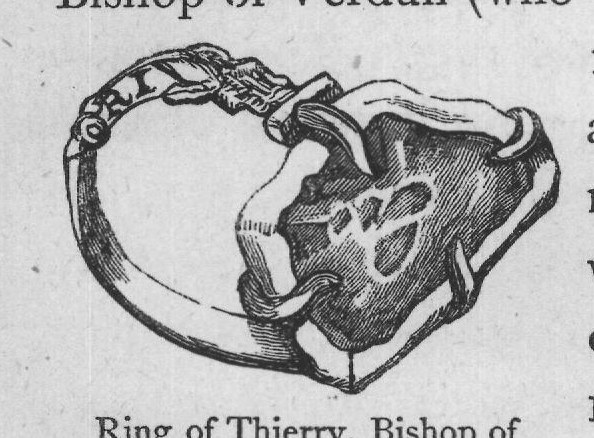
Mr. E. Waterton mentions a remarkable ring, set with fine opal, preserved at Mayence Cathedral, where it was found with an enamelled crosier in the tomb, as was supposed, of Archbishop Sigfroi III. (1249). In the Londesborough Collection is the ring of Thierry, Bishop of Verdun (who died in 1165), found in his tomb in 1829. It is of gold, with a sapphire, an irregular oval with five capsular marks on the face; the shank, two winged dragons, between the heads of which is the inscription AVE.
MARIA GRATIA. This ring was procured in exchange from the collec- Ring of Thierry, Bishop of Verdun. tion of M. Failly, Inspector of Customs, at Lyons in 1848. Mr. Octavius Morgan remarks: 'It is difficult to reconcile the practice of returning the ring to the Emperor' (to which I have in this chapter alluded) with that of interring the bishop with his ring on his finger; but it is probable that, when in the twelfth century the Emperor ceded to the Popes the right of investiture by the ring the sending back the ring was dispensed with; and, being the property of the Church, and not of the Emperor, the bishop was allowed to be interred with his ring as an emblem of his dignity.' The Rev. C. W. King remarks that the custom of burying ecclesiastics with all their official insignia appears to have lasted far down into the Middle Ages; for, amongst the amusing adventures of Andreuccio da Perugia, related by Boccaccio, he, when reduced to despair, joins some thieves in plundering the tomb of the Archbishop of Naples, interred the previous day in all his precious vestments, and with a ring on his finger valued at five hundred scudi. Two parties of plunderers, headed by a priest of the cathedral, visit the tomb in succession, and almost at the same time; to which circumstance Andreuccio owes his escape from a horrible death, and returns home in possession of the ring, which more than makes up for all his losses.
The Rev. C. W. King considers it probable that this common practice of plundering the tombs, gave origin to the huge rings of gilt metal, which bear the titles, or coats of arms, of some pope or bishop.
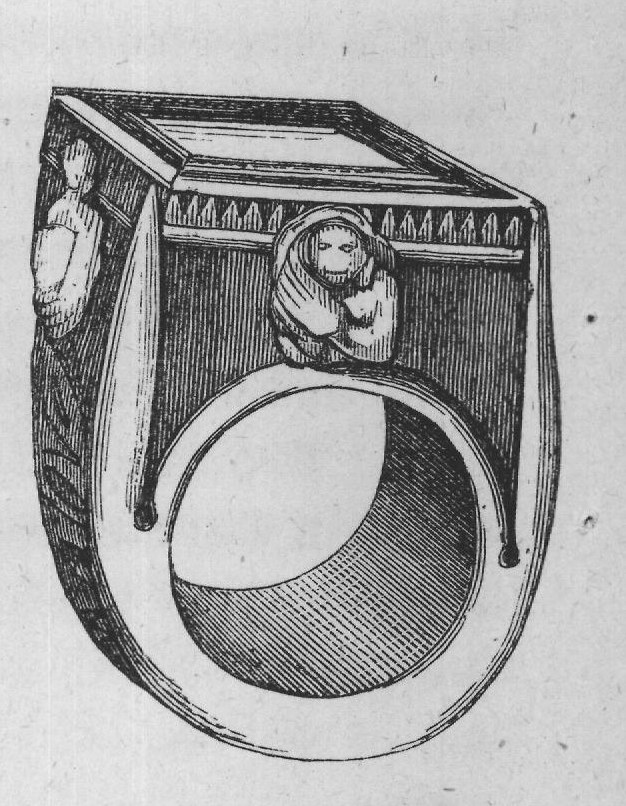
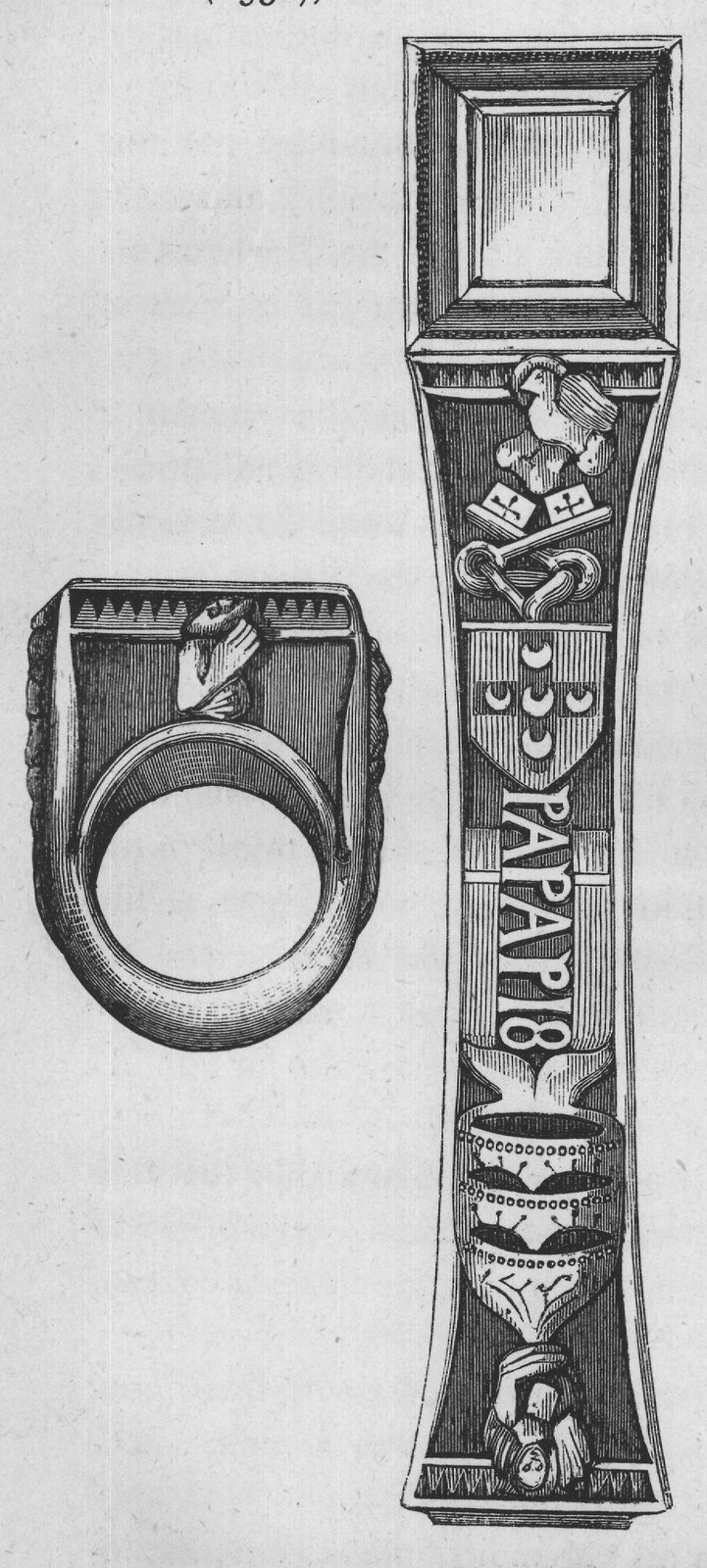
On the subject of pontifical rings of an ordinary character, I may observe that they are found in several collections, usually of brass or copper gilt. Benvenuto Cellini, in his 'Memoirs,' mentions a magnificent diamond as having been presented to Pope Paul the Third by the Emperor Charles the Fifth on his entry into Rome (1536), for which he was desired to make a ring, and PAPAPI8 ৫০০০০০০০০০৭ 00000000000 Ring of Pope Pius II. succeeded in giving the diamond a tint which surpassed anything yet done.