Home › Rings in Ecclesiastical Usages › Rings in Ecclesiastical Usages: Papal
Rings in Ecclesiastical Usages: Papal
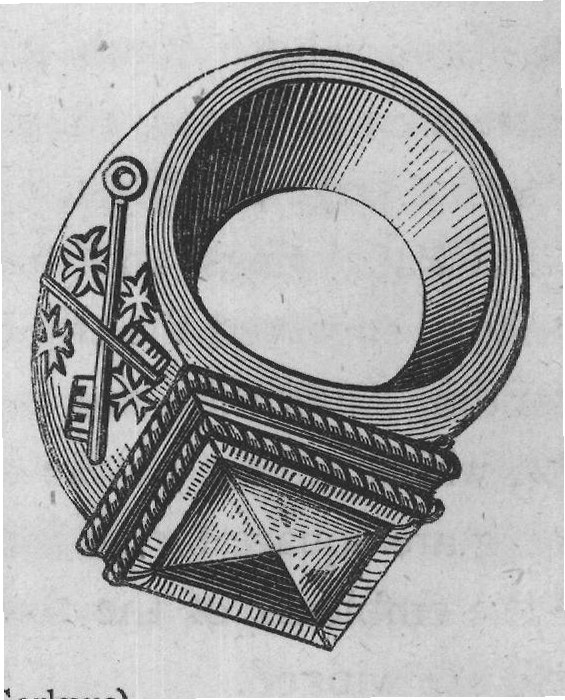
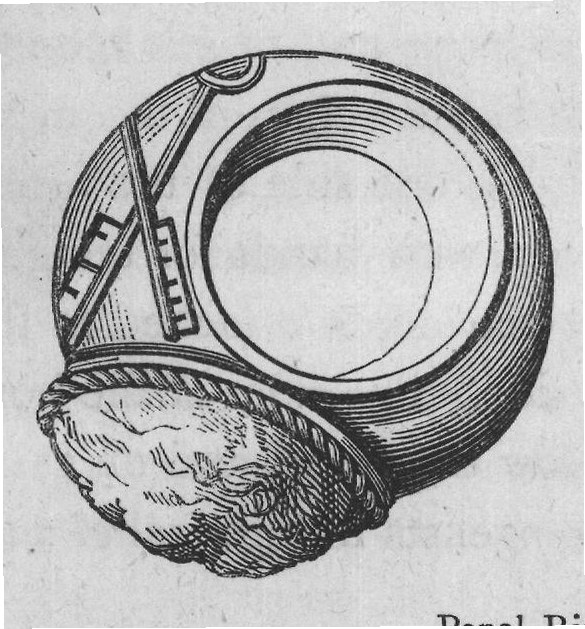
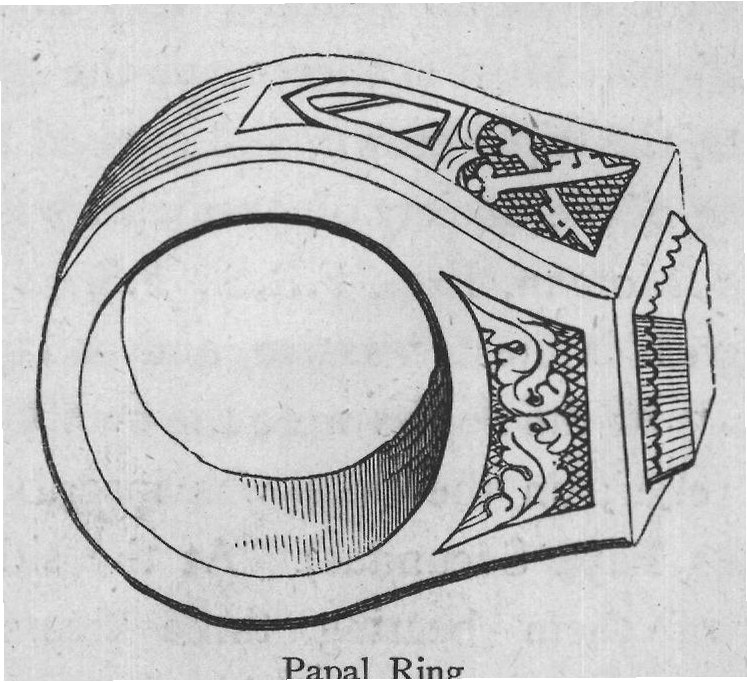
In the collection of Thomas Windus, Esq., F.S.A., is a ring bearing the arms of Pope Pius II. of the family of Piccolomini, the Papal tiara, and inscription, 'Papa Pio.' The ring is of brass, thickly gilt; the stone topaz: on the sides are the four beasts of the 'Revelation.' In the Braybrooke Collection is the ring of Pope Boniface, from whose tomb it was taken during the popular insurrection at Rome, 1849. It is large, and of gilt bronze, set with a large amethyst, cut into facets. It is of the usual type of Papal rings, and massive; on one side of the broad shank is engraved the triple crown, with bands for tying it, extending until they are met by the cords attached to the keys, which appear on the other side. The sides of the boxsetting are square for an inch below the stone, and on them are the emblems of the four Evangelists in high relief: all these are winged.
In the Waterton Collection at the South Kensington Museum are some remarkably fine specimens of bronze-gilt Papal rings of the fifteenth century, very massive and in excellent condition. Most of these have the symbols of the four Evangelists, the triple crown, and crossed keys. At a meeting of the Society of Antiquaries in November, 1858, Octavius Morgan, Esq., F.R.S., F.S.A., exhibited a Papal ring of great interest, massive, and of copper-gilt, set with blue glass. At the angles were the symbols of the four Evangelists in relief; on the hoop was inscribed PAVLVS PP SECNDVS (Paulus Papa Secundus). At the sides were two shields ; one of them bearing three fleurs-de-lys, and ensigned with an open crown, probably the arms of France; the other charged with a lion debruised by a bend, being the arms of the family of Barbo of Venice, to which Paul II. belonged. In the upper part of this shield was a small Papal tiara, which might have been placed there for want of room above, or might have been adopted by the Pope's relation, Marco Barbo, made by him a cardinal in 1464, and who died 1490.