Home › Rings in Ecclesiastical Usages › Rings in Ecclesiastical Usages: Innocent
Rings in Ecclesiastical Usages: Innocent
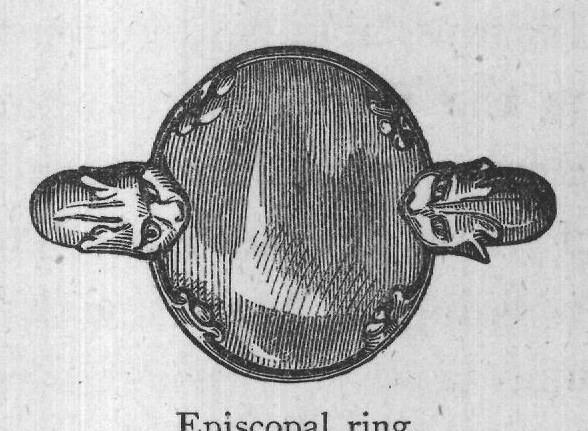
In 1191 the fashion of the episcopal ring was definitively settled by Innocent III., who ordained that it should be of gold, solid, and set with a precious stone, on which nothing was to be cut; previous to this, bishops' rings were not restricted to any special material or design. 'In the thirteenth century,' remarks Mr. E. Waterton, 'many of the episcopal rings were of very rude fashion, frequently in almost literal conformity with the rescript of Innocent III., without regard to shape or elegance. The stone was set just as it was found, merely having the surface polished, and the shape of the bezel was adapted to the gem. There are proofs that cameos were worn in episcopal rings. In the list of rings and precious stones collected by Henry III. for the shrine of St. Edward, in Westminster Abbey, there is enumerated: "j chamah in uno annulo pontificali." We know that during the Middle Ages the glyptic art had declined very much, and that from their fancied assimilation antique gems were occasionally used for devout subjects. Thus the monks of Durham converted an antique intaglio of Jupiter Tonans into the "caput Sancti Oswaldi.' During the latter part of the thirteenth century the large episcopal rings were enriched by the addition of precious stones, which were set around the principal one. Thus, in the Wardrobe Book' there is the following entry : 'Annulus auri cum quatuor rubettis magnis qui fuit Fratris J. de Peccham, nuper Cantuariensis Archiepiscopi. He died in 1292.' Episcopal rings were usually set with sapphires, probably from a popular belief that this precious stone had the power of cooling love; owing, perhaps, to the coldness of its touch, due to its density. The Rev. C. W. King, however, gives as a reason for the choice of the sapphire that, besides its supposed sympathy with the heavens, mentioned by Solinus, and its connexion with the god of day, Apollo, the violet colour agrees with the vestments appropriated to the priestly office.
Episcopal ring.