Home › Rings in Ecclesiastical Usages › Rings in Ecclesiastical Usages: Edmund
Rings in Ecclesiastical Usages: Edmund
A similar occurrence is recorded in the register on the decease of David Martyn, Bishop of St. David's, March 9, 1328. His executors had delivered the seals and ring to Master Edmund de Mepham, who had departed this life; and a letter is found from Henry de Eastry, Prior of Christ Church, to Robert Leveye, Edmund's executor, requesting him to render up these objects to which the Prior was entitled. The Wardrobe Books and other records would doubtless show that the rights of the Crown were constantly enforced on the decease of archbishops and bishops with no less jealous vigilance than those of the Church of Canterbury. In the Wardrobe Book of 28th Edward I., for instance, amongst various articles mention is made of the gold ring of William de Hothum, Archbishop of Dublin, who died in 1298, set with a sapphire, as also of many silver ciphi and gold rings set with various gems, delivered to the King on the decease of several other prelates at that period. In the same record are to be found the gold rings of the abbots of Glastonbury, St. Alban's, and Abingdon, lately deceased, in custody of the King's wardrobe.
It is deserving of remark that at an earlier period no claim, as regarded the pontifical ring, appears to have been acknowledged by the Bishops of Rochester.
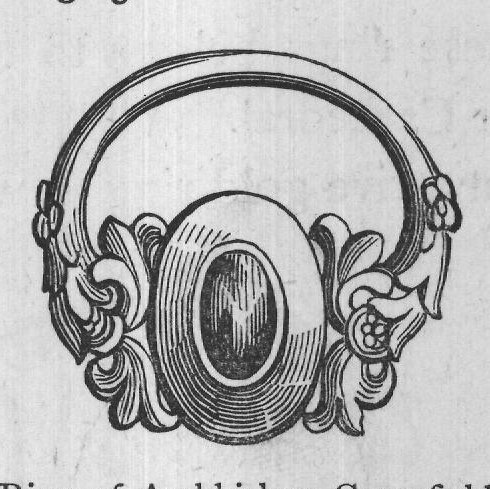
Mr. Edmund Waterton, in the 'Archeological Journal' (vol. xx. pp. 235 et seq.), gives a list of a few of the authentic episcopal rings now in existence in England. The ring of Seffrid, Bishop of Winchester, who died in 1151. This is most curious, for it is set with a gnostic gem, representing the figure with the head of a cock. It is a strange subject for the ring of a bishop.
A massive gold ring set with a sapphire, found in a tomb on the thumb of the skeleton of a bishop, supposed to be Hilary, Bishop of Chichester, who died in 1169, together with a silver chalice, and paten, and a pastoral staff. A gold ring with an octagonal sapphire, set à griffes, and with four small emeralds in the corners. This was found in a stone coffin on which was inscribed EPISCOPUS, and which also contained some remains of vestments, and a pastoral staff.
These three rings belong to the Dean and Chapter of Chichester.
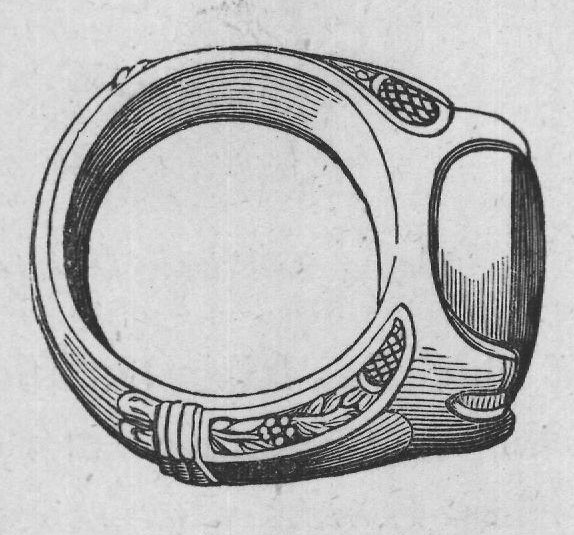
Gold ring set with a ruby, and found in York Minster in the tomb of Archbishop Sewall, who died 1258.
A gold ring, also set with a ruby, found in the tomb of Archbishop Greenfield, who died 1315.
Ring of Archbishop Sewall.
Ring of Archbishop Greenfield. 6 A gold ring, the stone of which has fallen out and which bears on the inside the chançon 'X honnor X et X joye x,' found in the tomb of Archbishop Bowett, who died in 1423. The three last rings are preserved in York Minster.
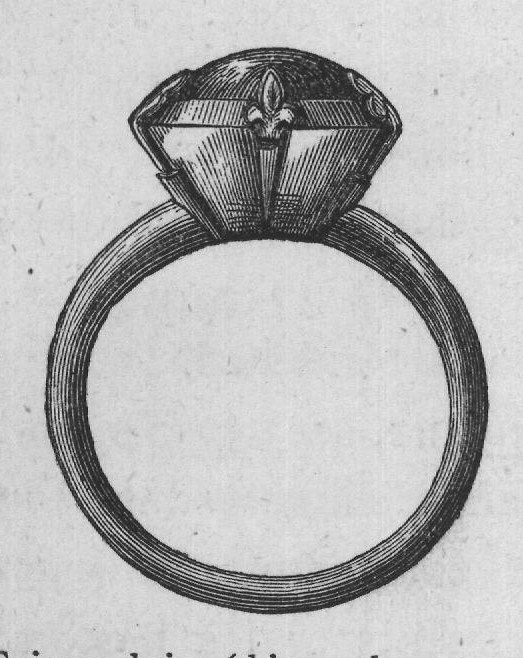
A large gold ring set with an irregular oval sapphire Q secured by four grips in the form of fleurs-de-lys. The stone is pierced longitudinally. This was found in Winchester Cathedral, and may be assigned to the thirteenth century. Episcopal ring (thirteenth century).
The ring of William of Wykeham, Bishop of Winchester, died 1404. A massive plain gold ring, set with a sapphire. By his will he bequeathed to his successor in the Bishopric of Winchester, his best book, De Officio Pontificali, his best missal, and his larger gold pontifical ring, set with a sapphire, and surrounded with four balass-rubies. A gold ring found in the tomb of Bishop Gardiner, in Winchester Cathedral (died 1555). It is set with an oval plasma intaglio of the head of Minerva; on the shoulders of the hoop are two square facetted ornaments, each set with five small rubies en cabochon.