Home › Rings from the Earliest Period › Rings from the Earliest Period: Etruscans
Rings from the Earliest Period: Etruscans
The Etruscans and the Sabines wore rings at the period of the foundation of Rome, 753 b.c.
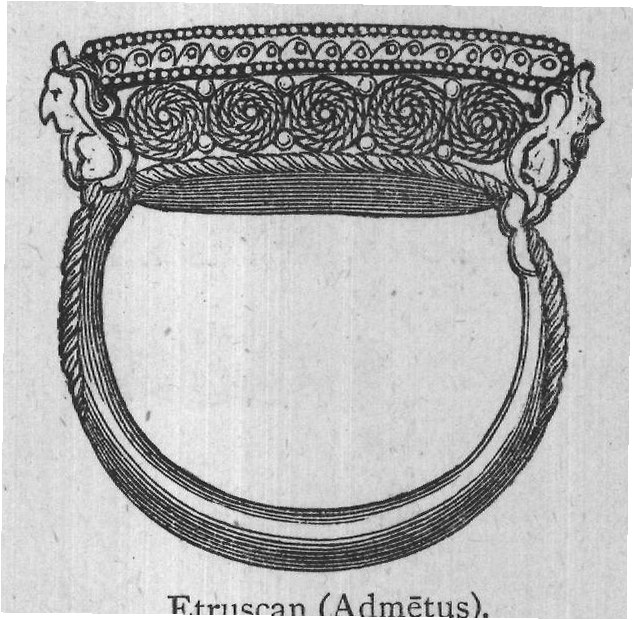
The Etruscans made rings of great value. They have been found of every variety-with precious stones, of massive gold, very solid, with engraved stones of remarkable beauty. Among Etruscan rings in the Musée Nap. III. the table of one offers a representation, enlarged, of the story of Admētus, the King of Pheræ in Thessaly. He took part in the expedition of the Argonauts, and sued for the hand of Alcestis, the daughter of Pelias, who promised him to her on condition that he should come to her in a chariot drawn 1 Appendix. by lions and boars. This feat Admētus performed by the assistance of Apollo, who served him, according to some accounts, out of attachment to him, or, according to others, because he was obliged to serve a mortal for one year, for having slain the Cyclops.
Among rings taken out of the tombs there are some in the form of a knot or of a serpent.
They are frequently found with Etruscan (Admētus).
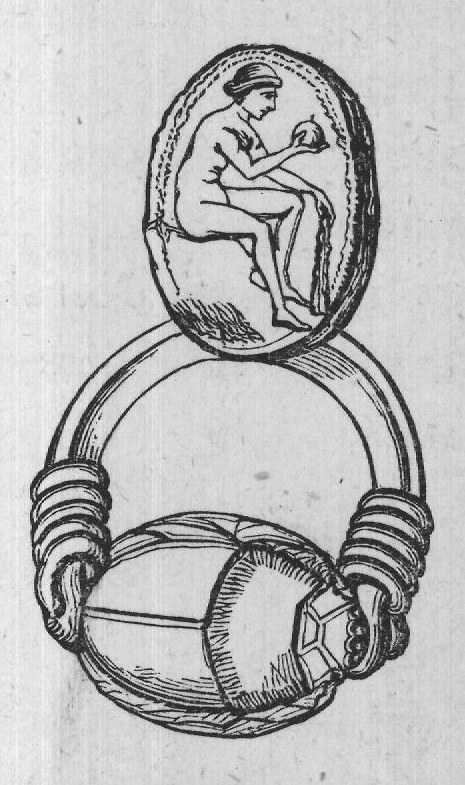
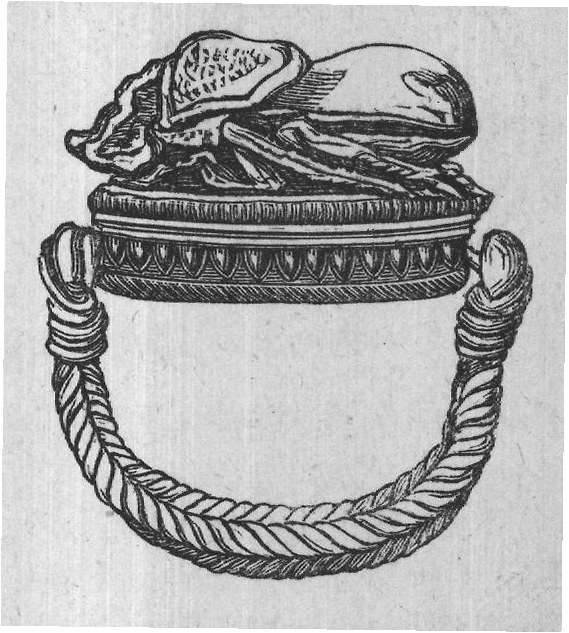
Representation of Admētus. shields of gold, and of that form which we call Gothic, that is elliptical and pointed, called by foreigners ogive, Etrusca with raised subjects chiselled on the gold, or with onyxs of the same form, but polished and surrounded with gold. C2 There are some particular rings which appear more adapted to be used as seals than rings, and they have on the shields, relievos of much more arched, and almost Egyptian, form.¹ Among the antique jewels at the Bibliothèque Nationale at Paris are two fine specimens of Etruscan rings. One is of gold, on which is a scarabæus in cornelian; the stomach Etruscan. of the scarabæus is engraved hollow and represents a naked man holding a vase. The other is a gold ring found in a tomb at Etruria, of which the bezel, sculptured in relief, could not serve as a seal.
The subject is a divinity combating with two spirits, a representation of the eastern idea of the struggles between the two principles of good and evil, such as are found on numerous cylinders that come from the borders of the Euphrates and the Tigris. This analogy between the religious ideas of the Etruscans and Etruscan. those of the most ancient monuments of the East is not ¹ Cellini, in his 'Memoirs,' says that Pope Clement VII. showed him a gold Etruscan necklace of exquisite workmanship, which had just been discovered in the ground. On examining it, 'Alas,' cried he, 'it is better not to imitate these Etruscans, for we should be nothing but their humble servants. Let us rather strike out a new path, which will, at least, have the merit of originality.' astonishing when it is shown that the Etruscans, the ancient inhabitants of Italy, were originally from Asia. The following engraving represents an intaglio on a scarabæus ring, of fine workmanship, preserved in Vienna.