Home › Rings from the Earliest Period › Rings from the Earliest Period (Use of signet-rings as symbols)
Rings from the Earliest Period (Use of signet-rings as symbols)
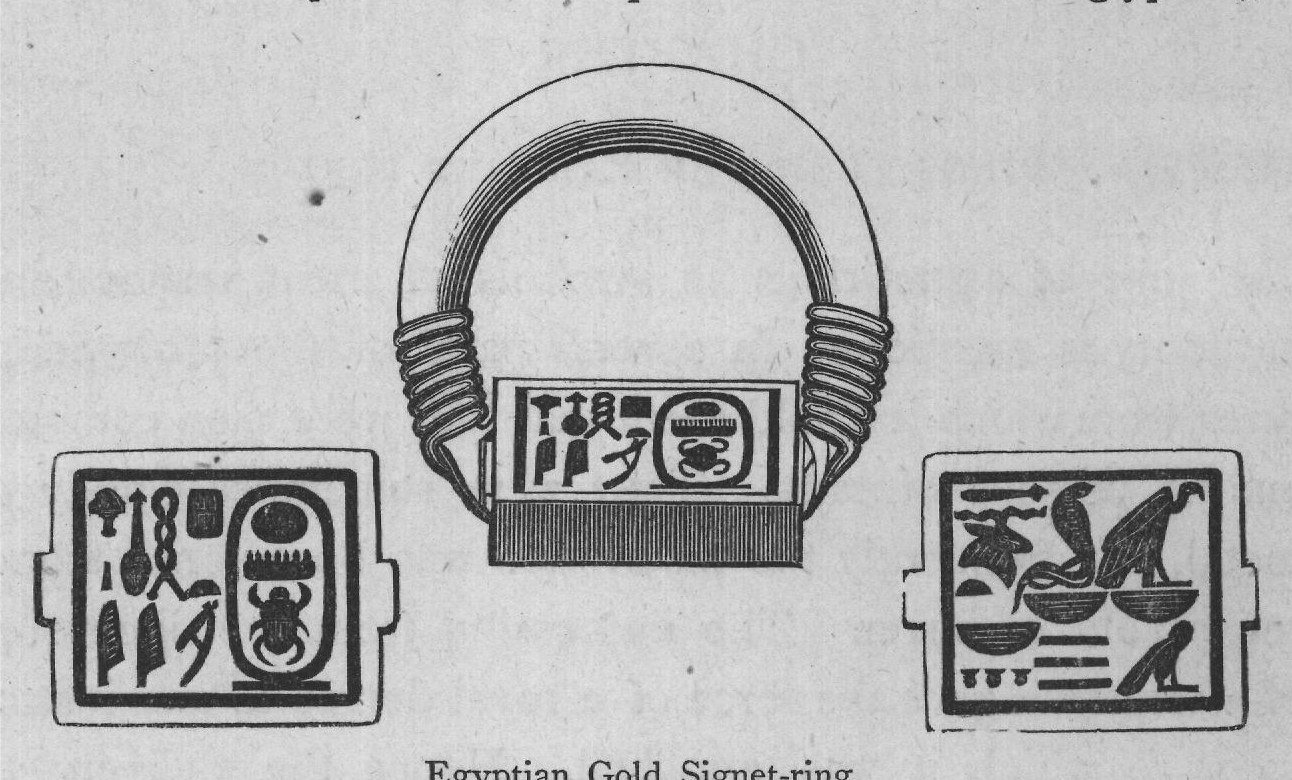
THE use of signet-rings as symbols of great respect and authority is mentioned in several parts of the Holy Scriptures, from which it would seem that they were then common among persons of rank. They were sometimes wholly of metal, but frequently the inscription was borne on a stone, set in gold or silver. The impression from the signet-ring of a monarch gave the force of a royal decree to any instrument to which it was attached. Hence the delivery or transfer of it gave the power of using the royal name, and created the highest office in the State. In Genesis (xli. 42) we find that Joseph had conferred upon him the royal signet, as an insignia of authority. Thus Ahasuerus transferred his 1 In 1841 Mr. Joseph Bonomi read a paper before the Royal Society of Literature on an ancient signet-ring of gold, resembling in every respect, except the name of the king, the ring which Pharaoh put on the finger of Joseph. The account of its purchase, loss, and subsequent recovery is very interesting. It was bought by Lord Ashburnham at Cairo in 1825. In the spring of the same year his Lordship embarked a valuable collection on board a brig he had chartered at Alexandria, to carry his heavy baggage to Smyrna. This was attacked and pillaged by Greek pirates, who sold their booty in the island of Syra. The ring then became the property of a Greek merchant, in The B authority to Haman (Esther iii. 12). The ring was also used as a pledge for the performance of a promise: Judah whose possession it remained until it was sold at Constantinople, and was brought to England in 1840. It then passed from the hands of Mr. Bonomi into those of Lord Ashburnham, its former possessor. It is conjectured, from evidence peculiar to Egyptian antiquities, that this ring belonged to the age of Thothmes III.
In the winter of 1824 a discovery was made in Sakkara of a tomb enclosing a mummy entirely cased in solid gold (each limb, each finger of which had its particular envelope inscribed with hieroglyphics), a Egyptian Gold Signet-ring. scarabæus attached to a gold chain, a gold ring, and a pair of bracelets of gold with other valuable relics. This account was wrested from the excavators à coups de bâton administered by Mohammed Defterdar Bey, by which means were recovered to Signor Drovetti (at whose charge the excavation was made) the scarabæus and gold chain, a fragment of the gold envelope, and the bracelets, now in the Leyden Museum, which bear the same name as this ring. From the circumstance of the bracelets bearing the same name as this ring, and from the word Pthah, the name of the tutelar divinity of Memphis (of which city Sakkara was the necropolis) being also inscribed upon it, there is little doubt it was found in that place, and, from the confession of the Arabs, a great probability that it came out of the same excavation. The discovery of so much gold in a single tomb, which, from the nature of the ornaments, must have belonged to the Pharaoh himself, or to a distinguished officer of his household, accords well with Mr. Cory's system of chronology, which places the death of the patriarch Joseph in the twenty-first promised to send Tamar, his daughter-in-law, a kid from his flock, and for fulfilment left with her (at her desire) his signet, his bracelet, and his staff (Genesis xxxviii. 17, 18). Darius sealed with his ring the mouth of the den of lions (Daniel vi. 17). Queen Jezebel, to destroy Naboth, made use of the ring of Ahab, King of the Israelites, her husband, to seal the counterfeit letters ordering the death of that unfortunate man. The Scriptures tell us that, when Judith arrayed herself to meet Holofernes, among other rich decorations she wore bracelets, ear-rings, and rings.