Home › Rings from the Earliest Period › Rings from the Earliest Period: Roman (Etruscan At a meeting)
Rings from the Earliest Period: Roman (Etruscan At a meeting)
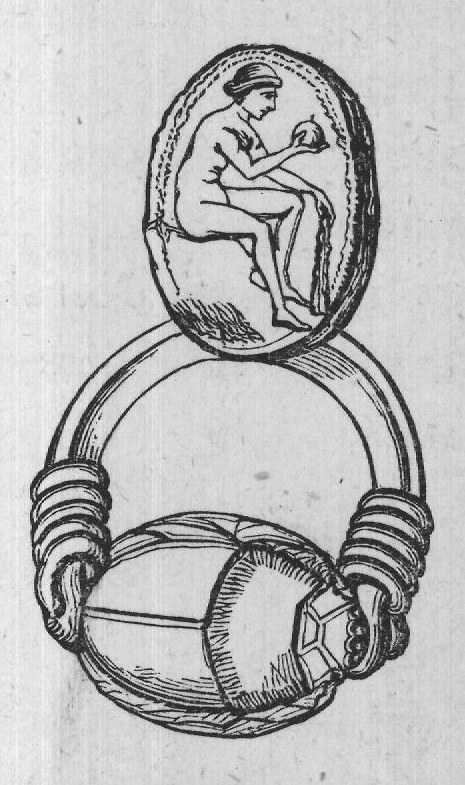
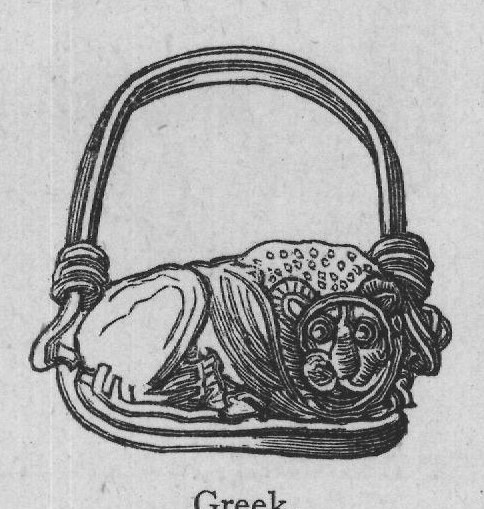
Etruscan At a meeting of the Archæological Institute (May 3, 1850) the Dowager Duchess of Cleveland exhibited a curious Roman ring of pure gold (weight 182 grains), of which an illustration is given in the Journal of the Institute (vol. vii. p. 190). 'It was found, with other remains, at Pierse Bridge (AD TISAM), county of Durham, where the vestiges of a rectangular encampment may be distinctly traced. The hoop, wrought by the hammer, is joined by welding the extremities together; to this is attached an oval facet, the metal engraved in intaglio, the impress being two human heads respectant, probably male and female-the prototype of the numerous "love seals" of a later period. The device on the ring is somewhat effaced, but evidently represented two persons gazing at each other. This is not the first Roman example of the kind found in England. The device appears on a ring, apparently of that period, found on Stanmore Common in 1781. On the mediæval seals alluded to, the heads are usually accompanied by the motto "Love me, and I thee," to which, also, a counterpart is found among relics of a more remote age. Galeotti, in his curious illustrations of the "Gemme Antiquæ Litteratæ," in the collection of Ficoroni, gives an intaglio engraved with the words "Amo te, ama me."" The following engravings represent: A ring in the Musée du Louvre, with a lion sculptured by a Greek artist, in an oriental cornelian; the reverse has an intaglio of a lion couchant. The second, from the Webb Collection, is that of an ancient Greek ring, of solid gold, with the representation of a comic mask in high relief. The other, a gold ring with a bearded mask, Roman, in the Waterton Collection at the South Kensington Museum-also in high reliefhas the shoulders thickened with fillets, engraved with stars.