Home › Rings from the Earliest Period › Rings from the Earliest Period: Hereford
Rings from the Earliest Period: Hereford
A brass signet-ring found in the Cathedral Close at Hereford, bears for impress a kind of merchant's mark, a cross, with the lower extremity barbed like an arrow, between the initials G. M.-now in the possession of the Dean of Hereford. In the Braybrooke Collection is a bronze signet-ring with a merchant's mark within a cable border: the mark may be intended to represent a buoy, which would accord well with the border, supposing it to be a trader's cipher; the hoop is likewise twisted to imitate the strands of a rope. This ring was found in the Thames.
In the same collection is a massive gold thumb-ring engraved as a signet, with a merchant's mark within a rude shield. The shoulders of the hoop are chased with Marguerite flowers, which were commonly adopted in the reign of Henry VI., in honour of the queen-mother, and may indicate the date of the ring. It was found at Littlebury, Essex, in 1848. In the same collection is a large gold thumb-ring, with a round hoop and signet, on which is engraved the letter E of Longobardic form, within delicatelycusped tracery, surmounted by a coronet. The hoop is inscribed externally with the words in. on. is. al. (in one is all): probably intended for a charm, of which so many forms are found upon rings of the fourteenth and fifteenth centuries.
In the Londesborough Collection is the fine specimen (to which I have alluded in a previous page) of a signet-ring bearing a 'merchant's mark.' 'The marks,' observes Mr. Fairholt, 'varied with every owner, and was as peculiar to himself as the modern autograph; they were a combination of initials, or letter-like devices, frequently surmounted by a cross, or a conventional sign, believed to represent the sails of a ship. The marks were placed upon the bales of merchandise, and were constantly used where the coat armour, or badge of a nobleman or gentleman entitled to bear arms would be placed. The authority vested in such merchants' rings is curiously illustrated in one of the historical plays on the life and reign of Queen Elizabeth, written by Thomas Heywood, and to which he gave the quaint title: "If you know not me, you know nobody." Sir Thomas Gresham, the great London merchant, is one of the principal characters, and in a scene where he is absent from home, and in sudden need of cash, he exclaims: "Here, John, take this seal-ring, bid Timothy send me presently a hundred pound." John takes the ring to the trusty Timothy, saying: "Here's his seal-ring; I hope a sufficient warrant." To which Timothy replies : "Upon so good security, John, I'll fit me to deliver it." Another merchant in the same play is made to obtain his wants by similar means :receive thou my seal-ring :
Bear it to my factor; bid him by that token Sort thee out forty pounds' worth of such wares As thou shalt think most beneficial.
The custom must have been common to be thus used in dramatic scenes of real life. These plays were produced in 1606.'1 1 Montfaucon, in his L'Antiquité Expliquée,' describes the representation of a trading seal 'as one of the most extraordinary that has yet been seen.' It was given to him by a monk of St. Victor, at Marseilles. The form was oblong, and the inscription was in three lines, the first of which is P. Hileyi, Publii Hileyi, at the end of which words was a well-formed caduceus. The second and third lines were Sex. Maci Paullini, Sexti Maci Paullini. The caducus, which was a symbol of traffic, denotes that these were two merchants and co-partners, and 'Merchants' marks, which appear to have been imitated from the Flemings during the reign of Edward the Third, and became very common during the fifteenth and early part of the sixteenth century, both on seals and signet-rings, offer a somewhat curious field for research, and are often very useful in identifying the persons by whom domestic and parts of ecclesiastical edifices on which they occur were ah R I R Merchants' rings. built. They were more generally used in the great seaports of England than in the south-a fact which is readily accounted for by the frequent intercourse between those ports and Flanders. It may be observed also that such marks belonged chiefly to wool-factors, or merchants of the staple.'-Archæological Fournal for March 1848.
In the collections of our English antiquaries are numerous specimens of thumb-rings, and in the chapter on the anchor, that they were adventurers by sea. One thing remarkable is that the first name, P. Hileyi, was taken by design, but yet so that it night be read; the letters being cut very deep, they contented themselves with taking out so much of them only as would spoil that part of the impression upon wax, or any other matter, and leave the other name to be impressed alone. That this was done by design appeared from the varnish seen in these traces, as well as in the rest of the seal, and was probably done by Sextus Macius Paullinus at the death of his partner Publius Hileyus. 'Ecclesiastical Usages in Connection with Rings' I have mentioned several of particular interest, notably an effigy with a signet-ring of remarkable size represented as worn over both the thumbs. Dr. Bruce found some thumb-rings along the line of the Roman wall.
The custom of wearing thumb-rings is alluded to by Chaucer, in the 'Squire's Tale,' where it is said of the rider of the brazen horse who advanced into the hall, Cambuscan, that 'upon his thumb he had of gold a ring.' Brome, in the 'Antipodes,' 1638, and also in the 'Northern Lass: ' ' A good man in the city wears nothing rich about him but the gout, or a thumb-ring.' In the 'Archæological Journal' (vol. iii. page 268) is a representation of a curious thumb-ring, which supplies a good example of the signet thumb-ring of the fifteenth century. It is of silver, alloyed, or plated with baser metal and strongly gilt. The hoop is grooved spirally, and the initial His engraved upon it; weight 17 dwts. 18 grs. It was found in 1846, in dredging in the bed of the river Severn, at a place called Saxon's or Saxton's Lode.
Signet rings of this kind were worn by rich citizens, or persons of substance not entitled to bear arms. Falstaff bragged that in his earlier years he had been so slender in figure that he could readily have crept through an 'alderman's thumb-ring,' and a ring thus worn-probably, as more conspicuous-appears to have been considered as appropriate to the customary attire of a civic dignitary at a much later period. A character in the Lord Mayor's show in 1664 is described as 'habited like a grave citizen-gold girdle and gloves hung thereon, rings on his fingers, and a seal-ring on his thumb.' In Labartes 'Hand-book of the Fine Arts in the Middle Ages' is a representation of a fine thumb-ring, of Hindoo workmanship, cut out of a single piece of jade, decorated with gold filagree, and incrusted with rubies.
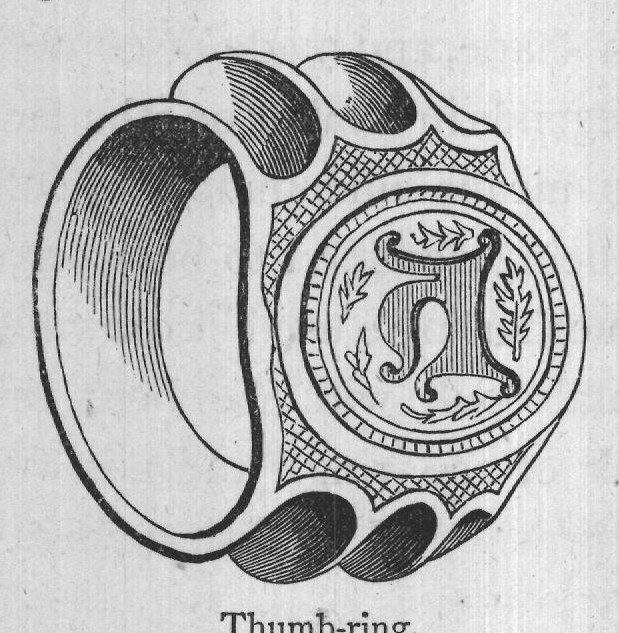
A magical thumb-ring of gilt, bearing the figure of a toad, and of German workmanship of the fourteenth century is in the Londesborough Collection, and is described in the chapter on 'Ring Superstitions.' The annexed representation is from a ring in the same collection. Thumb-ring.
The figure of a morse ivory thumb-ring of an Earl of Shrewsbury, belonging to Dr. Iliff, is given in the 'Proceedings of the Society of Antiquaries' (December, 1859), in which it is fully described. On this is engraved various coats of arms, surrounded by the Garter, and ensigned with an earl's coronet. A list of the quarterings is also given.1 In the Braybrooke Collection is a massive latten thumbring, with a signet engraved with I.H.S. and three tears below; the words, 'in Deo Salus' are inside the hoop. They are from the Penitential Psalms, and in union with the tears. Date from the thirteenth century.
In a portrait of Lady Anne Clifford, the celebrated 1 Appendix.
Countess of Pembroke, she wears a ring upon the thumb of her right hand.