Home › Rings from the Earliest Period › Rings from the Earliest Period (Being also twisted these two)
Rings from the Earliest Period (Being also twisted these two)
of being also twisted; these two have been twined together to form one ring.
In a communication from Mr. Worsaae, of Copenhagen, to the 'Archæological Journal,' he observes that the triangular pattern with three or four points on the Cuerdale rings differs totally from the designs on Celtic, Roman, or Saxon remains, and which never seems to occur on any objects found in the interior or southern parts of Europe. 'To the instances which Mr. Hawkins has already cited of similar patterns on silver objects found in Denmark and in Finland, I can only add that I have seen precisely similar objects with the same pattern in Ireland, Prussia, and Sweden, and that in the interior of Russia, in tumuli in the neighbourhood of Moscow, the same patterns have been found on rings. In nearly every instance these ornaments have been found along with oriental or Cufic coins, as in the case at Cuerdale.' Mr. Worsaae is of opinion that they are of eastern origin, and were brought to the north in the same way as the oriental coins.
In the collection of antiquities of the Royal Irish Academy there are two curious specimens of rings; one, like a ferule, fluted both externally and internally, so as to re- 00000 Rings in the Royal Irish Academy. semble seven plain rings, attached to one another; and their weight is 9 dwts.
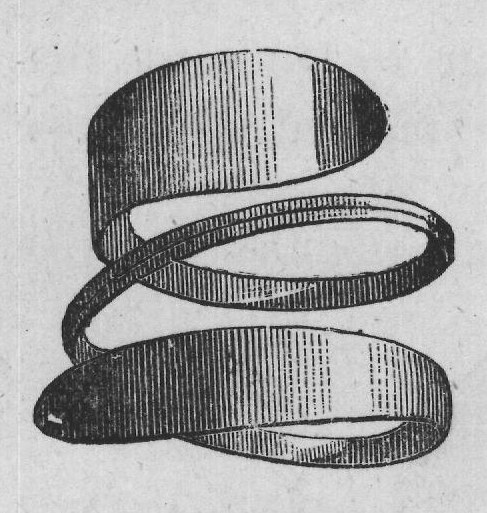
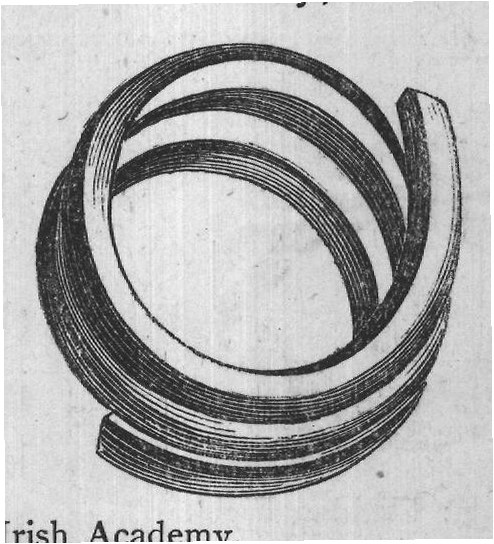
F The other is a five-sided bar of gold, flat on the inside near the finger, and angular externally; weight 1 oz. 12 dwts. 6 grs. This might be denominated a torque ring. The following illustration represents a spiral silver ring, found at Largo, weighing 120 grs. It is shaped, apparently, by the hammer.
The edges are serrated. A spiral ring found with Saxon remains in Kent, engraved by Douglas in his 'Nenia,' and another found in the Isle of Spiral silver ring.
Wight, represented in the 'Winchester' volume of the Archæological Association, may be compared with the present example.
A.WAY del JZWITT.
Dr. Mantell has a massive gold ring, supposed to have been worn on the finger, formed of two square bars rudely twisted together, and gradually diminishing in size towards the extremities, where they are united together. It was ploughed up at Bormer, in Sussex, and was presented to Dr. Mantell by the Earl of Chichester. It is represented in Horsfield's 'History of Lewes,' plate iv. Similar rings of this description, but differing in the fashion of the twist, have been noticed as found in Britain. The resemblance between these ornaments and the gold 'ring-money' of the interior of Africa is exceedingly curious.
Ring: Flodden Field. have been found on the The annexed engraving (from the 'Archæological Journal,' vol. iii. p. 269) represents a gold ring, belonging to Sir Noel Paton, F.S.A., Scotland, reported to field of Flodden: weight 8 dwts. 17 grs.
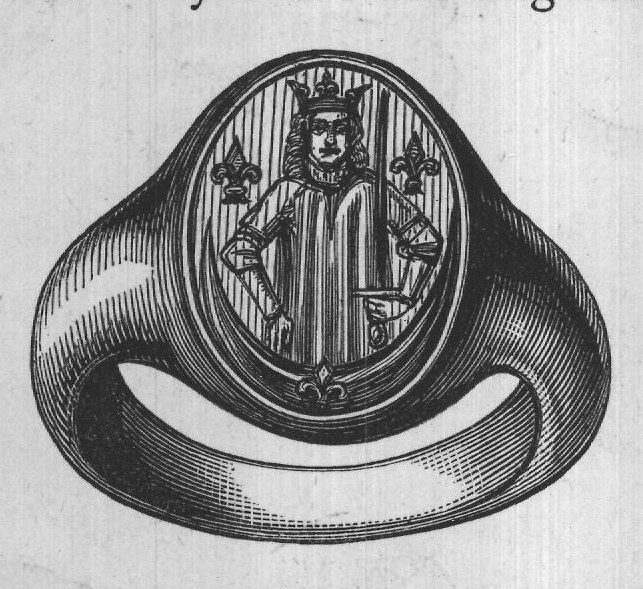
Other rings of a similar form have been discovered, and 'they appear to offer some analogy with the torc of the Celtic age.' The annexed illustration represents a remarkably fine ring engraved in Chifflet's 'Anastasis Childerici' (1655), on the same page as that of the Childeric ring (described in the chapter on 'Memorial and Mortuary Rings '), for purposes of comparison, in carrying out his original theory, that the supposed bees of Childeric were, by gradual transition, converted into the figure known as the fleur de lys of a later monarchy, as he endeavours to illustrate by numerous diagrams, but he omits to say where this ring marked 'sapphirus' was originally found. It is a mere supposition that the figure represents St. Louis, but in Montfaucon's 'Monuments de la Monarchie Française' (Paris, 1729), in a long disquisition on the origin, &c., of the fleur de lys, on referring to plate xxiii. tom. ii. p. 158, where St. Louis 'instruit ses enfans,' his shield is noticed as bearing for the first time three fleurs de lys.
Sandford, in his 'Genealogical History' (pp. 270, 289), says that Henry the Fifth, being Prince of Wales, 'did bear azure, 3 flowers de lys or, for the Kingdom of France, reducing them from semée to the number 3, as did Charles VI., the present King.' Among the old Northmen rings were generally worn by F2 rich people and persons of rank. Such rings are frequently found in barrows of pagan date, and from their nature and quality it is easy to determine that they were generally of very simple workmanship; the reason of which, undoubtedly, was that they were used instead of money in commercial transactions, and had, therefore, not unfrequently to be cut asunder. Still, rings of more artistic workmanship are sometimes found in pagan graves.
Bronze.
Gold.
Gold.
Gold.
Gold, enamelled and inlaid.
Gold.
Gold.
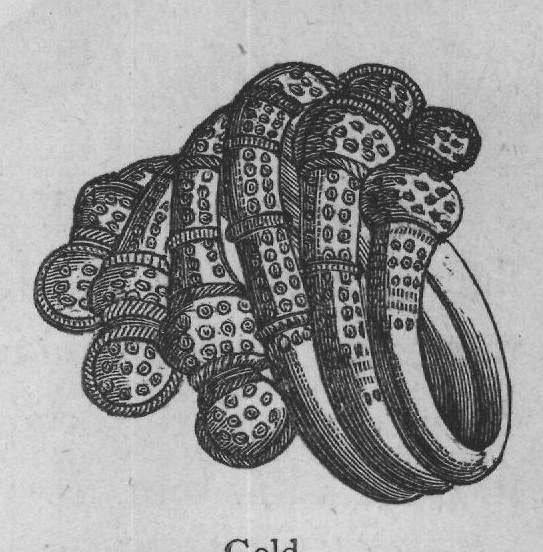
The preceding cuts are taken from examples in the Royal Museum, Copenhagen, of the curious twisted spiral rings alluded to, found in the graves of the old Northmen. Charlemagne sealed all his acts with his ring. That of his son Louis le Débonnaire had for inscription XPE. PRO-