Home › Rings from the Earliest Period › Rings from the Earliest Period: Herculaneum
Rings from the Earliest Period: Herculaneum
In the Museum at Naples are two fine specimens of rings discovered at Herculaneum and Pompeii, illustrations of which are here given from the work of M. Louis Barré, 'Herculaneum et Pompeii' (Paris, 1839-40) :- A 144444 Rings from Herculaneum and Pompeii.
A bronze ring is curious from having similar ornaments to those of the horse-furniture discovered some years ago at Stanwick, on the estates of the Duke of Northumberland in Yorkshire, and which are analogous in the character of their E design to those found in Roman places of sepulture in Rhenish Germany.
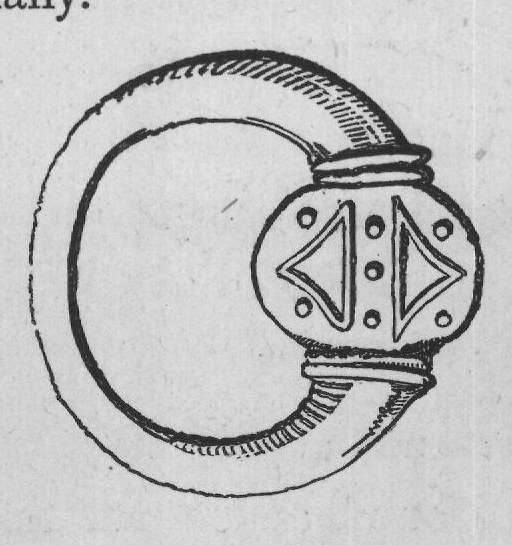
Roman.
Representation of a 'trophy' ring in the Museum of the Hermitage, St. Petersburg; the figure of a lion on the convex; on the reverse a trophy:- Roman 'Trophy' ring.
Roman ring (from the Museum at Mayence).
In the Waterton Collection are some valuable and curious specimens of Greek and Roman art in ring-manufacture. These are composed of gold, silver, bronze, iron, lead, earthenware, amber, vitreous paste, jet, white cornelian, lapis-lazuli, chrysoprase, &c. Amongst these will be seen some interesting Roman rings for children; one engraved with a rude figure of Victory, found at Rietri, in 1856, diam. 1 in. In the same collection are bronze 'legionary' rings-perhaps the number of a 'centuria,' some corps employed about Rome, where all the rings of this character connected with the collection have been found. Among the 'votive' rings in this collection, is one in the form of a shoe, inscribed FELIX, of bronze.
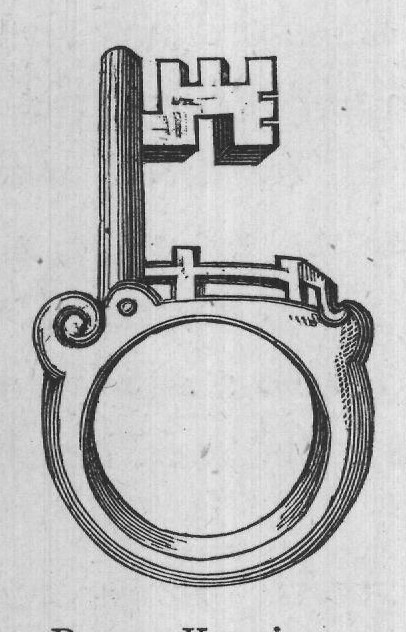
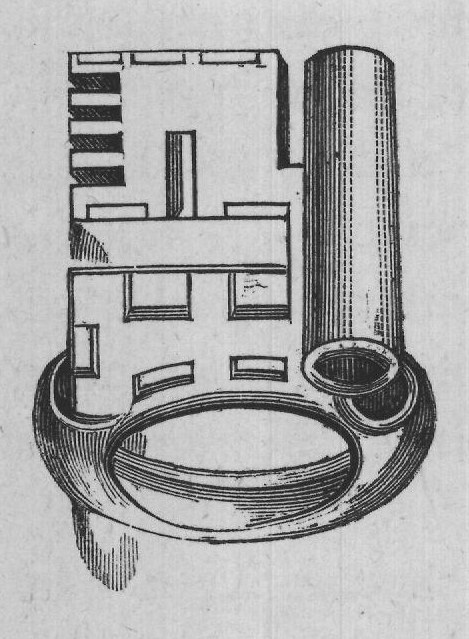
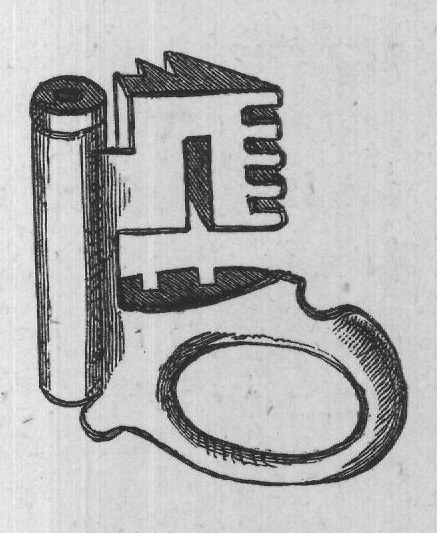
There are also specimens of rings with the key on the hoop, to which I have alluded in the chapter on 'Betrothal and Wedding Rings.' One has a fluted pipe; another has a key with two wards; in another the key is riveted on the hoop.
Roman Key-rings.
The earthenware rings are of brown or red. The amber rings are of mottled deep red, set with green paste. Those in vitreous paste are of pale blue, transparent yellowish and transparent brown. A 'jet' ring belongs to the late Roman period. A white cornelian ring has a smaller part of the hoop cut down, so as to form an oval bezel, on which is engraved a standing figure of Æsculapius. A gold ring, Roman, set with oval intaglio, on cornelian, of a trophy consisting of a horse's head bridled, and two Gallic shields crossed, with the name of Q. Cornel Lupi, is the seal of Quintus Cornelius Lupus, commemorating a victory over the Gauls: the setting is modern. Another gold ring, with oval bezel, set with an intaglio on yellow sard, has a youthful bust, full-faced; on one side a spear, E2 on the other side, in Greek letters, 'Hermai.' A gold ring with nicoli onyx is inscribed 'VIBAS LUXURI HOMO BONE.' Some of the Early Christian' rings in the same collection are very interesting. These are of silver, bronze, and lead. One of silver has an octagonal bezel engraved with the Agnus Dei; another, of bronze, has a square bezel inscribed 'VIVAS IN DEO'; a bronze ring with oval bezel is chased with a lamb, the shoulders and hoop chased so as to represent a wreath of palms; another, of bronze, has a projecting octagonal bezel, engraved with a dove and a star, the hoop formed so as to resemble a wreath. A massive bronze ring has the bezel engraved with the figure of an orante; on the hoop is also a sigillum engraved with a cross. One ring, of lead, has a flattened bezel rudely incised with a cross.
The following engraving represents the fore-finger, from a bronze statue, of late Roman workmanship, on which a large ring is seen on the second joint. A similar custom prevails in Germany.
Late Roman (from the Waterton Collection).
The latest 'surprise' in regard to rings is that in connection with Dr. Schliemann's discovery of antiquities upon the presumed site of Troy. The Doctor, in June 1873, after indefatigable exertions in excavating, came upon a trouvaille consisting of ancient relics of great rarity, value, and importance, including finger-rings, of which, as I have mentioned, the Homeric writings make no mention. These were found among a marvellous assemblage of bronze, silver, and gold objects, which lay together in a heap within a small space. This seemed to indicate that they had originally been packed in a chest which had perished in a conflagration (most of the articles having been exposed to the action of fire), a bronze key being found near them. The period to which these objects belong is the subject of much controversy, but their origin must date from a very remote period.