Inxpo No
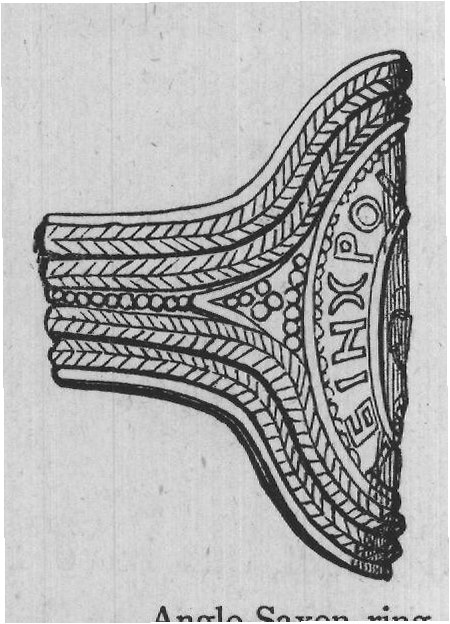
ME Anglo-Saxon ring, found near Bosington. a male head, round which is inscribed 'NOMEN EHLLA FID IN XPO,'-my name is Ella; my faith is in Christ. It is now in the Ashmolean Museum at Oxford.
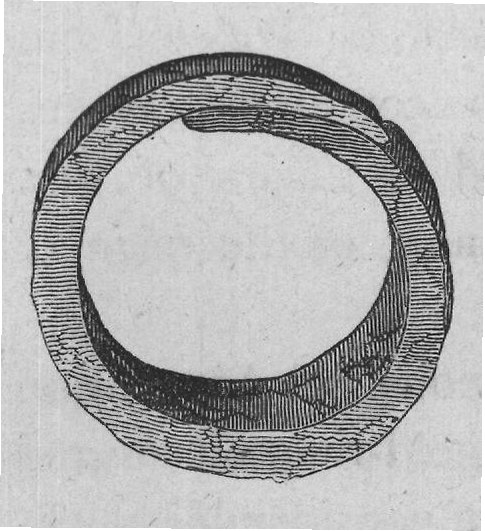
In 1840 at Cuerdale, near Preston, some curious discoveries of coins and treasure were made, considered to have been deposited about the year 910, and the ornaments such as were worn about the time of Alfred, or somewhat earlier. These included several rings, representations of which are given in the 'Archæological Journal' (vol. iv. p. 127). One is merely a piece of metal hammered flat, thinner and narrower at the ends, and formed into a circle; the ends lapping over, but without any fastening. It is entirely without ornament. In some specimens the metal is hammered and bent into the form of a ring, in the same manner as the flat one. Two rings are formed exactly like some armlets, found at the same time; the punch has had a triangular point, and triangles conjoined at their bases having been struck side by side, parallel rows of sunk lozenges have been produced. Another ring has been hammered into a small four-sided bar, then twisted, and ultimately formed into a ring, the ends of which meet, but have not been united. In another ring two wires have been hammered into a roundish form, tapering towards the ends, which have MLD been tied together. transverse blows of a blunt chisel, and has the appearance Each wire has been ornamented by