Home › Footprints on the Sands of Time › Footprints on the Sands of Time: Ichnology
Footprints on the Sands of Time: Ichnology
But, in justice to Dr. Deane, we must not omit to mention his part in the description and figuring of these interesting records. Unfortunately, he died before the completion of his beautifully illustrated work on the subject. He drew with his own hand a large number of lithographs from the actual slabs; and these drawings will always be of the greatest use to students of Ichnology. He worked at the subject in his spare moments, during an active professional career, and with great enthusiasm, as the following extract from his unfinished work will show. "An indescribable interest is imparted by opening the longsealed volume that contains the records of these extinct animals. The slabs were uncovered and raised under my supervision, and page after page, with their inscriptions, revealed living truths. There were the characters, fresh as upon the morning when they were impressed, reminding the spectator of the brevity of human 1 Ichnology of New England. antiquity, and of the frail tenure of human works! On that morning, how long ago no one can tell, or ever will know, gentle showers watered the earth, an ocean was unruffled, and upon its borders primæval beings enjoyed their existence and inscribed their eventful history."
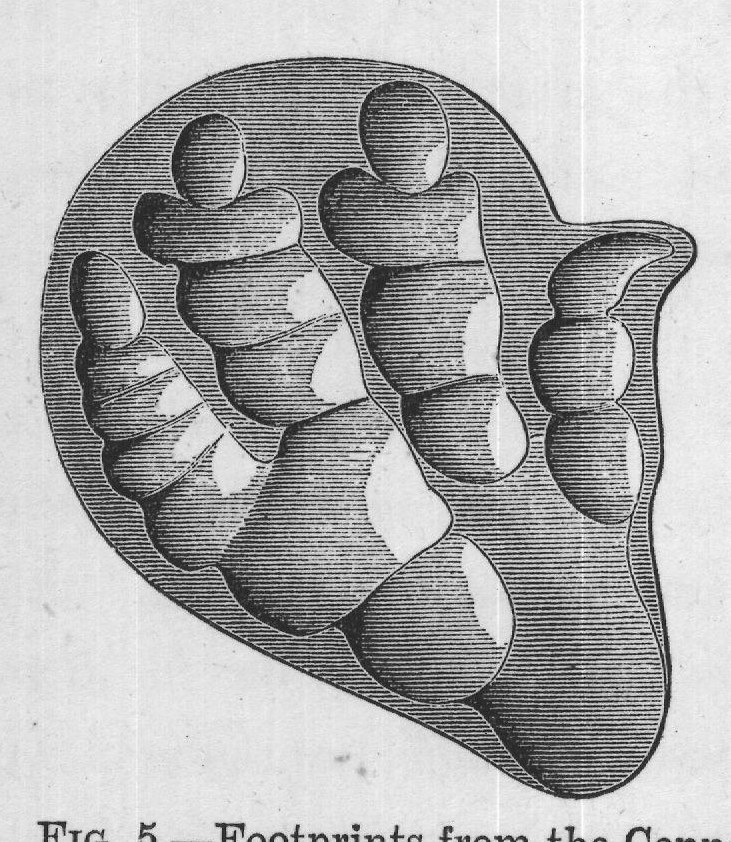
And now to sum up the results of their work. Most of the tracks so fully described and figured by these two authors were probably made by amphibians and reptiles, and it is doubtful if any of them were made, as they supposed, by birds. They vary extremely, both in size and character. While some are only half an inch long; others, like the huge Otozoum, of Hitchcock (see Fig. 5, left-hand corner), are twenty inches long, and show a stride of three feet! Some of the creatures that made the tracks had five toes, some four, and many of them only three. Again, some had hind feet and fore feet of nearly equal size, and evidently walked or crawled on all-fours.
We have here reproduced, from Professor Hitchcock's work, a highly interesting plate (Plate I.), which shows that some of the animals had large hind feet and small fore feet, and that they sometimes put down the latter, as kangaroos do, for there are the impressions of them. However, such impressions are rare, and, as a rule, the creatures, many of which were probably Dinosaurs, walked on their hind limbs, thus producing those three-toed bird-like impressions which are shown on the slabs represented in our figures. It is hardly likely that they hopped on their hind legs as kangaroos do; they were probably too heavy for that; but they may have made something like a hop in bringing up their hind feet, as we have seen the kangaroos do in the Zoological Gardens. Another very interesting point brought to light by the researches of Hitchcock and Deane is, that on some slabs may be seen what is believed to be the impression of the tail of a Dinosaur as it dragged along over the moist sand of the seashore or estuary where these antediluvian creatures of old disported themselves (see Fig. 5).